


Spring startup often brings a frustrating surprise when turning the ignition key produces nothing more than a faint click from the starter solenoid. Homeowners frequently ask whether are lawn mower batteries rechargeable when facing a dead starter battery after months of cold storage. The straightforward answer is yes, every standard starting battery in a riding mower and every lithium-ion pack in a cordless mower is fully rechargeable. Understanding how these batteries replenish their charge helps prevent unexpected downtime, avoids costly battery replacements, and keeps your equipment running smoothly all season long.
Riding mowers and lawn tractors rely on sealed lead-acid or absorbent glass mat (AGM) starter batteries that replenish power through an internal charging stator while the engine runs. Meanwhile, walk-behind cordless platforms use high-voltage lithium cells that recharge via external wall docks, similar to other modern cordless yard equipment platforms. Knowing the proper charging voltages, recognizing the difference between Group U1 and U1R terminal layouts, and choosing the right bench charger will protect your electrical system and extend the life of your battery.

Pros
- Spill-proof and vibration-resistant design ensures durability in lawn equipment
- High CCA rating provides reliable starting power for various mower engines
- Compatible with a wide range of riding mowers and lawn tractors from top brands
- Long service life with deep discharge recovery for seasonal use
Cons
- Battery only; no wiring harness or mounting accessories included, may require additional purchase for some mowers
- Weight of 14.1 pounds may be slightly heavier than some comparable batteries
The Mighty Max Battery ML-U1-CCAHR is a 12-volt, 320 cold cranking amps (CCA) sealed lead-acid (SLA) AGM battery designed primarily for riding mowers, lawn tractors, and other outdoor power equipment. This battery is a solid option for homeowners who need a dependable replacement battery that can handle the demands of frequent mowing in varying weather conditions. Whether you have a small suburban lawn or a larger rural property, this battery may provide the starting power you need.
According to the product specifications, the ML-U1-CCAHR features a high discharge rate and wide operating temperature range, which may help ensure reliable starts in both hot summer afternoons and chilly early mornings. The AGM construction is spill-proof and can be mounted in any position, offering flexibility for different mower designs. This battery is also resistant to shocks and vibration, which is important for equipment that experiences rough terrain.
Compatibility is a strong point for this battery. It is listed as compatible with a wide range of mowers including Craftsman 25780, Cub Cadet LTX 1046 KW, John Deere 330, and many more. This broad compatibility may make it a convenient choice for owners of multiple mowers or for those who want a reliable replacement without needing to search for a specific model.
In terms of build quality, the battery is described as long-lasting with deep discharge recovery capabilities. This means it may be able to recover from being drained more effectively than some standard batteries, which can be useful for seasonal equipment that sits unused for months. The included screws allow for straightforward installation, though users should note that no wiring harness or mounting accessories are included.
One potential limitation is the weight of 14.1 pounds, which might be slightly heavier than some comparable batteries. However, this weight is typical for a battery of this capacity and should not be an issue for most mower battery trays. Additionally, the battery is sold as a single unit, so buyers should ensure they are getting the correct size and terminal configuration for their mower.
Overall, the Mighty Max Battery ML-U1-CCAHR appears to be a practical and reliable choice for homeowners seeking a replacement battery for their riding mower or lawn tractor. It offers spill-proof safety, broad compatibility, and robust performance characteristics that may suit both casual and dedicated lawn care enthusiasts. As always, checking your mower's specific battery requirements before purchase is recommended.
Pros
- True maintenance-free operation – no topping off water or cleaning corrosion
- Strong CCA rating for reliable cold-weather starting on snow blowers or late-season mowing
- Comes fully charged and includes threaded posts for easy nut/bolt terminal hookup
- Works with most 12V small engine starters found on lawn tractors and zero-turn mowers
Cons
- Not a deep-cycle battery – not intended for extended power draws like electric winches or trolling motors
- Weight (nearly 13 lbs) may be slightly heavier than some comparable lithium or AGM options
- Some users may find the nut and bolt terminals require a wrench for installation instead of quick-connect clamps
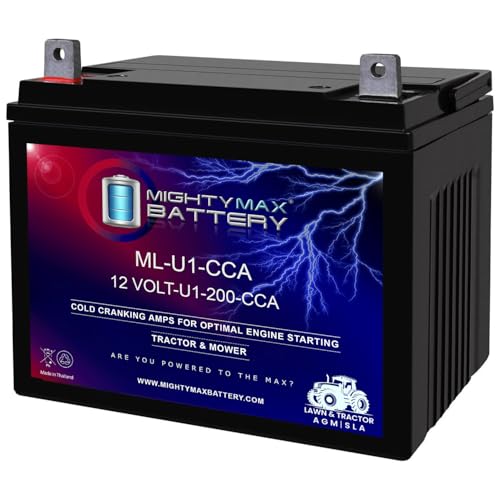
If you own a riding mower, lawn tractor, zero-turn mower, or even a snow blower, you know how frustrating a dead battery can be. The Mighty Max Battery 12V 200 CCA SLA AGM battery is designed to be a straightforward replacement for many small engine starting applications. It's a sealed lead-acid battery that uses AGM technology, meaning it's completely maintenance-free—no refilling, no acid spills, and no corrosion mess to clean up. For homeowners who just want to hop on their mower and get the grass cut without extra maintenance, this is a practical choice.
Performance-wise, the 200 cold cranking amps are sufficient for most riding mowers and lawn tractors. Even on chilly spring mornings or late-fall leaf cleanup days, this battery should give you reliable starting power. The AGM construction also means it handles vibration better than a flooded battery, which is important when you're bouncing over bumps in the yard. The nut and bolt terminals provide a solid, secure connection that won't loosen up over time—you can tighten them down and forget about them.
Build quality is what you'd expect from a reputable brand like Mighty Max Battery. The case is tough and sealed, so you can install it in a variety of positions (just not upside down). At 12.89 pounds, it's not too heavy to lift in and out of the battery tray. The dimensions (7.75 x 5.11 x 6.25 inches) are standard for many lawn mower batteries, so it should fit most trays without modification.
Setup is about as easy as it gets: remove the old battery, connect the new one (making sure to attach positive and negative correctly), tighten the nuts on the terminals, and you're ready to go. It comes pre-charged, so you don't need to wait for a first charge. Storage is simple too—since it's sealed, you can mount it in the mower all season without worrying about water levels or acid leaks.
One realistic limitation is that this is not a deep-cycle battery. It's built for short bursts of high current to start an engine, not for powering accessories like lights or electric clutches for an extended period. Also, some people prefer the convenience of quick-connect terminals, but the nut and bolt setup here is very secure and standard for many small engine applications.
Overall, the Mighty Max Battery 12V 200 CCA SLA AGM battery is a reliable, no-fuss replacement for your outdoor power equipment. If you want a battery that works when you need it and requires zero maintenance, this is a great pick. It's especially suited for suburban homeowners or rural property owners who want to get back to mowing quickly without dealing with battery headaches.
The 200 Cold Cranking Amps (CCA) rating is the key spec here. For most riding mowers and lawn tractors with engines between 12 and 25 HP, this battery provides enough power for reliable starts even in cooler temperatures. It uses AGM (Absorbent Glass Mat) technology, which means the electrolyte is absorbed into fiberglass mats rather than being free liquid. This gives it lower internal resistance and higher discharge rates than a standard flooded battery. The result is a strong, consistent crank that helps your engine fire up quickly.
Mighty Max Battery builds their SLA AGM batteries with a thick, impact-resistant polypropylene case that can handle the bumps and vibrations of lawn mowing. The sealed design means no acid fumes or corrosion buildup on terminals or cables—a common issue with traditional flooded batteries. Plus, the AGM construction is spill-proof, so you can mount the battery safely in mowers that tip or bounce. The nut and bolt terminals are made of brass or lead alloy and resist stripping.

Pros
- Maintenance-free AGM technology eliminates the need for water refills and reduces corrosion
- 200 CCA provides reliable starting power for most lawn tractors and riding mowers
- Universal U1 size fits a wide range of popular brands, simplifying replacement
Cons
- Some users may prefer a higher CCA rating for extremely cold climates or larger engines
- The square hole terminal design may require specific bolt sizes, potentially needing additional hardware for some mowers
The Daakmax AGM Battery Group U1 12V 24Ah 200CCA is a solid choice for homeowners looking to replace a worn-out battery in their riding mower or lawn tractor. Designed as a maintenance-free sealed lead-acid (SLA) battery, it fits the standard U1 size that many popular brands like Craftsman, Cub Cadet, and Toro use. If your mower struggles to start or you're tired of checking water levels in a flooded battery, this drop-in replacement could be a practical upgrade.
With 24 amp-hours (Ah) and 200 Cold Cranking Amps (CCA), this battery delivers enough punch to start most single-cylinder and small V-twin lawn tractor engines. The AGM construction means it's spill-proof and can handle moderate vibration from bumpy lawns—a clear advantage over traditional wet-cell batteries. The compact dimensions (7.68 x 5.12 x 7.09 inches) ensure it fits snugly in standard battery trays without modification.
Installation is straightforward thanks to the square hole nut and bolt terminals. The positive terminal is positioned on the left side, matching the layout of many Craftsman and Cub Cadet models. You'll just need a wrench to tighten the bolts securely. No special tools or adapters are required, which keeps the swap simple for DIY homeowners.
One of the biggest benefits of this battery is its maintenance-free design. You won't need to check electrolyte levels or deal with acid corrosion on your battery tray. The sealed case also reduces the risk of leaks, even if the mower tips slightly on uneven ground. For those who store their mower in a garage or shed over winter, this battery holds its charge reasonably well, though a trickle charger is still recommended for long off-seasons.
On the downside, 200 CCA is adequate for most residential riding mowers but may be borderline for larger engines or extremely cold climates. If you live in an area with harsh winters or have a heavy-duty lawn tractor, you might want a battery with higher cold cranking amps. Additionally, the square terminal design might not match every mower's existing cable connectors—some users may need to source the correct bolts or adapters.
Overall, the Daakmax U1 AGM battery offers a dependable, low-maintenance power source for typical suburban lawn care. It's a practical replacement for Craftsman, Cub Cadet, and Toro riding mowers, and the 1-year warranty provides reasonable peace of mind. For homeowners who want a hassle-free battery that gets the job done without constant upkeep, this is a solid option to consider.

Pros
- 300CCA delivers strong starting power for most lawn tractors
- AGM design means no watering and no leaks
- Fits many popular mower brands including John Deere, Toro, and Cub Cadet
- Compact dimensions fit standard Group U1 battery trays
- Good value for a reliable replacement battery
Cons
- Not suitable for heavy-duty or commercial use
- Terminal placement (positive on left) may not fit all models
- Some users may need to modify battery hold-downs
The WEIZE Lawn Garden AGM Battery is a solid replacement option for homeowners who need dependable starting power for their riding mowers or lawn tractors. This 12-volt battery delivers 300 cold cranking amps (CCA), which is plenty for most residential mowers used to maintain a typical suburban lawn. It's designed as a Group U1 battery, a common size for many popular brands like John Deere, Toro, Cub Cadet, and Craftsman.
In real-world use, this battery should provide reliable cranking even on cooler mornings when engines can be harder to start. The AGM (Absorbent Glass Mat) construction means it's sealed and spill-proof, so you don't have to worry about checking water levels or dealing with acid leaks. This makes it a low-maintenance choice for anyone who just wants to get the mower started and get on with their Saturday morning mowing.
Build quality appears solid based on the specifications and user feedback. The battery weighs about 18.7 pounds, which is typical for this size, and its dimensions (7.68 x 5.12 x 6.22 inches) should fit most standard battery trays. The terminals are the square hole nut and bolt type, which is common on many mowers. Just note that the positive terminal is on the left side, so it's a good idea to double-check your mower's cable orientation before buying.
Setup is straightforward for anyone comfortable with basic battery replacement. You'll need to disconnect the old battery, clean the terminals, and install the new one with the included hardware. There's no complicated wiring or programming required. Because it's an AGM battery, it can handle some vibration from mowing without issue, which adds to its durability over time.
One realistic limitation is that this battery is best suited for light-duty use. If you have a large lawn with heavy mowing demands or use your tractor for other tasks like towing, you might want a battery with higher CCA or reserve capacity. Also, the terminal configuration might not fit every model, so always check your current battery's orientation and terminal type before purchasing.
Overall, the WEIZE Group U1 AGM battery is a practical, budget-friendly replacement for many standard lawn mowers. It offers reliable starting power, maintenance-free operation, and compatibility with major brands. For the average homeowner looking to keep their mower running smoothly through the season, this is a solid option backed by a one-year warranty.
This WEIZE battery is designed as a Group U1 replacement, which fits a wide range of lawn tractors and garden mowers. It's compatible with popular brands such as John Deere, Toro, Cub Cadet, and Craftsman. However, always verify your mower's battery tray dimensions and terminal configuration before purchasing. The battery measures 7.68 inches long, 5.12 inches wide, and 6.22 inches tall (7.09 inches including terminals). The positive terminal is on the left side, and terminals are the square hole nut and bolt type.
WEIZE offers a 1-year warranty on this battery, covering defects in materials and workmanship. For warranty claims or support, the seller requests you contact them directly rather than going through Amazon's return process for battery-related products. This is standard for batteries due to shipping restrictions. Make sure to keep your purchase receipt and battery information handy if you need to make a claim.

Pros
- Affordable replacement for Toro mower batteries – saves money over dealer parts
- Spill-proof and vibration-resistant – safe for rough terrain and all-season use
- Maintenance-free – no need to add water or clean terminals frequently
- Compact size fits standard battery trays, easy to install in minutes
Cons
- Battery only – no mounting hardware or wire harness included; may need to reuse existing brackets
- 3.4Ah capacity may be lower than some OEM batteries, potentially requiring more frequent charging for heavy use
- Lead acid chemistry – not as lightweight or long-lasting as lithium-ion alternatives
If you own a Toro lawn mower that requires a 12V battery, the Mighty Max Battery ML3-12 is a practical and budget-friendly replacement option. This sealed lead acid (SLA) battery is designed to deliver reliable starting power for your mower without the hassle of regular maintenance. It’s a direct fit for many Toro models that use battery part number 106-8397, making it a convenient choice for homeowners who prefer to replace rather than repair.
Based on product specifications, this battery offers a high discharge rate and stable performance across a wide temperature range. Whether you’re mowing in the heat of summer or storing the mower in a cold garage, the ML3-12 is built to handle the extremes. The AGM (Absorbent Glass Mat) construction makes it spill-proof and resistant to shocks and vibration—important for the bumpy ride of a lawn mower.
Installation is straightforward: simply remove the old battery, connect the F1 terminals, and secure the battery in place using your existing mounting hardware. The compact dimensions (5.28 x 2.64 x 2.64 inches) mean it fits most standard battery trays without modification. However, note that the package includes only the battery—no wires or brackets—so you’ll need to reuse those from your original setup.
In everyday use, this battery provides consistent cranking power for most residential mowers. The 3.4Ah capacity is adequate for typical starting duties, but if you have a larger mower with additional electrical accessories (like headlights or electric start), you might need to recharge more frequently. For most homeowners mowing a standard suburban lawn, this battery should last a full season with proper charging.
One limitation is that SLA batteries are heavier than modern lithium-ion alternatives, but they are also more affordable and widely available. The one-year warranty from Mighty Max adds confidence, and many users find this battery to be a reliable drop-in replacement. If you’re looking to save money without sacrificing dependability, the ML3-12 is a solid choice for your Toro mower.

Pros
- High cold cranking amps (350 CCA) ensure reliable starts even in cooler weather
- GEL technology provides a longer cycle life compared to standard flooded batteries, reducing replacement frequency
- Vibration-resistant build handles the jolts of mowing and off-road equipment use
- Maintenance-free sealed design means no need to check water levels or clean terminals
Cons
- Premium price point may be higher than some standard flooded batteries
- No wire harness or mounting accessories included, so you may need to purchase separately
- GEL batteries can be sensitive to overcharging, requiring a compatible charger for best lifespan
The Energizer EN-U1-350-GEL is a 12-volt, 350 CCA sealed lead acid AGM battery designed for lawn mowers, garden tractors, and other outdoor power equipment. It suits homeowners who need a dependable replacement battery for their riding mower, zero-turn mower, or utility vehicle. This battery uses GEL technology, which offers a longer cycle life than standard AGM or flooded options, making it a good fit for frequent users who want fewer replacements.
In terms of performance, the 350 cold cranking amps provide strong starting power even in cooler weather. The GEL construction supports deep-cycle use, meaning the battery can handle repeated charging and discharging without losing capacity quickly. This is especially useful for equipment that runs for long periods or gets used seasonally. The battery also resists vibration and shock, which helps maintain reliability over rough terrain.
Build quality is solid with a sealed AGM design that is maintenance-free and spill-proof. You don't need to add water or clean corrosion often. The nut and bolt terminals make installation straightforward with standard lawn mower cables. The battery can be mounted in any position except upside down, offering flexibility for different equipment layouts.
Setup is simple: just connect the terminals to your mower's cables and secure the battery. No additional accessories are included, so you may need to supply your own mounting brackets or wire harness if required. Storage is easy since the sealed design allows it to sit safely in a garage or shed without leaking.
A realistic limitation is the price, which is higher than many flooded batteries. Also, GEL batteries need a charger compatible with GEL chemistry to avoid overcharging. If you use a standard charger, you risk reducing battery life. Additionally, the battery does not come with mounting hardware, so check your equipment's needs.
Overall, the Energizer EN-U1-350-GEL is a reliable choice for homeowners who want a long-lasting, low-maintenance battery for their lawn mower or tractor. It works best for those who value deep-cycle durability and vibration resistance over upfront cost. If you need a straightforward replacement with good starting power and less frequent replacement, this battery may be a practical investment.
This battery uses GEL technology, where the electrolyte is suspended in a silica gel rather than liquid. This design offers several advantages for lawn mower and tractor use. First, it provides a longer cycle life compared to standard AGM or flooded batteries, meaning it can handle more charge/discharge cycles before failing. Second, the gel is less prone to leaking, making the battery spill-proof even if tipped. Third, the construction resists vibration and shock better than flooded batteries, which is important for equipment that bounces over uneven ground. However, GEL batteries require a charger specifically designed for GEL chemistry to prevent overcharging. Using a standard car battery charger can damage the battery over time. If you already have a compatible charger, this battery can deliver reliable power for many seasons.

Pros
- Reliable 350CCA starting power for most residential lawn tractors and mowers.
- Maintenance-free AGM design saves time and effort compared to traditional flooded batteries.
- Compatible with a wide range of popular mower brands, simplifying replacement.
- Solid build quality with a 1-year warranty for added confidence.
Cons
- Some users may find the price slightly higher than basic flooded batteries, but the AGM technology justifies the cost.
- The battery may not fit all mower models perfectly, so checking dimensions is recommended.
- Limited to starting applications; not designed for deep-cycle use in electric vehicles or trolling motors.
The WEIZE Lawn Garden AGM Battery is a 12-volt, 350 cold-cranking-amp (CCA) power source designed specifically for starting lawn tractors, riding mowers, and garden tractors. It belongs to the BCI Group U1 size class, which is a common fit for many residential mowers. This battery is an absorbed glass mat (AGM) type, meaning it is sealed, spill-proof, and maintenance-free—no need to check water levels or worry about acid leaks. For homeowners who want a straightforward, reliable replacement battery without the hassle of traditional flooded batteries, this is a practical choice.
With 350 CCA, this WEIZE battery provides ample starting power for most single-cylinder and twin-cylinder lawn tractor engines, even in cooler spring or fall weather. The AGM design also offers low internal resistance, which can help deliver strong cranking current consistently. While it is not intended for deep-cycle use (like powering lights or accessories for extended periods), it excels at its primary job: starting your mower reliably every time you turn the key. Many users appreciate the peace of mind that comes with a fresh, high-quality battery when the mowing season begins.
Build quality appears solid, with a durable polypropylene case that resists vibration and impacts common in lawn equipment. The battery weighs 21.45 pounds, giving it a substantial feel that stays put in the battery tray. The terminals use a square hole nut and bolt design, which provides a secure connection and is compatible with most standard cable ends. The positive terminal is on the left side (when facing the battery), which matches many popular mower brands like John Deere, Toro, Cub Cadet, and Craftsman.
Installation is straightforward for anyone comfortable with basic tools—just remove the old battery, clean the terminals, place the new WEIZE battery in the tray, and connect the cables (red to positive, black to negative). The dimensions (7.68 x 5.12 x 6.22 inches) fit standard U1 trays, but it's always wise to measure your existing battery compartment to ensure a perfect fit. No special maintenance is required beyond keeping the terminals clean and tight.
A realistic limitation is that this battery is specifically designed for starting engines, not for powering electric mowers or other deep-cycle applications. Also, while AGM batteries generally last longer than flooded ones, their lifespan still depends on usage, charging habits, and storage conditions. Some users may find the price slightly higher than basic flooded batteries, but the convenience of maintenance-free operation and reliable starting power often justifies the cost.
Overall, the WEIZE Lawn Garden AGM Battery is a smart choice for homeowners looking for a dependable, no-fuss replacement battery for their lawn tractor or mower. It offers good cranking power, a durable build, and compatibility with leading brands. If you want a battery that will start your mower reliably season after season without requiring any upkeep, this WEIZE model is worth considering.
The WEIZE AGM battery delivers 12 volts and 350 cold cranking amps (CCA), providing strong starting power for most residential lawn tractors and mowers. The AGM (Absorbent Glass Mat) technology ensures low internal resistance, which helps deliver high current quickly for reliable engine starts. This battery is not designed for deep-cycle use, so it's best for starting applications only. The high reserve capacity helps maintain performance even under accessory loads. Overall, it offers a solid power solution for typical mowing needs.
This WEIZE battery features a durable polypropylene case that resists vibration, shock, and corrosion. The AGM construction is sealed and spill-proof, so you can mount it in various orientations without worry. The terminals are made with square hole nut and bolt connectors for a secure, reliable electrical connection. Weighing 21.45 pounds, the battery feels substantial and stable in the tray. With proper care, the AGM design can offer a longer service life compared to traditional flooded batteries.
The WEIZE battery is a BCI Group U1 size, which fits many popular lawn tractors and mowers from John Deere, Toro, Cub Cadet, Craftsman, and other brands. Dimensions are 7.68 x 5.12 x 6.22 inches, with a total height of 7.09 inches including terminals. The positive terminal is on the left side when facing the battery. Installation is simple: remove the old battery, clean the tray and cables, place the new battery, and connect the cables (red to positive, black to negative). Always verify compatibility with your specific mower model before purchasing.

Pros
- Affordable price point for a reliable replacement battery
- Maintenance-free AGM design-no watering or cleaning needed
- Good cold cranking amps (200 CCA) for consistent starting in cooler weather
- Fits many popular lawn tractor and mower brands
Cons
- Some users may find the terminal configuration requires careful matching with their equipment
- Limited to group U1 applications; not suitable for larger riding mowers or tractors with different battery sizes
- Warranty support is handled directly by the seller, which may be less convenient than Amazon's return process
If you own a lawn tractor or riding mower from John Deere, Toro, Cub Cadet, or Craftsman, you know how frustrating a dead battery can be. The WEIZE 12V 200CCA U1 AGM battery offers a practical and budget-friendly replacement option for homeowners who need reliable starting power for their outdoor equipment.
This battery delivers 200 Cold Cranking Amps (CCA), which is plenty for most small to mid-sized lawn tractors and mowers. The AGM (Absorbent Glass Mat) and SLA (Sealed Lead Acid) design means it's maintenance-free and spill-proof, so you don't have to worry about checking water levels or dealing with acid leaks. It's a straightforward swap for most U1 group batteries, with dimensions of 7.68 x 5.12 x 6.22 inches and a weight of about 16.95 pounds, making it easy to handle during installation.
Build quality appears solid for the price point. The case is durable enough to withstand the vibrations and jostling typical of mowing. The terminals are clearly marked with positive on the left (red) and negative on the right (black), using a square hole nut and bolt design that should fit most standard connectors. Just double-check your mower's terminal orientation before buying, as some models may have a different layout.
Installation is straightforward for anyone comfortable with basic DIY tasks. Remove the old battery, clean the tray and terminals, place the new WEIZE battery in position, and connect the cables. No special tools or professional help needed. Storage is not an issue since it's a sealed battery, but like any lead-acid battery, it's best to keep it charged during long periods of inactivity, especially in cold weather.
One realistic limitation is that this battery is designed specifically for group U1 applications. If you have a larger riding mower or a tractor that requires a different group size, this won't fit. Also, while the 200 CCA rating is adequate for most small engines, extremely cold climates or engines with high compression might benefit from a higher CCA battery. Additionally, warranty support is handled directly through the seller, which some users may find less convenient than Amazon's standard return process.
Overall, the WEIZE 12V 200CCA U1 AGM battery is a smart choice for budget-conscious homeowners who need a reliable replacement for their lawn tractor or mower. It offers good value, easy installation, and dependable starting power for the typical mowing season. Just ensure compatibility with your equipment's terminal layout and battery group size before purchasing.
Pros
- Maintenance-free design – no water refills or acid spills, perfect for homeowners who prefer low upkeep.
- Strong cold cranking amps (280 CCA) for reliable starting even in harsh winter conditions.
- Durable AGM construction resists vibration and leaks, ideal for rough terrain and frequent use.
- Wide compatibility with major riding mower brands simplifies replacement decisions.
Cons
- Rated only 23Ah – may have shorter runtime for electric accessories compared to larger batteries.
- Heavier than some lithium alternatives (14.1 lbs) – may require careful handling during installation.
- Some users may prefer a battery with higher CCA for larger engines or extreme cold climates.
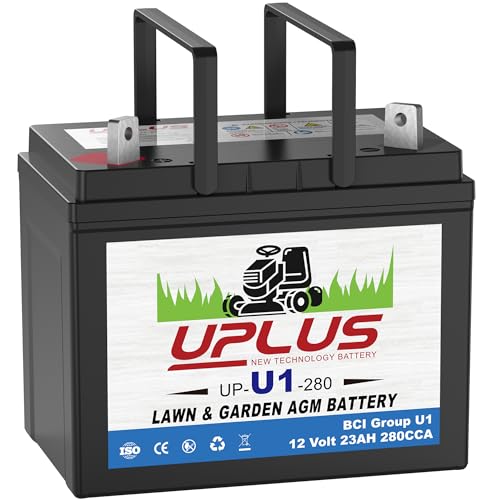
The UPLUS U1 riding lawn mower battery is a sealed lead-acid AGM replacement designed for homeowners who want a reliable, maintenance-free power source for their gas-powered mower. This battery replaces the standard U1 group size (7.68 x 4.92 x 6.93 inches) and fits many popular riding mowers from John Deere, Cub Cadet, Husqvarna, Craftsman, Toro, and others. With 12 volts, 23 amp-hours, and 280 cold cranking amps, it provides enough power to start most lawn tractors and garden tractors reliably, even in cold weather.
In real-world use, the 280 CCA rating ensures strong starting performance down to -22°F, which is a key advantage for homeowners in colder regions. The sealed AGM construction means there is no need to check water levels, no risk of acid spills, and the battery is vibration resistant—important for the bumpy ride of a mowing session. Users can expect a service life of over five years when properly cared for, thanks to the use of 99.99% pure primary lead that improves charge acceptance and reduces internal corrosion.
Durability is a strong point: the calcium-calcium technology lowers the self-discharge rate and minimizes grid corrosion, which helps the battery hold a charge longer during off-season storage. The battery is also leak-proof and can be mounted in various orientations (except inverted). This makes it a practical choice for homeowners who store their mowers in unconditioned garages or sheds.
Installation is straightforward for anyone familiar with basic battery replacement. The terminals are clearly marked: left positive (red) and right negative (black). No extra tools beyond a basic wrench set are needed. The battery weighs 14.1 pounds—similar to other U1 AGM batteries—so lifting it into the tray is manageable for most adults. After connecting the leads, the mower should start right up if the charging system is working properly.
A realistic limitation is the 23Ah capacity, which is standard for this group size but lower than some larger batteries. This means it is best suited for starting and powering basic electrical components (lights, PTO clutch)—not for extended use of high-draw accessories. Some users with large engines or frequent stop-start mowing might prefer a battery with higher CCA, but for most standard riding mowers, this is adequate.
Overall, the UPLUS U1 battery is a solid choice for homeowners seeking a dependable, long-lasting replacement battery. Backed by a 15-month warranty and local after-sales support from a California warehouse, it offers peace of mind. If you are looking for a maintenance-free option that handles cold starts and resists vibration, this battery is worth considering for your lawn tractor or garden mower.
Comprehensive Guide to Recharging and Maintaining Lawn Mower Batteries
All modern lawn mower batteries are designed to be recharged, whether installed in a traditional riding tractor or a walk-behind cordless unit. Starting a gas engine requires a sudden burst of high amperage that temporarily depletes the battery, while electric mowers pull continuous current throughout the mowing cycle. Understanding how your mower battery stores, releases, and recovers electrical energy ensures you can diagnose starting failures quickly and avoid premature battery replacement.
Lawn Mower Battery Chemistries and Rechargeability
Lead-acid chemistry remains the standard power source for riding mowers, lawn tractors, and commercial zero-turn equipment. These 12-volt starter batteries feature lead plates immersed in an electrolyte solution of sulfuric acid and water. When you start the engine, an electrochemical reaction transforms lead dioxide and sponge lead into lead sulfate, releasing the electrical current required by the starter motor. Applying an external charging current reverses this chemical reaction, converting the lead sulfate back into active lead material and restoring full capacity.
Modern replacement options frequently utilize Absorbent Glass Mat (AGM) construction rather than traditional flooded designs. Products like the Mighty Max ML-U1-CCAHR and the WEIZE Lawn Garden AGM Battery use fine fiberglass mat separators to suspend the liquid electrolyte securely between the internal plates. This sealed configuration makes the battery spill-proof and provides substantial resistance against engine vibration. Gel batteries, such as the Energizer EN-U1-350-GEL, use a silica-thickened electrolyte that supports deep-cycle recovery while maintaining reliable rechargeability across many mowing seasons.
Walk-behind and modern battery-powered riding mowers utilize lithium-ion battery packs operating at higher nominal voltages, typically ranging from 40 volts up to 80 volts. These lithium packs rely on internal battery management systems (BMS) that regulate cell balancing, temperature, and current flow during both discharge and recharge cycles. Unlike lead-acid units, lithium cells deliver consistent output until nearly depleted and recharge rapidly on dedicated docking stations without memory effect issues.
How Lawn Mowers Recharge Their Batteries Onboard
Gas-powered riding lawn mowers and zero-turn tractors feature an onboard charging system driven directly by the engine. Beneath the engine flywheel sits a stationary ring of wire coils known as the stator. As permanent magnets mounted inside the spinning flywheel pass over these stator coils, they generate alternating current (AC) electricity proportional to engine speed. This mechanical-to-electrical energy conversion provides the baseline power needed to run mower accessories and recharge the starter battery.
Because batteries store direct current (DC), the alternating current produced by the stator must be converted before reaching the battery terminals. A diode or an electronic voltage regulator-rectifier transforms the AC power into regulated DC electricity, typically targeted between 13.5 volts and 14.5 volts DC at wide-open throttle. This running voltage is higher than the resting potential of the battery, allowing current to flow back into the cells and replenish the energy consumed during ignition.
A frequent reason mower batteries fail to recharge during regular use is running the engine for insufficient periods or at low throttle settings. Starting a large displacement engine consumes significant amperage that can require 15 to 30 minutes of continuous operation at full throttle to fully replace. If an operator only idles the tractor across the yard or cuts for ten minutes, the onboard stator will not have enough operating time to replenish the starter battery, gradually leading to a discharged condition.
Voltage Benchmarks: Testing Static and Cranking Health
Verifying whether a battery can take and hold a charge begins with taking a static resting voltage measurement using a digital multimeter. Set the multimeter to DC volts on the 20-volt scale, then touch the red positive probe to the positive terminal and the black negative probe to the negative terminal. For accurate results, the mower must be completely off, and the battery should rest for at least an hour after running or charging to allow surface charge to dissipate.
A fully charged, healthy 12-volt mower battery registers between 12.6 volts and 12.8 volts in an open-circuit state. If the multimeter reads approximately 12.2 volts, the battery is already 50 percent discharged and requires an external recharge to prevent accelerated internal degradation. A reading resting at or below 10.5 volts indicates a dead or shorted internal cell, which almost always means the battery cannot recover and must be replaced.
Static resting voltage alone does not tell the complete story, which is why dynamic cranking load testing is essential. While monitoring multimeter probes connected across the battery posts, turn the ignition key to crank the engine. If the voltage plunges below 9.6 volts during cranking, the internal plates have lost their ability to deliver sustained cold cranking amps. A battery in this compromised condition may read 12.6 volts with no load yet fail completely to engage the starter solenoid.
Proper Procedures for Bench Charging a 12-Volt Battery
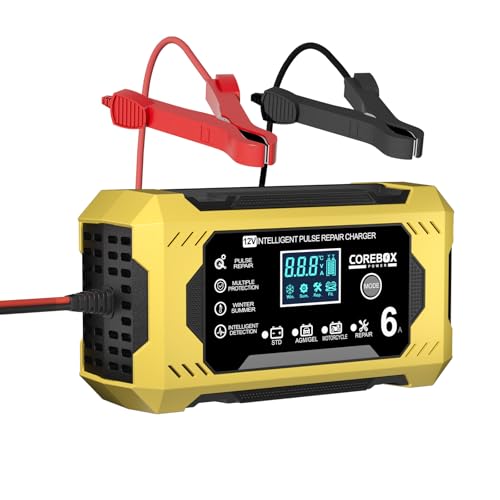
When an onboard stator cannot restore a deeply discharged battery, removing the unit to connect it to an external bench charger is necessary. Always select a dedicated smart charger designed for 12-volt lead-acid and AGM batteries rather than an unmonitored automotive booster. Smart chargers automatically monitor internal voltage, shifting from bulk charging to absorption and finally dropping into a safe float maintenance mode once charging completes.
Controlling the charging current is critical for small BCI Group U1 mower batteries. Because lawn tractor batteries typically offer capacities between 20 and 35 amp-hours, they should be charged at low currents between 1 amp and 3 amps. Connecting a high-output 10-amp or 20-amp automotive quick charger generates excessive internal heat, which boils away liquid electrolyte in flooded cells and forces open the emergency pressure relief valves on sealed AGM units.
Safe execution requires a specific connection sequence to eliminate electrical sparks near battery vents. Make sure the bench charger is unplugged from the wall outlet before attaching the red positive clamp to the positive terminal, followed by the black negative clamp to the negative terminal. Once securely connected, plug the charger into AC power and select the appropriate AGM or standard lead-acid mode. When charging is finished, unplug the charger from the wall before removing the clamps, disconnecting the negative clamp first.
Safe Jump-Starting Rules: Preventing Regulator Burnout
Jump-starting a dead 12-volt riding mower from an automobile is possible, but doing so improperly can destroy the mower charging system. The single most important rule is that the donor vehicle engine must remain turned off during the entire procedure. A passenger car engine runs an alternator capable of delivering 60 to 120 or more amps, which will instantly overwhelm and burn out the delicate diodes in a lawn tractor voltage regulator.
The car battery provides more than enough passive electrical capacity to turn the mower starter motor while the car engine is completely shut down. Connect the red jumper cable clamp to the positive terminal of the car battery, then attach the other red clamp to the positive terminal of the mower battery. Next, connect the black jumper clamp to the negative terminal of the car battery, and fasten the remaining black clamp to an unpainted metal frame bolt on the mower chassis rather than the negative battery post.
Once the cables are locked in place with the donor car turned off, turn the ignition key on the riding mower to crank the engine. The engine should turn over immediately if the starting issue was caused solely by low battery voltage. After the mower starts, disconnect the jumper cables in exact reverse order, removing the negative ground clamp from the mower chassis first, followed by the car negative clamp, the mower positive clamp, and finally the car positive clamp.
Terminal Orientation and Fitment: Group U1 vs. Group U1R
Physical fitment and terminal orientation are critical factors when replacing or recharging riding mower batteries. The Battery Council International (BCI) designates the standard lawn and garden tractor battery size as Group U1, which features approximate dimensions of 7.75 inches long, 5.12 inches wide, and between 6.25 and 7.09 inches tall. Equipment manufacturers engineer battery trays with tight tolerances that match these exact exterior dimensions to keep the battery securely anchored.
The primary difference between Group U1 and Group U1R lies in terminal post positioning relative to the front label of the casing. In a standard Group U1 battery, the positive terminal sits on the front left, while the negative terminal sits on the front right. Conversely, a Group U1R battery places the positive terminal on the right side and the negative terminal on the left side. Riding mowers often have rigid, short factory wiring harnesses that cannot stretch across the battery casing if an owner inadvertently purchases the incorrect terminal orientation.
Attempting to force battery cables onto the wrong terminals creates a severe risk of reverse polarity, which instantly blows the tractor main fuse and destroys the charging stator diodes. Furthermore, stable mounting hardware prevents terminal vibration and fatigue when operating lawn tractors on uneven terrain. The majority of lawn batteries utilize square-hole nut and bolt terminals, so always ensure the included hardware is tightened securely without cross-threading the soft lead connection tabs.
Cold Cranking Amps and Engine Displacement Demands
A rechargeable battery must provide sufficient Cold Cranking Amps (CCA) to rotate the engine crankshaft rapidly against cylinder compression. Cold Cranking Amps measure the number of discharge amps a 12-volt battery can deliver at 0 degrees Fahrenheit for 30 seconds while maintaining at least 7.2 volts. Matching the battery CCA rating to the displacement and cylinder configuration of your lawn tractor engine is vital for reliable starting.
Small lawn tractors equipped with single-cylinder engines under 18 horsepower typically require starting batteries rated between 200 CCA and 240 CCA, such as the Daakmax 200CCA or ML-U1-CCA units. In contrast, heavy-duty garden tractors and zero-turn mowers powered by 20 to 27 horsepower V-twin engines demand significantly more starting torque. These larger twin-cylinder engines require starter batteries rated from 300 CCA to 350 CCA, represented by models like the WEIZE 350CCA or Energizer EN-U1-350-GEL.
Installing a battery with lower CCA than the manufacturer recommends will lead to sluggish cranking, starter motor overheating, and rapid battery discharge. Even if the battery accepts a complete bench charge, a single cold morning or high-compression stroke can pull the voltage low enough to prevent ignition. Always check your engine service manual to confirm the factory cold cranking requirements before purchasing a replacement starter battery.
Winter Storage, Self-Discharge, and Plate Sulfation
The vast majority of lawn mower battery failures happen during the winter months when equipment sits idle in cold storage. Conventional lead-acid batteries naturally discharge at a rate of 3 percent to 5 percent per month even when disconnected. If a battery sits partially discharged for several months, lead sulfate on the internal plates slowly crystallizes into dense, hardened deposits that do not dissolve during normal recharging.
This condition, known as irreversible sulfation, permanently reduces active plate surface area, drastically lowering both storage capacity and cold cranking power. Furthermore, as a lead-acid battery discharges, its electrolyte shifts from an acid-water mixture toward pure water, significantly raising its freezing point. A fully charged battery with a specific gravity of 1.265 will not freeze until roughly minus 70 degrees Fahrenheit, but a discharged battery can freeze and crack its outer casing at 20 degrees Fahrenheit.
Preventing off-season battery loss requires proactive maintenance using a microprocessor-controlled float charger. Disconnect the negative terminal cable from the mower battery to eliminate parasitic key-off drains from the wiring harness. Attach a smart maintainer set to 12V float mode, which supplies microscopic micro-pulses of current only when terminal voltage dips below 12.6 volts, keeping the battery chemically active and fully charged without boiling away electrolyte.
Recharging Cordless Lithium-Ion Lawn Mower Packs
Cordless electric lawn mowers use proprietary lithium-ion battery packs that operate entirely differently from 12-volt tractor batteries. These packs combine numerous cylindrical lithium cells in series and parallel configurations to achieve operating voltages between 40 volts and 80 volts. Each pack includes a specialized Battery Management System circuit board that monitors cell balancing, high-amperage draws, and operating temperatures during use and charging.
Following dedicated cordless battery maintenance routines is essential for preserving lithium cell lifespan across multiple cutting seasons. Lithium packs should never be charged immediately after heavy mowing in hot weather when internal cell temperatures exceed safe limits. The integrated BMS will activate a thermal cutoff lockout, flashing error lights until the pack cools down to ambient temperatures.
Lithium batteries also require specific storage practices during the off-season to minimize cell degradation. Storing lithium packs at 100 percent charge in a hot shed accelerates internal oxidation, while leaving them completely depleted can cause individual cell voltages to drop below the critical BMS safety cutoff threshold. Aim to store cordless mower battery packs at roughly 40 percent to 50 percent charge in a temperature-controlled indoor location between 50 and 70 degrees Fahrenheit.
Diagnosing Parasitic Drains and Stator Output Failures
If a newly recharged mower battery consistently goes dead after sitting parked for a few days, the issue may stem from an external electrical problem rather than the battery itself. Parasitic draw occurs when an onboard component continues drawing current after the ignition key is turned off. A stuck electric PTO clutch relay, a failing ignition switch, or a deteriorated wiring harness can continuously draw milliamps from the battery, pulling resting voltage down to dead levels within 48 hours.
To diagnose parasitic drain, disconnect the negative battery cable and connect a digital multimeter configured to DC milliamps between the negative battery terminal and the disconnected black ground wire. With the key off, a normal reading should show zero or near-zero current draw. If the meter registers continuous draw, disconnect electrical components one by one, such as the hour meter, headlights, and PTO switch, until the current draw disappears to isolate the culprit.
You should also test the engine charging system to ensure the stator and voltage regulator are functional. Start the mower engine, advance the throttle to wide-open operating speed, and touch multimeter probes to the battery terminals in DC volts mode. A functioning charging circuit should register between 13.5 volts and 14.5 volts DC; any reading staying at baseline battery voltage or dipping indicates a failed stator coil, a blown inline fuse, or a defective diode regulator that is failing to recharge the battery while mowing.
Proper battery care and regular voltage verification will ensure your lawn mower starts dependably on the very first turn of the key each spring. Whether managing a sealed AGM starting battery on a riding tractor or a high-voltage lithium pack for a cordless push mower, keeping resting voltages above critical discharge thresholds eliminates unnecessary replacement expenses. Always pair gentle off-season maintenance charging with seasonal terminal cleaning to maximize battery lifespan and keep your outdoor power equipment working at peak efficiency.



Write Your Review
No reviews yet. Be the first to share your experience!