


Managing residential turf without pushing heavy equipment or dealing with noisy gas engines has become significantly simpler with modern automated yard tools. Many homeowners facing dense turf, tight side corridors, and overhead tree cover wonder what is the best robot lawn mower for their specific yard layout. Early autonomous mowers depended on fragile perimeter boundary wires that easily snapped during aeration or edging routines. Newer wire-free platforms utilize advanced positioning systems such as real-time kinematic satellite receivers, multi-camera artificial intelligence vision, and solid-state light detection sensors to navigate lawns without physical wires.
Selecting the right platform depends heavily on terrain grade, obstacle density, and fence clearance. While conventional riding equipment often struggles along steep banks, finding specialized mowing equipment for steep hills or automated four-wheel-drive units ensures dependable traction without rutting turf. Features such as built-in edge trimmers, active multi-wheel steering, and dynamic obstacle detection allow these machines to maintain clean boundaries while avoiding toys and pets. Understanding how different navigation architectures handle satellite occlusion and physical bottlenecks will help you determine the optimal setup for continuous hands-free turf management.

Pros
- No perimeter wires needed – quick and flexible installation.
- Dual-LiDAR and AI obstacle avoidance provide reliable navigation in complex environments.
- Built-in edge trimming reduces the need for manual edging.
- Compact design fits narrow pathways and tight spaces.
Cons
- Lawn size limit of 1/4 acre may not suit larger properties.
- Premium price point compared to basic robotic mowers.
- Lack of rain sensor or slope handling details may require user caution in wet or hilly conditions.
The ECOVACS Goat O1000 LiDAR PRO is a wire-free robotic lawn mower designed for homeowners who want a truly automated mowing experience without the hassle of installing boundary wires. It's best suited for small to medium lawns up to 1/4 acre, especially those with complex layouts, narrow pathways, or plenty of obstacles like trees and garden décor.
In terms of performance, the dual-LiDAR system maps your lawn with high precision, allowing the mower to navigate even under dense tree cover or near metal fences where GPS signals may struggle. The built-in TruEdge border trimming system helps keep edges neat along driveways and flower beds, reducing the need for manual trimming. AI-powered obstacle recognition detects over 200 common objects, so the mower can avoid toys, pets, and furniture without getting stuck.
Build quality appears solid, with a compact and slim body that measures about 24 x 12 x 19 inches and weighs 48 pounds. The LiDAR sensors are well-protected, and the overall construction feels durable for outdoor use. The mower's design prioritizes maneuverability, easily navigating passages as narrow as 31.5 inches, which is great for side yards and multi-zone lawns.
Setup is straightforward thanks to the wire-free design – simply place the mower in your yard, use the ECOVACS app to map the area, and define mowing zones, schedules, and no-go zones. The app is intuitive and allows for flexible control, including adjusting cutting height and setting specific mowing times. Maintenance is minimal, with no wires to repair and easy access to the blade and underside for cleaning.
One realistic limitation is the lawn size cap of 1/4 acre, which may not be enough for larger suburban or rural properties. Additionally, the $999 price point is on the higher end for robotic mowers, though the advanced navigation and edge trimming features may justify the cost for those who value convenience. There's also no mention of a rain sensor or slope handling, so users in rainy climates or with hilly yards should consider these factors.
Overall, the ECOVACS Goat O1000 LiDAR PRO is a strong choice for tech-savvy homeowners with small to medium lawns who want a truly wire-free, intelligent mowing solution. It excels in complex environments and reduces the time spent on manual mowing and edging. If you're looking for a low-maintenance, app-controlled mower that handles obstacles well, this model is worth considering.
The Goat O1000 LiDAR PRO uses ECOVACS HoloScope 360° Dual-LiDAR to create a detailed map of your lawn without needing perimeter wires or GPS. This system provides centimeter-level accuracy, even in areas with poor satellite reception like under trees or near fences. The mower can learn your yard's layout and adjust its path to ensure full coverage.
The AI vision system adds another layer of intelligence by recognizing over 200 types of obstacles, from garden hoses to pets. This helps the mower avoid collisions and navigate around objects rather than simply bumping into them. The combination of LiDAR and AI makes this one of the more advanced navigation systems available in a residential robotic mower.

Pros
- No perimeter wire simplifies installation and makes reconfiguring the mowing area much easier than traditional boundary-based bots
- Dual-LiDAR positioning maintains accurate navigation in shaded spots and tight corners, which is a common weak point for GPS-only mowers
- The integrated edge trimmer reduces the need for manual string trimming along hardscapes, saving you time on finishing touches
- Strong 32V power and dual blades are well matched for dense, fast-growing warm-season grasses common across the southern U.S.
- The ECOVACS app offers granular control over zones, schedules, and cutting heights, giving you flexibility for a customized lawn care routine
Cons
- The $1,399 price point is a significant investment, which may put it out of reach for budget-conscious shoppers
- No reviews are available yet, so real-world long-term reliability and customer support experiences are still unproven
- With a 1/2 acre capacity, this model may not be the best fit for larger suburban or rural properties without splitting the yard into multiple zones or running multiple sessions
The ECOVACS Goat A2000 LiDAR PRO is a wire-free robotic lawn mower built for homeowners with medium-sized yards up to half an acre. It does away with the traditional perimeter wire and RTK antenna, instead relying on a HoloScope 360 degree dual-LiDAR system that maps your yard as it goes. This makes it a strong option for people who want automated mowing without the hassle of burying boundary wire or fussing with GPS corrections under tree cover.
In terms of cutting performance, the product description highlights a 32V motor and a dual-blade disc system designed to handle thick, fast-growing grass like Bermuda, Zoysia, Fescue, and St. Augustine. The integrated TruEdge trimmer adds a practical touch for getting along sidewalks, driveways, and flower beds. Based on the specs, this setup may work well for homeowners who expect a clean, edgeto-edge cut without having to follow up with a string trimmer. The 2 cm positioning accuracy and dual-LiDAR mapping should also help it navigate tight corners and irregular lawn borders more reliably than GPS-based mowers in shaded areas.
Build quality appears solid for outdoor use, with a durable battery and charging system designed for quick turnarounds. The 3.0Ah battery charges in about 50 minutes thanks to 113.4W fast charging, which helps keep the mower ready for repeated mowing cycles. The app-based controls let you set custom zones, no-go areas, travel paths, and cutting schedules, making it adaptable to complex yard layouts. The AIVI 3D obstacle avoidance system is another practical feature, potentially reducing the chance of collisions with toys, pets, or yard debris.
Setup and daily handling are where this mower shines for typical American lawn care routines. Without a perimeter wire, installation is much simpler than traditional robotic mowers. You can place the charging station, let the mower map the yard, and then adjust zones and schedules through the app. Storage is straightforward, and the mower itself handles the mowing, trimming, and edge work, which is a big plus for busy homeowners or anyone who wants to avoid Saturday morning mowing marathons.
That said, there are some realistic limitations to keep in mind. The $1,399 price is premium, and with zero reviews currently listed, there is not yet a track record of real-world reliability or customer support. Many homeowners may prefer to wait for user feedback before making such a big investment. Also, while the 1/2 acre capacity works for many suburban lots, larger properties will need multiple mowing sessions or zone management to cover everything efficiently.
Overall, the ECOVACS Goat A2000 LiDAR PRO is a feature-rich robotic mower for tech-savvy homeowners who want wire-free convenience, precise mapping, and built-in edge trimming. If you have a medium-sized lawn with complex borders, shaded areas, and a mix of grass types, this design may help you cut down on manual mowing and trimming time. Just weigh the upfront cost and the lack of verified reviews against the convenience and automation it promises to deliver.
The Goat A2000 LiDAR PRO uses a 32V motor and dual-blade disc system to generate strong cutting torque, which is particularly useful for thick and fast-growing grass. The product description specifically mentions compatibility with Bermuda, Zoysia, Fescue, and St. Augustine, so it should handle warm-season lawns common in the U.S. The cutting height and speed can be adjusted through the app, allowing you to tailor the mow to your grass type and the season.
The built-in TruEdge trimmer is a standout feature. Instead of relying on the main blades to get close to hardscapes, this mower has a separate trimmer mechanism that cuts along driveways, sidewalks, and flower beds. According to the specs, it comes with two rolls of trimming line, each covering approximately 3 km, which reduces the need for manual string trimming between mows.
For the average suburban yard, this setup should deliver consistent, edge-to-edge cutting. The dual-LiDAR navigation keeps the mower on a precise path, while the 2 cm positioning helps it avoid scalping and uneven cuts. Some users may find that thick, wet grass clumps a bit more than with a traditional gas mower, but for regular scheduled mowing, it should maintain a tidy appearance.
One of the big selling points of the Goat A2000 is its wire-free design. Instead of laying perimeter wire, you rely on the HoloScope 360 degree dual-LiDAR system to map your yard. This system scans the environment continuously, so the mower builds a detailed map and updates it as it works. Because it uses LiDAR rather than GPS, it maintains accuracy even under trees, near fences, or in shaded spots where GPS mowers often lose signal.
The AIVI 3D obstacle avoidance adds another layer of smarts. It uses cameras and AI to recognize common obstacles like toys, garden tools, pets, and even people. This helps the mower avoid running into things or getting stuck, which is a common frustration with older robotic mowers. You can also set no-go zones through the app to keep it away from delicate flower beds, ponds, or play areas.
For complex yard layouts, the app lets you create multiple mowing zones and define travel paths between them. That way, you can guide the mower to the front yard, back yard, or side strips without it wandering aimlessly. This level of customization is practical for homeowners with irregular lawns or obstacles like driveways and patios breaking up the space.
The Goat A2000 uses a 3.0Ah battery paired with 113.4W fast charging, which brings it back to full in roughly 50 minutes. That is a convenient feature for maintaining a regular mowing schedule, especially if the mower needs to go out multiple times a week during the growing season. The battery capacity is appropriate for up to 1/2 acre, though actual runtime will depend on grass density, terrain, and the amount of edge trimming being done.
When the battery gets low, the mower automatically returns to the charging station, recharges, and then resumes mowing where it left off. This means you can set a schedule and let it handle the job without babysitting it. The fast charging is a welcome upgrade compared to older robotic mowers that can take several hours to recharge.
For homeowners who want to minimize downtime, this setup should work well. Just keep in mind that very thick or wet grass can drain the battery faster, so you may need to adjust the schedule or let the mower run in multiple sessions on larger lawns.

Pros
- No perimeter wires to bury - setup is faster and far less frustrating than traditional robotic mowers.
- Excellent navigation accuracy from the RTK plus four-camera system, even in shaded corners and narrow passages.
- Powerful 4WD and active steering handle steep slopes and obstacles without tearing up the grass.
- Anti-theft features like GPS tracking, PIN lock, and an alarm protect your investment.
- Wide 9.49-inch cutting deck reduces mowing time for a two- to three-acre suburban lawn (well, up to 0.37 acre, so more for smaller lots).
Cons
- The 0.37-acre coverage limit means this mower is best for small to medium lawns, not multi-acre rural properties.
- At 50 pounds, you'll need some muscle to carry it between yard sections or upstairs for storage.
- The premium price tag puts it well above entry-level robotic mowers, which could be a concern for budget-conscious buyers.
The Roborock RockMow X115H is a wire-free robotic lawn mower designed for homeowners who want to automate the chore of mowing without the headache of installing boundary wires. With a coverage rating of 0.37 acre, it's aimed squarely at typical American suburban lots rather than sprawling rural acreage. If you have a small to medium yard with some slopes, flower beds, and a few obstacles, this mower could be a solid match.
Based on the product specifications, the RockMow X115H uses a dual-navigation setup that combines full-band RTK satellite positioning with four cameras for AI vision. That means it can keep its position even in tight spots, under dense tree canopies, or near tall fences where ordinary robot mowers often struggle. The mower also features 4WD with active steering and dynamic suspension, which should help it climb steep slopes up to 80% and roll over small obstacles up to 3.15 inches without damaging the turf. The cutting deck is 9.49 inches wide with height adjustments from 1.57 to 3.54 inches, so you can manage different grass types and seasonal growth.
Build quality appears to be robust, with a 50-pound frame that feels substantial for a robotic mower. The dark grey finish looks modern, and the deck material seems designed to handle the rigors of outdoor use. According to the product description, the multi-sensor obstacle avoidance system uses four advanced sensors to detect static objects like rocks and also to steer clear of people or pets, which is reassuring if you have kids or animals playing in the yard.
Setup is one of the biggest selling points here. You don't have to bury any wires, which typically takes hours with older robotic mowers. Instead, you can use the app's auto-mapping feature, or manually drive the mower with your smartphone like a remote control to trace precise boundaries around gardens. Once mapped, you can set multi-zone schedules, monitor progress in real time, and even activate a wildlife-friendly mode that avoids small animals. The included 4G connectivity adds long-range control and real-time GPS tracking, plus a PIN lock and alarm for anti-theft protection.
Maintenance is fairly straightforward for a robot mower. You'll need to periodically clean the blades and underside of the deck, and the app likely alerts you when maintenance is due. The 9.49-inch cutting width is narrower than a traditional push mower, but for a robot that works autonomously, it's a reasonable trade-off. Keep in mind that the 0.37-acre limit means this isn't meant for large estates, and the 50-pound weight makes it less portable than smaller models.
For suburban homeowners who want to reclaim their weekends and have a moderately sized lawn with some slopes or tricky obstacles, the Roborock RockMow X115H offers a premium, hands-free mowing experience. It's also a good pick for older users or anyone with physical limitations who finds pushing a mower tough. That said, the higher price point and limited coverage area mean it's not for everyone. If your lawn fits the size and you're comfortable with app-based control, this mower could be a worthwhile investment in less back pain and more free time.
The RockMow X115H's cutting system is designed for clean, even trimming on small to medium lawns. The 9.49-inch (24 cm) cutting width is wider than many robot mowers, which helps cut down on mowing time. Cutting height ranges from 1.57 to 3.54 inches, letting you adjust for seasonal growth or personal preference. The dynamic suspension keeps the deck stable on uneven ground, which is key for avoiding scalping on bumps and dips. Based on the product description, the blade setup appears to be sharp and efficient, but as with any mower, you'll want to replace blades periodically to maintain quality.
Navigation is where the RockMow really stands out. It pairs full-band RTK with a four-camera AI vision system, which means it can hold a precise position even in shaded corners, under trees, or near fences. The multi-sensor obstacle avoidance uses four sensors to detect static objects like garden beds and also moving things like pets or people. This setup may help reduce the chance of the mower getting stuck or causing collisions. In real-world use, obstacles like hoses, toys, or patio furniture should be less of a worry, though no system is perfect.
Weighing 50 pounds and measuring 25 x 11 x 18 inches, the RockMow X115H is a substantial piece of equipment. The heavy-duty 4WD system and active steering are designed for rugged terrain, and the dynamic suspension adds stability on uneven ground. The dark grey finish looks durable, and the overall construction appears aimed at long-term outdoor use. While we can't speak to years of ownership, the materials and design choices suggest it should hold up well to regular mowing in typical U.S. weather, including afternoon showers and summer heat.
The biggest maintenance upgrade here is the wire-free setup. There are no boundary wires to bury, which saves hours of prep work. You have two mapping options: AI auto-mapping for open lawns, or manual app-controlled mapping for precise boundary tracing around flower beds and pathways. The Roborock app handles scheduling, progress tracking, and wildlife-friendly mode. Maintenance itself is straightforward: keep the blades sharp, clean the underside regularly, and check for any debris wrapped around the wheels. The included 4G module means you can monitor the mower remotely, and the anti-theft features add an extra layer of protection if you leave it outside.
Pros
- No perimeter wire installation required – saves time and avoids trenching.
- RTK positioning provides accurate, repeatable mowing patterns.
- 36 extra blades included for long-term low-maintenance operation.
- App-based auto mapping and multi-zone management for tailored lawn care.
- Automatic recharging ensures the mower is always ready to work.
Cons
- Limited to lawns of 1/4 acre or smaller – not suitable for larger properties.
- No customer reviews yet, making real-world performance uncertain.
- Premium price point compared to other robotic mowers with similar coverage.
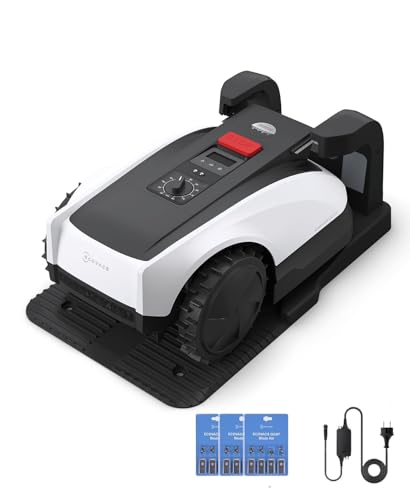
The ECOVACS Goat O1000 RTK Care Kit is a wire-free robotic lawn mower designed for small to medium properties up to 1/4 acre. This model uses RTK satellite positioning to achieve centimeter-level accuracy without buried perimeter wire – a significant convenience for homeowners who want simple installation and a clean yard without trenches. The bundle also includes 36 extra blades, reducing the frequency of replacements.
In real-world use, the mower follows systematic patterns rather than random paths, resulting in consistent coverage and fewer uncut patches. The app enables auto mapping, meaning the mower scans your lawn and creates a map that you can divide into zones. You can then set different schedules for front, back, and side yards. According to the product description, multi-zone management is easy to adjust from your phone, which may appeal to homeowners who want to prioritize certain areas.
Build quality appears solid for a robot mower, with a plastic body common in the class. The included RTK extension cable helps improve satellite signal reception, an important feature if your yard has obstacles like trees or a house that might block signals. This setup can maintain stable positioning and boundary accuracy even in complex environments.
Setup involves placing the RTK antenna in an open area and connecting the extension cable, then running the auto-mapping cycle. After that, you can set cutting boundaries virtually through the app. Maintenance is straightforward: replace the blades as needed (the extra 36 blades provide many cycles), and periodically clean the mower body and charging contacts. The automatic recharging function means the mower returns to its dock when the battery runs low, then resumes mowing - truly a 'set and forget' experience.
That said, there are limitations to consider. The 1/4-acre capacity restricts use to smaller lawns, and there are no verified user reviews to confirm long-term reliability. The price is on the higher side for a robot mower of this size. Additionally, while the RTK extension cable helps, extremely dense tree cover or very tall structures could still cause signal issues. Finally, some users may prefer a robotic mower with a physical boundary wire for absolute edge control.
Overall, the ECOVACS Goat O1000 RTK Care Kit is a compelling option if you value a wire-free setup, precise navigation, and low maintenance for a small lawn. It best suits tech-savvy homeowners who want to automate mowing completely and don't mind the upfront investment. If your yard is under 1/4 acre and you dislike dealing with perimeter wires, this model is worth serious consideration.
The O1000 RTK CARE bundle comes with 36 additional replacement blades, significantly extending the time before you need to purchase new ones. This is a practical addition for homeowners who want to minimize ongoing costs and avoid frequent interruptions. Also included is an RTK extension cable, which allows you to place the antenna in a location with the best satellite visibility - essential for accurate boundary detection. The standard charging dock and power adapter are included as well. Having these extras out of the box may help reduce the overall hassle of robot mower ownership.

Pros
- No perimeter wire required - quick 5-minute setup and easy lawn mapping.
- Advanced obstacle avoidance using AIVI 3D to protect yard items and the mower.
- Quiet, eco-friendly electric operation with low maintenance - no gas, oil, or spark plugs.
- App control with zoning, scheduling, and real-time monitoring for tailored mowing.
Cons
- Limited to lawns up to 1/4 acre; not suitable for larger properties.
- No user reviews yet, so real-world performance is unverified.
- Initial cost may be higher than traditional push mowers for small lawns.
The ECOVACS Goat O1000 RTK is a wire-free robotic lawn mocker built for homeowners with small to medium lawns up to 1/4 acre. It is designed for those who want a fully automated mowing experience without the hassle of installing boundary wires or dealing with noisy gas engines. This model is best suited for suburban yards with simple to moderately complex landscapes, including trees, flower beds, and slopes up to 45%.
Performance-wise, the Goat O1000 uses a combination of RTK, Vision, and 3D ToF sensors for centimeter-level positioning. According to the product description, it creates precise mowing patterns and handles tricky areas around trees and other obstacles. The AIVI 3D obstacle avoidance system can detect lawn furniture, toys, pets, and even narrow passages as tight as 2.3 feet. This means less worry about the mower getting stuck or damaging things. It also handles slopes up to 24 degrees, which covers most residential yards.
Build quality appears solid at 23.58 pounds, with a compact footprint of about 24 by 10 by 16 inches. The black plastic body is typical for outdoor robots, though specific weather resistance ratings are not provided. Users should expect it to handle light rain and dew but may want to store it in a sheltered spot when not in use. The low height and light weight make it easy to lift and carry to storage.
Setup is one of its biggest selling points: no perimeter wire to bury. The robot maps the lawn automatically using LiDAR-enhanced RTK, so initial configuration takes about 5 minutes. From there, the ECOVACS App lets you create multiple mowing zones, set no-go areas, adjust cutting height, and set schedules. Maintenance is minimal - just clean the blades and sensors occasionally, and replace blades when needed. No oil changes, no gas mixing, and no spark plug checks.
However, there are realistic limitations. The 1/4 acre limit means it won't work for larger properties. Also, with zero customer reviews at the time of this review, it's hard to gauge real-world reliability and durability. The price of $699 is competitive for a wire-free robot mower, but still a significant upfront investment compared to a basic push mower. Some users might find the app connectivity occasionally finicky.
Overall, the ECOVACS Goat O1000 RTK is a compelling option for homeowners who want a wire-free, automated lawn solution for a small yard. If you value convenience and quiet operation over raw power, and your lawn fits the size and slope requirements, this mower could be a great fit. Consider it if you're tired of manual mowing and want to reclaim your weekends.
The Goat O1000 RTK relies on a triple-sensor system: RTK (Real-Time Kinematic) satellite positioning, Vision camera, and a 3D Time-of-Flight sensor. This combination allows the mower to map your yard without any perimeter wires and navigate with centimeter-level accuracy. According to the product specifications, it can detect obstacles as small as 2.3 feet wide, including lawn furniture, toys, trees, and pets. This helps prevent collisions and keeps both the mower and your yard safe. It can also handle slopes up to 45% (24 degrees), which covers most residential inclines. The intelligence means less babysitting and more reliable mowing around complex landscapes.
With the ECOVACS App, you have full control over the Goat O1000 RTK from your smartphone. You can create multiple mowing zones, set no-go areas (like around flower beds or kids' play areas), adjust cutting height, and set weekly schedules. The app also shows real-time mowing progress, battery status, and any error alerts. The mower automatically returns to its charging dock when the battery is low, then resumes mowing once charged. This level of automation means you can set it and forget it, letting the robot handle lawn care while you relax or tackle other tasks.
Evaluating Autonomous Mowing Systems for Modern Turf Management
Answering what is the best robot lawn mower requires identifying the primary physical obstacles across your property rather than simply focusing on listed acreage ratings. Modern wire-free machines have replaced buried boundary wires with complex sensor arrays that navigate around flower beds, trees, and steep elevation changes. A property with open skies and rolling slopes demands a completely different propulsion and positioning system than a shaded suburban lot with narrow side corridors and dense tree canopies. Evaluating how positioning hardware, drive motors, and cutting assemblies interact ensures you select an automated machine capable of maintaining pristine turf without human intervention.
Navigation Architectures: RTK-GNSS vs. Dual-LiDAR Systems
Satellite navigation combined with real-time kinematic correction provides centimeter-level positioning accuracy across open turf. Systems utilizing RTK rely on a stationary base station antenna that constantly calculates atmospheric signal delays and transmits instant differential corrections to the roaming mower. This systematic path planning allows the machine to cut in crisp, parallel stripes rather than wandering in inefficient random bounce patterns. However, standard RTK positioning requires an unobstructed line-of-sight between both the satellite constellation and the ground reference antenna to maintain its spatial coordinates.
Solid-state LiDAR navigation introduces an autonomous alternative that operates completely independent of orbiting satellites or exterior base station antennas. Dual-LiDAR systems, such as the HoloScope 360 setup found on the ECOVACS Goat A2000 LiDAR PRO Robotic Lawn Mower, emit thousands of invisible light pulses every second to map physical surroundings with roughly two-centimeter precision. Because LiDAR relies on optical distance measurements reflected off nearby physical structures, it functions flawlessly in shaded spaces, under dense tree canopies, and beside towering privacy fences where satellite signals frequently drop. Homeowners with heavily wooded lots or tall retaining walls often find LiDAR mapping significantly more reliable than basic satellite rovers during daily mowing cycles.
Handling Dense Tree Canopies, Fences, and Signal Multipath
Dense foliage and tall architectural barriers present the single greatest hurdle for satellite-guided autonomous mowers. Satellite multipath distortion happens when radio frequencies bounce off metal siding, brick walls, or dense tree trunks before reaching the rover, creating phantom coordinates that cause erratic wandering or complete operational pauses. When an RTK mower loses satellite lock, it typically halts immediately to prevent driving into flower beds or swimming pools. Solving this issue requires secondary positioning aids, such as integrated vision cameras or extended antenna mounts that restore signal geometry.
Hybrid navigation systems solve satellite dropouts by combining multi-frequency RTK with optical computer vision. The roborock RockMow X115H Robot Lawn Mower incorporates a Full-Band RTK module paired with an advanced Quad-Camera AI Vision array to track ground features when skyward satellite signals become occluded. If tall evergreens or covered patio roofs obscure satellite reception, the optical vision cameras step in to maintain continuous path tracking through visual odometry. Similarly, packages like the ECOVACS Goat O1000 RTK Care Kit Robotic Lawn Mower include dedicated RTK extension cables, enabling owners to mount the reference antenna high along rooflines or clear fence posts for optimal sky exposure.
Terrain Climbing Dynamics and Slope Safety Ratings
Lawn slope gradients represent a major operational divide among automated mowing machinery. While standard residential riding equipment is restricted to a maximum 15-degree incline under ANSI safety standards to avoid rollover accidents, compact robotic mowers operate with exceptionally low centers of gravity. Two-wheel-drive robotic models, such as the ECOVACS Goat O1000 RTK Robot Lawn Mower, comfortably traverse grades up to 45 percent, which translates to roughly 24 degrees of slope. These two-wheel-drive configurations rely on aggressive rear drive treads and front caster wheels, making them suitable for typical drainage swales and mild front-yard embankments.
Severely terraced properties, retention basins, and steep hillside transitions demand true four-wheel-drive propulsion. The roborock RockMow X115H Robot Lawn Mower utilizes a pro-grade 4WD platform paired with active steering and a dynamic suspension system to conquer slopes reaching 80 percent, or 38.7 degrees. Traditional dual-drive mowers often slide downhill or tear manicured turfgrass when attempting zero-radius turns on steep damp slopes. Active steering coordinates all four wheels independently, preventing turf scuffing while maintaining continuous uphill traction across damp turf. Furthermore, heavy-duty suspension assemblies allow these all-wheel-drive machines to scale surface obstacles up to 3.15 inches, such as exposed tree roots and stepping stones, without high-centering.
Border Trimming and Perimeter Edge Management
Uncut perimeter edges have historically forced robotic mower owners to continue manual string trimming every weekend. Because most robotic cutting decks are centered underneath the chassis between the wheels, the spinning blades cannot physically reach the outer edge of concrete curbs or wooden fences. Standard machines typically leave a ragged four-to-six-inch border of uncut grass along every physical boundary. Homeowners seeking true automation must examine whether a prospective unit includes mechanical edge-trimming solutions or offset cutting assemblies.
Integrated border trimmers eliminate the need for secondary manual string trimming around garden beds and walkways. The ECOVACS Goat A2000 LiDAR PRO Robotic Lawn Mower and ECOVACS Goat O1000 LiDAR PRO Robot Lawn Mower solve this issue by incorporating dedicated TruEdge trimming modules that extend beyond the primary wheelbase. Using replaceable trimming line spools, these integrated edging systems cleanly slice perimeter turf flush against driveways and landscape timbers. By scheduling edge-trimming routines directly alongside regular deck passes, property owners maintain razor-sharp boundary lines without picking up a manual string trimmer.
Narrow Passage Transit and Multi-Zone Garden Layouts
Suburban lawn configurations frequently feature divided front and back yards linked only by narrow side walkways or tight security gates. Robotic mowers designed for complex properties must possess compact physical chassis dimensions and precise lateral clearance tolerances. Units like the ECOVACS Goat O1000 LiDAR PRO Robot Lawn Mower feature a slim-body design engineered to slip through narrow corridors as tight as 0.8 meters, or roughly 31.5 inches. Without slim packaging and tight turning capabilities, a robotic mower will refuse to transit between front and rear turf zones, requiring manual relocation between separate yards.
Multi-zone software management allows homeowners to establish distinct mowing rules for segregated grass areas. Mobile management applications enable users to map isolated front lawns, shady side yards, and open back turf while designating safe crossing paths over concrete sidewalks or paved patios. Operators can easily schedule frequent cuts for high-visibility front lawns while programming less frequent passes across shaded side lots. Furthermore, virtual no-go zones keep machines safely away from gravel pathways, delicate flower gardens, and temporary outdoor projects without physical barriers.
AI Vision and Multi-Sensor Obstacle Avoidance
Early robotic mowers relied strictly on mechanical bump sensors, causing them to collide repeatedly with patio furniture, playground sets, and landscape edging before changing direction. Modern intelligent machines employ complex multi-sensor fusion systems that incorporate artificial intelligence, optical cameras, and Time-of-Flight LiDAR sensors. The ECOVACS Goat O1000 LiDAR PRO Robot Lawn Mower utilizes AI vision algorithms trained to detect and navigate around more than 200 common outdoor obstacles, including garden hoses, stray dog toys, and decorative yard art. Detecting objects from several feet away allows the machine to smoothly decelerate and contour around hazards without impact.
Obstacle avoidance systems are equally vital for protecting family pets and local wildlife during unattended mowing cycles. Advanced perception systems like those on the roborock RockMow X115H Robot Lawn Mower combine four specialized sensors to monitor the immediate path ahead in real time. Dedicated wildlife-friendly operating modes restrict automatic mowing schedules during nighttime hours to protect nocturnal animals such as hedgehogs and toads. If an energetic pet or child unexpectedly approaches the working mower, the optical vision system instantly disengages the rotating cutting disc and alters its travel path to ensure complete safety.
Powertrain Voltage, Cutting Width, and Grass Species Compatibility
Cutting performance varies substantially across different turfgrass varieties, especially between soft cool-season blends and thick warm-season grasses. Dense stoloniferous turf varieties such as Bermuda, Zoysia, and coarse St. Augustine present immense rotational resistance that can stall low-voltage electric motors. To manage heavy, fast-growing growth, the ECOVACS Goat A2000 LiDAR PRO Robotic Lawn Mower incorporates a high-power 32-volt electrical platform paired with a dual-blade disc assembly. Higher motor torque maintains continuous blade velocity through thick spring overgrowth, preventing the ragged tearing and yellowed blade tips associated with underpowered autonomous cutting heads.
Deck cutting width and height adjustability directly dictate overall mowing efficiency and turf health. The roborock RockMow X115H Robot Lawn Mower features an expansive 9.49-inch cutting swath that reduces total travel distance required to cover larger properties up to 0.37 acres. Its flexible cutting height spans from 1.57 to 3.54 inches, allowing owners to match seasonal agronomic recommendations for various grass species. Maintaining a taller cut during hot summer months encourages deeper root development and moisture retention, while a lower spring setting promotes dense lateral greening across manicured turf.
Routine Blade Replacement, Battery Care, and Underside Maintenance
Autonomous robotic mowers use small, razor-sharp pivoting blades attached to a spinning disc rather than the massive, heavy forged steel blades found on gas tractors. For a broader overview of edge profiles across different mowing platforms, reviewing our detailed lawn mower blade selection guide clarifies how blade geometry influences mulching performance. Because robotic blades spin continuously during scheduled micro-cuts, their edges gradually dull when contacting dirt and small twigs. Bundles like the ECOVACS Goat O1000 RTK Care Kit Robotic Lawn Mower include 36 extra replacement blades, allowing owners to rotate and swap cutting edges every few weeks to guarantee a clean, surgical cut.
Underside deck hygiene and battery cycle management play equal roles in preserving long-term machine reliability. Wet grass clippings readily accumulate inside the cutting chamber, creating excess motor drag and reducing overall runtime per battery cycle. Applying specialized protective deck spray coatings to the clean plastic underbody helps repel moisture and prevents dense turf clumps from adhering around the rotating disc. On the electrical side, high-efficiency charging systems help minimize operational downtime across large yards. Fast-charging stations delivering 113.4 watts can fully replenish a 3.0Ah battery pack in roughly 50 minutes, ensuring the machine completes its multi-zone mowing schedule before sundown.
Connectivity, Mapping Methods, and Anti-Theft Security Systems
Initial property mapping has evolved from a tedious chore into an intuitive smartphone experience. Many current machines offer automatic mapping routines where onboard cameras and LiDAR sensors survey the yard perimeter independently in mere minutes. For yards featuring detailed garden beds, flagstone borders, or delicate botanical arrangements, manual mapping modes let owners steer the mower like a remote-control rover to trace hyper-precise boundaries. Creating accurate initial maps prevents subsequent navigation errors, ensuring the robot respects garden beds and follows established travel paths between designated cutting zones.
Because robotic mowers represent substantial yard investments operating out in the open, robust anti-theft security measures are essential. Premium platforms like the roborock RockMow X115H Robot Lawn Mower incorporate onboard 4G cellular modules, real-time GPS tracking, and secure PIN lockout controls. If an unauthorized individual lifts or moves the machine outside its geofenced perimeter, the mower immediately locks its drive wheels, sounds a high-decibel audible alarm, and transmits instant location coordinates to the owner’s smartphone. These integrated tracking and lockdown features provide total peace of mind when operating autonomous equipment on unfenced front yards.
Deciding on the optimal robotic mower comes down to auditing your property’s physical terrain, tree canopy density, and boundary complexities. Open acreage with steep rolling hills benefits tremendously from the traction and power of all-wheel-drive RTK systems, while shaded properties with tall fences and narrow gates thrive under the satellite-free precision of dual-LiDAR mapping. Prioritizing features such as integrated border trimming and proactive obstacle avoidance eliminates the secondary chores that often undercut the convenience of autonomous lawn care. By aligning machine capabilities with your yard’s specific layout, you can enjoy a perfectly manicured lawn every single day without sacrificing your personal weekend hours.





Write Your Review
No reviews yet. Be the first to share your experience!