

Overhanging tree limbs, dead wood, and encroaching canopy branches create constant hazards for property owners attempting to maintain clean lawn borders and clear equipment pathways. Determining what is the best manual pole saw requires balancing overall extension reach, structural rigidity, blade cutting efficiency, and tool weight. Manual tree pruners eliminate the fuel mixing, engine maintenance, and battery charging associated with motorized power equipment while providing dependable reach into high crowns. Selecting the right setup ensures you can prune overhead growth cleanly without dangerous ladder climbing or risking branch strikes on delicate turf below.
Pruning thick branches before they fall also protects your mowing equipment from hidden debris, which pairs naturally with routine yard maintenance like clearing debris before deploying lawn mower leaf collection systems across the property. A high-reach pole saw equipped with carbon steel cutting teeth and dual-pulley pruning shears delivers clean botanical cuts that promote healthy tree healing while keeping mower travel lanes free of low-hanging obstacles. Durable fiberglass section handles and secure double-locking mechanisms maintain stability even when fully extended into mature palm fronds or hardwood branches. Investing in a capable manual system provides the overhead control required to maintain an attractive, safe landscape throughout every growing season.
Pros
- Extends up to 27 feet, allowing you to trim high branches from the ground safely.
- Lightweight fiberglass poles reduce strain during long pruning sessions.
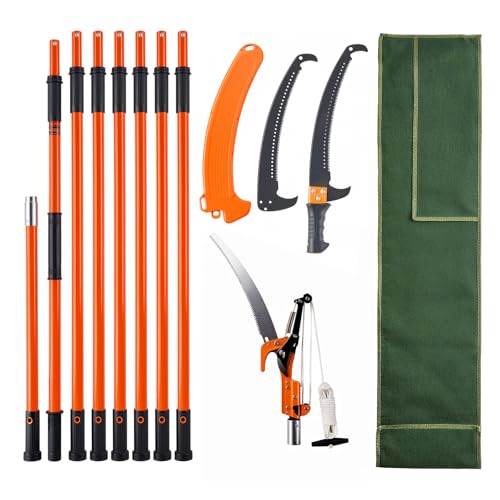
- Dual cutting tools – saw blade for larger branches and scissors for twigs – provide versatility.
- Double-lock joints ensure the pole stays securely in place without wobbling.
- Comes with storage bag and blade sleeve for easy, safe storage.
Cons
- Manual operation requires physical effort; not as fast as powered pruners for heavy-duty jobs.
- At 14.8 pounds, it may feel heavy when fully extended, especially for users with less upper body strength.
- The rope and pulley system may require occasional adjustment to maintain smooth operation.
The VEVOR Manual Pole Saw is an extendable tree pruner designed for homeowners who need to trim high branches without a ladder. It suits those with small to large yards, especially if you have tall palms or shrubs. This tool is a practical addition to any lawn care kit, offering a safe way to reach branches that would otherwise require risky climbing.
The saw features a rust-proof carbon steel blade with Teflon coating for clean cuts. The included scissors handle twigs, while the pulley system reduces effort. According to the product description, the double-lock joints keep the pole firm and stable during use. The blade's hook knives help clear stuck branches, making the cutting process more efficient.
Build quality is solid with fiberglass handles that are lightweight yet durable. The orange color makes it easy to spot in the garage or yard. The saw sleeve and storage bag help keep the tool safe when not in use, preventing accidental cuts and loss of accessories.
Setup involves connecting the 8 poles, which lock securely with the double-lock mechanism. Maintenance is minimal – just clean the blade after use and keep the rope free of debris. The compact storage bag makes it easy to store in a garage or shed without taking up much space.
One limitation is that manual operation requires physical effort, and the weight at full extension may be challenging for some users. It may not replace a powered chainsaw for very thick branches, but for routine pruning of branches up to a few inches thick, it works well.
Overall, this pole saw offers good value for budget-conscious homeowners who want a safe, extendable tool for regular pruning. It's a practical choice for those who prefer a manual option that doesn't rely on batteries or fuel, and it's especially useful for maintaining trees and shrubs around the property.
The VEVOR manual pole saw uses fiberglass handles that are lightweight yet strong, reducing overall weight by 10% compared to earlier models. The double-lock joints create a firm connection between sections, minimizing wobble during use. The carbon steel blade with Teflon coating resists rust and stays sharp over time. Storage is well thought out: a saw sleeve covers the blade for safety, and a storage bag holds all 8 pole sections and the scissors. This makes it easy to keep the tool organized and protected when not in use, whether in a garage, shed, or truck bed.
Evaluating Overhead Pruning Mechanics and Manual Pole Saw Design
Determining what is the best manual pole saw requires analyzing how extension length, handle rigidity, cutting blade metallurgy, and tool weight balance together under real working conditions. While motorized pole saws offer automated cutting speed, manual pole saws deliver greater maximum reach, lighter overhead mass, and zero engine maintenance. A quality manual saw enables property owners on the ground to slice through thick limbs cleanly while avoiding the severe fall hazards of working from a ladder. By examining pole locking systems, blade tooth geometry, and compound pruner mechanics, you can select equipment that handles aggressive seasonal pruning with confidence.
Overhead Extension Reach and Sectional Handle Architecture
Total reach remains the primary specification for any pole pruner, but maximum height must be supported by structural rigidity. Pole systems generally utilize either telescoping sliding tubes or multi-piece sectional poles that interlock end to end. Telescoping poles adjust rapidly, but sectional poles maintain uniform wall thickness and superior stiffness across their entire working length. The VEVOR Manual Pole Saw, 7.3-27 ft Extendable Tree utilizes an 8-piece sectional architecture that allows operators to customize their working length anywhere from 7.3 feet up to 27 feet.
Handle material plays a decisive role in user safety and mechanical durability during extended pruning sessions. Lightweight fiberglass serves as the premier choice for manual pole saws because it combines high tensile strength with flex resistance. Fiberglass also provides dielectric insulating properties, creating a safer non-conductive barrier compared to aluminum handles. High-grade fiberglass construction keeps the extended assembly rigid enough to transmit positive cutting pressure without bowing excessively under its own weight.
Joint stability determines whether a pole saw feels solid or dangerously loose at full extension. Weak joint connections allow rotational twisting, which causes the cutting blade to wander out of the saw kerf mid-stroke. The VEVOR pole pruner features double-lock joint connections specifically engineered to keep all eight pole sections tightly aligned during heavy sawing. This dual-locking approach prevents sleeve slippage and protects the fiberglass tubing from stress fractures when handling long, swinging branch cuts.
Blade Metallurgy, Kerf Dynamics, and Hook Geometry
A manual pole saw blade must cut efficiently with minimal downward force because the operator stands far below the cutting surface. Tree saw blades feature curved profiles that naturally hook into branch wood, allowing gravity and pull strokes to do the heavy work. Unlike traditional carpenter handsaws that cut on the push stroke, arboricultural pole saws cut almost exclusively on the pull stroke. Pull-stroke cutting puts the long pole in tension rather than compression, preventing the handle from buckling as teeth bite into hard wood.
Steel composition and surface treatments directly influence how long a cutting edge stays sharp against abrasive bark and dense wood fibers. The VEVOR manual pole saw features a 0.05-inch (1.2 mm) thick carbon steel blade engineered for high tensile strength and flex recovery. A durable Teflon coating covers the carbon steel surface to prevent rust, shed sticky tree sap, and reduce friction inside the cutting channel. Much like maintaining proper edge geometry when reviewing a lawn mower blade selection guide, a sharp, low-friction pruning blade prevents ragged cuts that invite fungal diseases into living tree limbs.
Specialized hook geometry on the saw blade head elevates a standard pruning saw into a versatile canopy management tool. Top-mounted hook knives serve as stabilizing stops that keep the blade from slipping out of the kerf on long, aggressive strokes. When branches release, this upper hook allows the operator to reach up and dislodge hung twigs or tangled vines caught in the canopy. A bottom hook knife acts as an undercut knife, scoring the lower bark before making the primary top cut to prevent bark stripping.
Compound Pulley Pruning Attachments for High Twig Management
Cutting small, flexible branches with a reciprocating saw blade often leads to frustrating blade binding and excessive branch whipping. Quality manual pole saws solve this challenge by integrating a spring-loaded bypass pruner head alongside the primary saw blade. Bypass pruners utilize a curved cutting blade that slides past a counter-hook, producing clean botanical scissor cuts on fresh green growth. The VEVOR system incorporates sharp manganese steel scissors designed specifically for slicing through tender branches, palm fronds, and foliage that would otherwise deflect a saw blade.
Actuating a pruning head mounted at the top of a 27-foot pole requires substantial mechanical leverage to slice through dense wood fibers. A compound pulley system multiplies the operator’s pulling force, drastically reducing the physical effort needed to close the cutting jaws. The VEVOR pruner combines a labor-saving multi-pulley mechanism with an 11.5-foot (3.5 m) high-tensile compound nylon pull rope. This pulley arrangement allows the user to exert smooth downward tension on the rope to sever twigs cleanly up to an inch in diameter.
Managing the pull rope during high-canopy work requires deliberate routing to avoid frustrating snags and tangled lines. Allowing a slack rope to drift freely through dense branches can trap the pole head high in the tree, requiring awkward maneuvers to free the tool. Keeping the nylon rope routed close along the fiberglass pole sections maintains line control and prevents loops from catching on lower stubs. When operating at lower heights or using the saw blade alone, the pruner scissors and rope mechanism can remain idle without interfering with the saw stroke.
Managing Tool Weight, Flex, and Operator Ergonomics
Operating an extendable pole tool overhead places unique physical demands on your shoulders, back, and core muscles. Even modest weight increases at the base of the pole feel magnified when balancing a lever arm that reaches over 20 feet into the air. Total tool weight must therefore be minimized without sacrificing wall thickness or joint integrity. The VEVOR manual pole saw weighs approximately 13 lbs (5.9 kg), reflecting a lightweight design that reduces fatigue during prolonged pruning sessions.
Pole flex is an inevitable physical reality when extending any tool past 20 feet, but managing that flex is essential for cutting control. A pole that bends excessively creates a bouncing sensation that pulls the blade out of the cutting groove and wastes operator energy. Controlling flex requires adopting a wide, stable stance and maintaining an operating angle between 45 and 60 degrees relative to the ground. Standing directly beneath the branch increases flex and places the operator in the direct path of falling wood.
Footing stability is equally vital when maneuvering a long pole saw across uneven turf, ditches, or sloping property lines. Navigating challenging lawn contours with your eyes focused upward demands caution, similar to the situational awareness required when mowing steep hills safely around perimeter boundaries. Always inspect your footing before hoisting the pole, clearing trip hazards such as fallen branches, irrigation heads, or surface roots from your working area. Taking brief rest breaks between large limb cuts allows your forearm and shoulder muscles to recover, maintaining steady control over the pole.
Safe Overhead Cutting Practices and Drop Zone Management
Executing proper pruning cuts preserves tree health and prevents dangerous tear-outs that can damage valuable ornamental or shade trees. When removing large tree limbs, arborists rely on the traditional three-cut method to manage weight and prevent peeling bark down the trunk. The first cut is a shallow undercut made on the bottom of the branch roughly six to twelve inches outward from the branch collar. The bottom hook knife on the VEVOR saw blade makes scoring this underside clean and straightforward, ensuring the limb snaps cleanly rather than tearing bark down the trunk.
The second cut is the through-cut, placed several inches further out on the top side of the branch beyond the initial undercut. As you saw downward through the top of the limb, the branch will naturally crack and drop free onto the ground below. Relieving the bulk of the branch weight through this second cut leaves behind a manageable short stub connected to the tree trunk. The third and final cut is made just outside the branch collar, creating a clean vertical surface that allows the tree to form protective callus tissue over the wound.
Establishing an unconditional drop zone underneath and around your cutting area is essential for personal and property safety. A falling branch can bounce unpredictably off lower limbs or hard ground, traveling several yards away from its vertical drop path. The safe drop zone should extend to at least double the length of the branch being removed, keeping bystanders, pets, and fragile landscaping clear of the area. Operators must always wear ANSI-approved safety glasses, a sturdy hard hat, and heavy work gloves to guard against falling debris, sawdust, and sharp twigs.
Practical Selection Factors for Homeowners and Property Managers
Selecting the best manual pole saw depends on the specific trees, landscape boundaries, and structural clearance goals on your property. Suburban lots bordered by mature oak, maple, or pine trees frequently develop low-hanging branches that scrape vehicle roofs or obstruct mower access along fence lines. A modular system with adjustable reach adapts seamlessly to both medium-height ornamental trees and high boundary canopies. The VEVOR Manual Pole Saw, 7.3-27 ft Extendable Tree delivers the reach needed for tall shade trees while allowing quick teardown into individual hand-manageable sections for low brush clearing.
Detachable saw heads offer exceptional versatility by converting into standard handheld pruning saws for ground-level tasks. Once high limbs have been brought down to the turf, using a 20-foot pole to buck wood into manageable firewood pieces is awkward and inefficient. Removing the saw head from the pole provides a razor-sharp hand saw equipped with aggressive carbon steel teeth and a curved cutting profile. Operators can quickly limb fallen branches, cut thick brush piles, or prune low shrubs without switching to a different cutting tool.
Ongoing maintenance for manual pole saws is simple but critical for preserving smooth operation and cutting efficiency over many seasons. After cutting resinous woods like pine or palm trees, wipe the Teflon-coated carbon steel blade with a mild solvent or blade cleaner to remove sticky sap deposits. Inspect the double-lock joint collars periodically to verify that threads and locking pins remain clean of grit, bark dust, and moisture. Storing the fiberglass poles and cutting components in a dry location inside their protective sleeve and storage bag prevents ultraviolet degradation and accidental blade dulling, keeping the tool ready for seasonal work.






Write Your Review
No reviews yet. Be the first to share your experience!