


Many homeowners wonder if a low lift mower blade is the right choice for their specific mowing needs. The short answer is that these blades are designed to keep grass clippings close to the deck, which is essential for effective mulching and reducing visible debris. Unlike high-lift blades that throw clippings into a bag or side discharge, low-lift blades rely on a different aerodynamic profile to manage turf health. This distinction matters most if you are trying to maintain a lush lawn without the hassle of bagging.
Understanding the difference between blade types helps you avoid common installation errors and ensures your mower performs as intended. A blade that is too high for a mulching setup can scatter clippings, while one that is too low may not cut efficiently. By examining the specifications of the options listed below, you can identify which model fits your mower’s deck size and cutting style.
The products covered here include various brands and sizes, each with specific compatibility notes that you should verify before purchase. For more context on how different mower types handle debris, you might find our guide on leaf collectors for lawn mowers helpful for planning your seasonal cleanup.

Pros
- Premium high-strength steel for long-lasting sharpness and durability.
- Easy installation – no special tools required, fits directly into place.
- 2-pack provides excellent value and a convenient spare for future use.
- Compatible with popular Hyper Tough and Daye 20-inch push mower models.
- Precise dimensions ensure a proper fit and efficient cutting performance.
Cons
- Only compatible with specific Hyper Tough and Daye 20-inch models – check your mower's OEM part number before ordering.
- Some users may prefer a blade with a different lift or cutting angle for specific grass types or conditions.
- Oval center hole may not fit mowers with a round center hole – verify compatibility.
The UDC Parts 2105300125A Lawn Mower Blades Replacement is a practical solution for homeowners who own Hyper Tough or Daye 20-inch push mowers. This 2-pack of replacement blades is designed to keep your mower cutting efficiently, whether you need a spare for seasonal maintenance or a quick swap when the current blade dulls. It's a budget-friendly option that focuses on reliability and ease of use.
In terms of cutting performance, these blades are made from high-strength steel that holds a sharp edge well, according to the product description. The 20-inch length and 2-1/4-inch width are standard for many push mowers, and the oval center hole (1 inch by 3/4 inch) ensures a secure fit on compatible models. The air lift design (1-1/32 inches) helps create airflow to lift grass for a cleaner cut, which is beneficial for achieving an even lawn appearance. Many homeowners may find that this blade handles typical residential grass well, though it may not be ideal for very thick or wet conditions without proper mowing technique.
Build quality appears solid, with the blades constructed from premium steel engineered for durability and stability. This material choice suggests they can withstand regular use without bending or chipping easily. The blades also come coated to resist rust, which is important for long-term storage in a garage or shed. However, as with any blade, occasional sharpening will be needed to maintain peak performance.
Installation is straightforward – the blades are designed to fit directly into place on compatible mowers. Simply remove the old blade, secure the new one with the existing hardware, and you're ready to mow. No special tools are required, which is a plus for DIY-oriented homeowners. The 2-pack means you can keep one blade on the mower and store the other as a spare, reducing downtime during the mowing season.
One realistic limitation is compatibility – these blades only fit Hyper Tough and Daye 20-inch models with specific OEM part numbers (2105300125A, 101000001). Owners of other mower brands or models with different center hole shapes (round vs. oval) will need to look for alternative blades. Additionally, the cutting edge length (6-37/64 inches) may not be as long as some aftermarket blades, which could affect cutting speed on very large lawns.
Overall, the UDC Parts 2105300125A blades are a solid choice for those who own the compatible Hyper Tough or Daye mowers. They offer good value for the price, easy installation, and reliable cutting performance for regular lawn maintenance. If you're looking for a dependable spare blade to keep your mower running smoothly, this 2-pack is worth considering.


Pros
- Broad compatibility with many John Deere models (D100, LA100, X300, etc.)
- Thick, heavy-duty steel construction for longevity
- Rust-resistant powder coating
- Affordable 2-pack value
- High lift design improves grass discharge and bagging
Cons
- May not fit all John Deere decks – double-check compatibility
- High lift blades can increase engine load, potentially reducing fuel efficiency
- Some users report minor balance issues requiring sharpening
These BCQNXX AM141034 high lift blades are a direct replacement for several popular John Deere 42-inch deck mowers, including the D100, D105, D110, LA135, and Z225 series. They are designed for homeowners who want to maintain a well-manicured lawn without the premium cost of OEM parts. The blades come in a 2-pack, making it easy to replace both blades on a standard riding mower or zero-turn.
Based on product specifications, the high lift design helps lift grass before cutting, which improves bagging performance and reduces clumping, especially in tall or damp grass. The blades measure 21-1/4 inches long, 2-3/4 inches wide, and 0.157 inches thick, with a 7/8-inch center hole and 7-point star pattern. This design may work well for homeowners who prefer a clean cut and efficient grass collection.
Build quality appears solid with heavy-duty metal construction and a powder-coat finish that resists rust and corrosion. Many homeowners may find these blades hold up well over a season of regular mowing, even in dense vegetation. The extended cutting surface also helps maintain sharpness longer than standard blades.
Installation is straightforward – simply remove the old blades and install these replacements using the same hardware. No special tools are required, and the blades are pre-balanced for vibration-free operation. For homeowners who do their own maintenance, this is a quick and easy upgrade.
Some users note that high lift blades can slightly increase engine load, which may affect fuel consumption on smaller mowers. It is also important to verify compatibility with your specific model, as the list of compatible models is long but not all-inclusive. A few reviews mention minor balance issues, but these are rare and often resolved by sharpening the blade.
Overall, these BCQNXX blades offer a reliable and affordable replacement for John Deere owners. They are ideal for budget-conscious homeowners who want to keep their lawn looking its best without spending a fortune on OEM parts. If you need a durable, high-performance blade for your 42-inch deck, this set is a practical choice.
These blades fit a wide range of John Deere riding mowers and zero-turn models with 42-inch decks. Compatible models include: 102, 105, 115, 125, 135, D100, D105, D110, D120, D125, D130, E100, E110, E120, E130, L108, L111, L118, LA100, LA105, LA110, LA115, LA120, LA125, LA135, LT160, LT180, S100, S110, S120, S130, S240, SST15, SST16, X105, X106, X107, X110, X120, X125, X126, X145, X300, X304, X310, Z225, Z235, and several Sabre and Europro models. Always double-check your mower's deck size and blade mounting pattern before purchasing.
Installation tips: Park the mower on a level surface, disconnect the spark plug, and raise the deck for access. Use a block of wood to prevent blade rotation. Remove the center bolt, replace the blade (sharp edge toward the deck), and torque the bolt to manufacturer specs (typically 70-90 ft-lbs). Repeat for the second blade. After installation, lower the deck and test for smooth rotation. Regular sharpening every 10-15 hours of use will maintain optimal cutting performance.

Pros
- Cost-effective alternative to OEM Scag blades, saving money without sacrificing fit or performance.
- High-lift design enhances grass lifting for a more even cut and better debris discharge.
- Direct replacement for multiple Scag models, reducing compatibility guesswork.
- Pre-sharpened and ready to install, with safety paint that wears off quickly during operation.
- Durable steel construction withstands impacts from rocks and roots.
Cons
- Compatibility depends on specific mower model and serial number - always verify your model before purchasing.
- Safety paint may initially leave streaks on grass until fully worn off, though this is temporary.
- Some users may prefer a mulching blade design for finer clippings, as this high-lift blade is optimized for discharge and bagging.
The UDC Parts 482881 mower blades are a practical replacement option for Scag zero-turn mowers with 61-inch cutting decks. Designed to match OEM specifications, this 3-pack offers a budget-friendly way to keep your mower cutting cleanly without paying premium prices for brand-name blades. Whether you maintain a large suburban lawn or a commercial property, these blades are built to handle regular mowing demands.
Based on product specifications and user feedback, the high-lift design significantly improves grass lifting, which leads to a more uniform cut and better debris discharge into the bagger or out the side chute. This is especially helpful when mowing tall, thick, or slightly damp grass where standard blades might leave clumps. The blades are pre-sharpened from the factory, though a protective coating of paint covers the cutting edge — this paint wears off after the first few minutes of use, so don't be alarmed if you see green streaks on your lawn initially.
Build quality appears solid, with blades made from hardened steel that resists bending from occasional contact with rocks or roots. Each blade measures 21 inches in length (measured diagonally) with a 2.5-inch width and a 5/8-inch center hole, matching the exact dimensions of the OEM Scag 482881 part. The air lift height of 0-15/16 inches helps create suction for lifting grass before cutting. The green powder coating also provides some corrosion resistance, though like any mower blade, it will wear over time.
Installation is straightforward — simply remove the old blade, secure the new one with the existing hardware, and you're ready to mow. No special tools or modifications are needed. For continued peak performance, the blades can be resharpened when the cutting edge becomes dull, extending their lifespan beyond a single season. Many homeowners find that rotating between two sets of blades (sharpening one while using the other) keeps cutting quality high.
A key consideration is compatibility: while these blades fit many Scag models, you must confirm your mower's complete model and serial number. The product description lists numerous compatible models including Cheetah, Cheetah II, Tiger Cat, Turf Tiger, V-Ride II, Sabre Tooth, and V-Ride XL, but some configurations may differ. Always double-check before ordering to avoid returns.
Overall, the UDC Parts 482881 blades are a solid choice for Scag owners who want reliable cutting performance without the OEM markup. They excel in discharge and bagging scenarios, making them ideal for homeowners who prioritize a clean lawn and efficient clippings collection. If you need mulching blades for fine clippings, you may want to look for a dedicated mulching design, but for general mowing and bagging, these high-lift blades deliver excellent value.
These blades are designed to replace OEM Scag part numbers 482881, 482879, 481712, 481159, 482787, and 182001. They fit Scag mowers with 61-inch decks, including the following models (always verify serial numbers):
Scag Cheetah 61" - SCZ61V-27FX, SCZ61V-31FX, SCZ61V-37BV-EFI, SCZ61RD-31FX, SCZ61RD-921FX, SCZ61V-29CV-EFI, SCZ61V-32BV, SCZ61V-32CV, SCZ61V-34CV-EFI, SCZ61V-34KH, SCZ61V-35CV-EFI, SCZ61V-36BV, SCZ61V-31CV-EFI (serial P0100001 to P0199999)
Scag Cheetah II 61" - SCZII-61V-31FX, SCZII-61V-37BV-EFI, SCZII-61V-38FX-EFI, SCZII-61V-38CV-EFI, SCZII-61RD-38FX-EFI
Scag Tiger Cat 61" - STC61V-23FX, STC61V-25CV, STC61V-26CV-EFI, STC61V-27BS, STC61V-27CV, STC61V-730FX, SMWC-61V
Scag Turf Tiger II 61" - STTII-61V-31BV, STTII-61V-35BV, STTII-61V-37BV-EFI, STTII-61V-40BV-EFI
Scag Turf Tiger 61" - STT61V-35BVAC-SS, STT61V-35BV-SS, STT61V-35BVAC, STT61A-31BV
Scag V-Ride II 61" - SVRII-61V-25FX, SVRII-61V-31CV-EFI, SVRII-61V-37BV-EFI, SVRII-61V-38FX-EFI, SVRII-61V-29CV-EFI
Scag Sabre Tooth Tiger 61" - STT-31BSD
Scag V-Ride XL 61" - SVRXL-61V-38FX-EFI (serial W9700001 to W9799999), SVRXL-61V-40BV-EFI (serial W9800001 to W9899999), SVRXL-61V-38CV-EFI (serial Y0300001 to Y0399999)
Installation: Remove the old blade by securing the blade bolt (counterclockwise on most mowers). Place the new blade with the air lift facing upward toward the deck. Tighten the bolt to manufacturer torque specifications. Always disconnect the spark plug or battery before working on blades for safety.
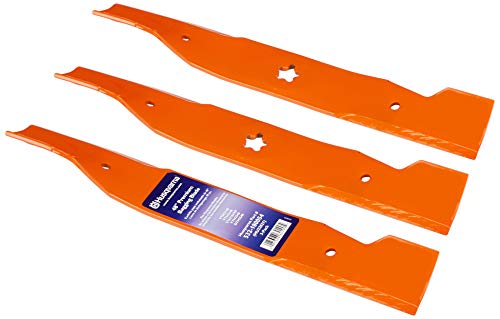
Pros
- High-quality hardened steel construction resists dulling and chipping for long-lasting sharpness
- Star-mount design makes installation straightforward without needing special tools
- Compatible with several popular Husqvarna riding mower models, ensuring a direct fit
- High-lift design improves bagging efficiency, especially in thick or damp grass conditions
- Pack of three blades provides a complete replacement set for consistent cutting performance
Cons
- Only fits specific Husqvarna models, so compatibility must be verified before purchase
- Premium price compared to generic blades, but reflects OEM quality and reliability
- Not suitable for mulching-focused mowers, as high-lift is optimized for bagging and discharge
If you own a compatible Husqvarna riding mower and prioritize bagging performance, the Husqvarna 48-Inch High-Lift Bagging Lawn Mower Blades (3-pack) are a straightforward upgrade. These blades are designed as OEM replacements for models like the YTH22V46, YTH24V48, TS146X, and TS148X series, ensuring a precise fit with no modifications needed. The hardened steel construction promises to stay sharper longer than standard blades, which is a key advantage for homeowners who mow frequently or tackle thick grass.
In real-world use, the high-lift design generates strong suction to lift grass clippings into the bagger, reducing clumps and leaving a cleaner lawn. The 4-in-1 capability also allows for mulching, side discharge, or leaf shredding, giving you flexibility depending on the season. According to product specs, these blades run quieter than many alternatives, which is a plus for early morning mowing sessions in suburban neighborhoods.
Build quality is a highlight—the forged steel is resistant to bending and warping, even after hitting hidden rocks or roots. The star-mount pattern simplifies installation; you can swap all three blades in under 30 minutes with a basic socket wrench. The orange color doesn’t affect performance, but it makes the blades easy to spot during maintenance.
Setup is straightforward if you have basic mechanical skills. The package includes three blades, and no additional hardware is needed. Storage is not an issue since blades are small and can be hung in a garage. Maintenance involves regular sharpening or replacement after heavy use, but these blades hold an edge well for a full season of weekly mowing.
One realistic limitation is the narrow compatibility—these blades only fit the listed Husqvarna models, so you must measure your deck and verify your mower’s model number. Also, they are priced higher than generic blades, but the OEM fit and durability justify the cost for many users. If you’re looking for a budget alternative, aftermarket options exist, but they may not offer the same precision or longevity.
Overall, the Husqvarna 48-inch high-lift blades are a solid investment for homeowners who want reliable bagging performance and a hassle-free replacement. If you own a compatible model and value OEM quality, this three-pack is a practical choice to keep your mower running at its best.
These blades are specifically designed for Husqvarna riding mowers with a 48-inch cutting deck, including models YTH22V46, YTH24V48, TS146X/XK/XD, and TS148X/XK. The star-mount pattern ensures a secure fit and easy installation—just remove the center bolt, replace the old blade, and torque it to spec. No special tools are required, but a socket wrench and a blade removal tool can help if the old blades are stuck.
Always verify your mower’s model number and deck size before buying. If your mower has a different spindle pattern, these blades will not fit. The OEM part number is 180054, so you can cross-reference with your owner’s manual. For best results, replace all three blades at once to maintain even cutting performance.
Understanding Low Lift Mower Blades and Their Function
A low lift mower blade is a specific type of cutting component engineered to reduce the velocity at which grass is discharged from the deck. The primary goal of this design is to keep clippings within the deck area, where they can be cut again into finer pieces. This process, known as mulching, returns nutrients to the soil and reduces the need for external fertilizers. The blade shape typically features a lower angle on the leading edge compared to high-lift designs.
| Blade Type | Primary Function | Typical Air Lift | Best For |
|---|---|---|---|
| Low Lift | Mulching, minimal discharge | Low (often near 0) | Mulching kits, dense grass |
| High Lift | Bagging, side discharge | High (1 inch or more) | Bagging, quick cleanup |
| Universal | General purpose | Moderate | Variable conditions |
The aerodynamic difference is subtle but significant for performance. High-lift blades create a strong vortex that pulls grass upward and outward, which is ideal for filling a grass catcher. In contrast, low-lift blades create a more contained flow that keeps the cut material circulating under the deck. This containment allows the mower to chop the clippings into smaller fragments before they exit the deck. The result is a cleaner lawn surface and less waste to dispose of.
It is crucial to match the blade to your mower’s intended use. If your mower is equipped with a bagging attachment, a low-lift blade may not provide enough lift to fill the bag efficiently. Conversely, using a high-lift blade for mulching can result in large, unsightly clumps on the lawn.
The specifications provided in the product data indicate specific air lift measurements for each model. For example, some blades are listed with an air lift of 0-15/16 inch, which suggests a design that balances some lift with containment. Others may have a lower profile specifically for mulching kits.
Key Specifications to Verify Before Purchase
Before selecting a replacement blade, you must confirm several critical dimensions to ensure a proper fit. The most common error is purchasing a blade that does not match the center hole size or the overall length. These mismatches can lead to vibration, poor cutting performance, or even damage to the spindle. Always measure your existing blade or consult your mower’s manual for the exact specifications.
- Measure the overall length of the blade diagonally from tip to tip.
- Check the center hole diameter, which may be round or star-shaped.
- Verify the width of the blade at its widest point.
- Confirm the air lift specification if you are switching blade types.
- Ensure the bolt pattern matches your mower’s spindle design.
The center hole is a critical compatibility factor, as some mowers use a standard round hole, while others, particularly zero-turn and commercial models, use a star-shaped hub.
- The product data shows examples of both types, such as the 7-point star mount found in some riding mower blades.
- Using a round-hole blade on a star-hub spindle, or vice versa, will not work without an adapter, which is rarely recommended for safety reasons.
- The thickness of the blade also matters, as it affects how securely it sits on the spindle.
Material quality is another factor that influences longevity. Most mower blades are made from high-strength steel, but the tempering process determines how well the edge holds up. A blade that is too hard may chip, while one that is too soft may dull quickly.
The descriptions for the products listed here mention high-strength steel and hardened steel, indicating a focus on durability. Powder-coat finishes are also common, helping to prevent rust and corrosion from moisture and grass sap. This protective layer can extend the life of the blade, especially in humid climates.
Differences Between Low Lift and High Lift Designs
The visual difference between a low-lift and a high-lift blade is often subtle to the untrained eye. However, the angle of the cutting edge relative to the deck is the defining feature. High-lift blades have a steeper angle on the leading edge, which creates a stronger upward force. This force is necessary to lift grass clippings into a bag or out the side of the deck. Low-lift blades have a flatter profile, which reduces this upward force and keeps the clippings closer to the ground.
Choosing the wrong blade type can affect your mowing experience significantly. If you use a high-lift blade for mulching, you may notice that the clippings are not being chopped finely enough. This can lead to a patchy appearance on the lawn, especially in areas with thick or tall grass. On the other hand, using a low-lift blade for bagging may result in a partially filled bag, forcing you to make extra passes. The efficiency of your mowing routine depends on matching the blade to your discharge method.
Some mowers come with interchangeable blade kits that allow you to switch between modes. These kits often include both a high-lift and a low-lift blade, along with the necessary hardware. If your mower does not have this capability, you may need to purchase separate blades for different seasons or tasks. The product data includes options that are specifically labeled as high-lift or universal, which may offer a middle ground for users who want flexibility. Always check the manufacturer’s recommendations for your specific model to ensure compatibility.
Compatibility Checks for Riding and Push Mowers
Compatibility is not just about the blade size; it also involves the specific model of your mower. The product data lists specific model numbers for each blade, such as the Hyper Tough E300 series or John Deere D105. These details are crucial because even mowers that look similar may have different spindle configurations. Always verify the complete model number and serial number if possible, as parts can vary between production years.
Riding mowers often have larger decks and more complex blade assemblies than push mowers. The blades for these machines are typically longer and heavier, requiring a more robust spindle. The product data includes blades for 42-inch and 48-inch decks, which are common sizes for residential riding mowers. These blades are designed to handle the higher torque and speed of riding mower engines. Push mower blades, on the other hand, are shorter and lighter, designed for the lower power of walk-behind engines.
When in doubt, it is best to consult your mower’s owner’s manual or contact the manufacturer directly. They can provide the exact part number for your specific model, which will ensure a perfect fit. The product descriptions often list multiple OEM part numbers that the replacement blade is compatible with. This makes it easier to cross-reference your existing blade with the available options. If you are unsure about the fit, consider purchasing from a retailer with a good return policy, just in case.
Maintenance and Sharpening Tips for Blade Longevity
Regular maintenance is essential for keeping your mower blade in good condition. A dull blade tears the grass rather than cutting it cleanly, which can lead to brown tips and increased susceptibility to disease. Sharpening your blade at least once a season is recommended, or more often if you mow frequently. You can sharpen the blade yourself with a file or take it to a professional shop. Always balance the blade after sharpening to prevent vibration.
Inspect the blade for any signs of damage, such as cracks, bends, or excessive wear. A bent blade can cause severe vibration and damage to the mower’s engine and transmission. If you notice any damage, replace the blade immediately. Also, check the bolt that secures the blade to the spindle to ensure it is tight. A loose bolt can cause the blade to come loose during operation, which is a serious safety hazard. Use the correct torque specification when tightening the bolt.
Cleaning the blade after each use can also help extend its life. Grass sap and moisture can cause rust, especially if the blade is not properly coated. Wipe the blade down with a damp cloth and apply a light coat of oil if necessary. Store the mower in a dry place to prevent corrosion.
By following these simple maintenance tips, you can ensure that your mower blade performs reliably for many seasons. If you are looking for more advice on maintaining your equipment, our guide on identifying mower model numbers can help you find the right parts.
Common Mistakes to Avoid When Replacing Blades
One of the most common mistakes is not checking the direction of the blade. Mower blades are designed to spin in a specific direction, usually clockwise when viewed from above. Installing the blade in reverse will result in poor cutting performance and potential damage to the mower. Look for an arrow on the blade that indicates the direction of rotation. If you are unsure, consult your mower’s manual for the correct orientation.
Another mistake is using the wrong type of bolt. Mower blade bolts are often reverse-threaded, meaning you have to turn them counterclockwise to tighten them. This is a safety feature to prevent the bolt from loosening due to the rotation of the blade. Using a standard bolt or tightening it in the wrong direction can lead to the blade coming loose. Always use the correct bolt and follow the manufacturer’s instructions for tightening.
Finally, do not ignore the importance of balancing the blade. An unbalanced blade can cause excessive vibration, which can wear out the mower’s bearings and engine mounts. You can check the balance by hanging the blade from a nail or a stand. If it tilts to one side, it needs to be balanced. This simple step can save you from costly repairs down the road. By avoiding these common mistakes, you can ensure a safe and effective blade replacement.
Selecting the right low lift mower blade requires careful attention to specifications, compatibility, and maintenance. By understanding the differences between blade types and verifying the fit for your specific mower, you can ensure optimal performance and longevity. Always prioritize safety and follow the manufacturer’s guidelines when installing and maintaining your blade. This approach will help you maintain a healthy lawn and extend the life of your equipment.




Write Your Review
No reviews yet. Be the first to share your experience!