


Grass that clumps under the deck or leaves uneven strips can make deck design seem like the obvious culprit. But is a deeper mower deck better depends on more than the shell’s height: blade design, chamber shape, discharge path, mower power, and the grass being cut all affect results. A deeper chamber may provide more room for clippings to move, but depth alone doesn’t promise a cleaner cut or prevent clogging.
It helps to distinguish deck depth from cutting width and deck height. Width describes the swath, height describes the cutting position, and depth refers to the chamber’s vertical space around the blades. Each dimension serves a different purpose, so a buyer should compare the mower’s actual specifications and intended use rather than treating a deeper shell as an automatic upgrade. For related questions about collecting clippings, see this guide to using a grass bag with a mower.
Top Products

Pros
- Easy to use – just connect a hose and turn on the water to clean the deck in minutes.
- Wide compatibility with many popular lawn tractor models, making it a versatile choice for homeowners with multiple mowers.
- Affordable price point – a low-cost way to improve mower maintenance and longevity.
- Lightweight and compact, easy to store in a garage or shed when not in use.
Cons
- Requires a mower deck with a wash port (most newer models have one, but older ones may not).
- Plastic construction may feel less durable than metal alternatives, but it’s adequate for occasional use.
- Some users report that the connector can be slightly loose on certain decks, requiring a gentle hand to avoid leaks.
If you own a lawn tractor or riding mower, keeping the deck clean is one of the simplest ways to maintain cutting performance and prevent rust. The JEENDA Lawn Mower Deck Wash Connector is a practical, budget-friendly accessory that helps you do exactly that. It’s essentially a small hose adapter that attaches to the wash port on your mower deck, allowing you to connect a garden hose and spray water directly onto the blades and underside of the deck.
Using this connector is straightforward: after mowing, you simply attach the connector to the wash port, hook up your hose, and turn on the water. The spray pattern helps loosen caked-on grass clippings, dirt, and debris, which then drain out through the discharge chute or side opening. This routine not only keeps the blades cleaner (which can improve cutting performance) but also reduces the chance of rust forming on the deck’s underside. Many homeowners find that a quick rinse after each mowing session makes a noticeable difference in how the mower handles wet grass over time.
Compatibility is a strong point here. The product claims to work with a wide range of brands, including Cub Cadet, Craftsman, Husqvarna, John Deere, MTD, Troy-Bilt, Poulan, and many others. The product description lists specific John Deere models (100-series, X-series, Z-series) and others, so it’s likely to fit most modern lawn tractors that come with a standard wash port. The connector itself is made of green plastic, which should resist corrosion and hold up well to regular use. It’s very lightweight (just over 0.1 pounds), so it won’t add any noticeable weight to your mower.
Setup is simple: no tools required. You just push the connector onto the wash port, and it stays in place with a friction fit. Some users have noted that the fit can be a bit loose on certain decks, but it’s generally fine if you’re careful not to yank the hose. The connector does not come with a shut-off valve, so you’ll need to control water flow from the hose end. After cleaning, you can detach it and store it in your garage or shed.
One limitation is that not all mowers have a wash port. If your mower is older or a budget push model, it may not have this feature. In that case, you’d need to clean the deck manually with a scraper or hose. Also, while the plastic construction is durable enough for occasional use, it may not withstand frequent heavy-duty cleaning over many years – but at this price point, it’s easy to replace if needed.
Overall, the JEENDA Deck Wash Connector is a smart addition for any lawn tractor owner who wants to keep their equipment in good shape. It’s inexpensive, easy to use, and compatible with many popular brands. If you already have a mower with a wash port, this is a no-brainer purchase for routine maintenance. For those with older mowers or smaller push mowers, you might need to look for alternative cleaning methods.
This deck wash connector is designed to fit most lawn tractors and riding mowers that come with a standard wash port. According to the manufacturer, it is compatible with brands such as Cub Cadet, Craftsman, Husqvarna, John Deere, MTD, Troy-Bilt, Poulan, Yard Man, and many others. For John Deere, specific models include the 100-series (102, 105, 115, etc.), D-series, LA-series, X-series, Z-series, and more – but check your mower’s manual to confirm the wash port size and location. The connector replaces OEM part numbers 921-04041, 721-04041, 532416405, and GX22425. It’s always a good idea to verify that your mower has a wash port before purchasing; if you’re unsure, consult your owner’s manual or look for a small female threaded port on the deck near the blade area.
Pros
- Made from durable 40MnB steel for long-lasting sharpness and resistance to bending
- High-lift design enhances grass lift for better bagging and side discharge
- Rust-resistant coating helps prevent corrosion and makes handling safer during installation
- Compatible with a broad range of John Deere 42-inch deck models, offering easy replacement
Cons
- Some users may prefer a mulching blade for finer clipping processing
- The coating may wear off quickly during use, though this is normal
- Only available in a 2-pack; no single-blade option for those needing just one
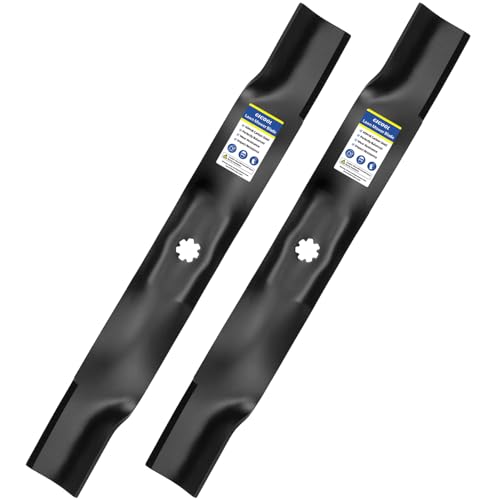
The GICOOL AM137327 high lift mower blades are a practical replacement option for John Deere 42-inch deck mowers. Designed to fit a wide range of models including the D100, E100, LA100, and Z225 series, these blades are a solid choice for homeowners looking to restore cutting performance without spending a fortune on OEM parts. Based on the product specs, they appear well-suited for regular lawn maintenance on suburban properties or larger yards.
In terms of cutting performance, the high-lift design is a key feature. It generates strong airflow to lift grass before cutting, which helps produce a cleaner, more even finish. This lift also improves bagging and side discharge efficiency, reducing the chance of clumps forming on the lawn. The blades are made from 40MnB steel, a material known for its toughness and edge retention, so they should hold up well through multiple mowing seasons with proper care.
Build quality seems solid for the price point. The blades measure 21.5 inches long, 2.67 inches wide, and 0.2 inches thick, with a 1.375-inch air lift. The 7-point star center hole matches John Deere's OEM pattern, ensuring a secure fit on the spindle. A rust-resistant coating is applied to the cutting edge, which may help during installation and early use, though it will wear off naturally as you mow. Overall, the construction appears durable enough for typical residential use.
Installation is straightforward—just remove the old blade and bolt on the new one. No special tools or modifications are needed, which is a plus for DIYers. Maintenance is minimal: keep the blades sharp and balanced, and check for wear periodically. For storage, they take up little space in a garage or shed. The 2-pack is convenient for those who want a spare or need to replace blades on a dual-blade deck.
One realistic limitation is that high-lift blades are optimized for bagging and discharge, not for mulching. If you prefer to mulch clippings for lawn nutrition, you might want to consider a dedicated mulching blade. Also, the coating will wear off during use, which is normal but might surprise some users expecting it to last longer. However, this doesn't affect cutting performance.
Overall, the GICOOL AM137327 blades are a reliable, budget-friendly option for John Deere owners. They deliver good cutting performance, easy installation, and broad compatibility. If you need to replace worn blades and want a product that offers OEM-like fit and function without the premium price, these are worth considering.

Pros
- Affordable price for a useful maintenance tool
- Easy to install on compatible mowers
- Helps prevent grass buildup that can lead to rust and poor cutting
- Fits a wide range of popular riding mower brands and models
Cons
- Compatibility is model-specific - you need to check your mower deck first
- May require additional adapter if your hose fitting is non-standard
- Some users report it can loosen over time and need retightening
If you own a riding mower or lawn tractor, you know how fast grass clippings can cake under the deck. That buildup not only looks messy but can also reduce cutting performance and lead to rust. The JEENDA Lawn Mower Deck Wash Connector is a simple solution - it's an attachment that lets you connect a garden hose directly to your mower deck for quick flushing. This product is ideal for any homeowner who wants to keep their equipment in good shape without spending a lot of time or money.
Based on the product specs, this connector is compatible with many popular brands including Cub Cadet, Craftsman, Husqvarna, John Deere, MTD, Troy-Bilt, and more. It's designed to replace original parts like 921-04041, 721-04041, and 532416405. The small green plastic and brass fitting hooks into an existing hole on the deck, and you simply attach a hose - turn on the water and let it rinse out the debris. Many users find this makes post-mowing cleanup much easier compared to scraping or using a pressure washer.
Build quality appears solid for a part in this price range. The connector uses a metal core with a plastic outer housing, which should hold up to normal garden hose water pressure and seasonal use. Of course, it's not indestructible - like any small part exposed to moisture and vibration, it may need occasional checking to make sure it hasn't loosened. But for under five dollars, it's an inexpensive way to add a handy maintenance feature to mowers that didn't come with one.
Installation is straightforward if your deck has the correct mounting hole. Most compatible mowers already have a threaded hole or a plug that you remove before screwing in the connector. You don't need any special tools - just hand tighten and you're ready. Some users recommend adding a bit of plumber's tape to ensure a snug, leak-free fit. Once installed, cleaning takes just a minute: attach the hose, turn on the water, start the mower (with blades engaged and on a flat surface), and let the water flush out clippings. Be sure to follow safety precautions - keep hands and feet away from the deck area.
A realistic limitation is that compatibility isn't universal. You need to check your mower's model and deck size against the list provided. Also, some decks may have a different design where this connector won't fit properly. If you're unsure, measuring your existing hole or consulting your owner's manual helps. A few users mention that the connector can vibrate loose after multiple uses, so periodic tightening is wise. Additionally, this only rinses the top and sides of the deck - it won't replace a thorough manual scraping if you have heavy caked-on debris.
Overall, the JEENDA Deck Wash Connector is a practical, low-cost accessory for anyone who wants to simplify lawn mower maintenance. If you have a compatible mower and you value keeping your deck clean for better cutting and longer life, this is a worthwhile addition. It's especially handy for those who mow frequently or deal with damp grass that tends to stick. For the price, it's a small investment that can pay off by reducing rust and improving mower performance over time.
Deeper Mower Decks: What Changes and What Does Not
A deeper mower deck can be beneficial in some conditions, but it isn’t universally better. Its extra chamber space may give clippings more room to circulate before they leave through the discharge opening, particularly when the deck’s blade and baffle arrangement are designed to work with that volume. The complete design matters, because a deep shell paired with unsuitable blades, restricted discharge, or insufficient power may still produce a poor result.
Deck depth is only one part of the cutting system
Deck depth describes the vertical dimensions of the cutting chamber, not how high the mower cuts or how wide a path it covers. Cutting height is set by the mower’s adjustment system, while cutting width is the distance covered by the blade or blades. Those dimensions are related to operation, but none can be substituted for another when comparing equipment.
The blade creates airflow as it rotates, and the deck’s internal shape guides that air and the clippings. Baffles, blade profile, discharge design, and the amount of grass entering the chamber all influence how material moves. A deck’s depth can provide space, but it cannot compensate for a damaged blade, poor fit, accumulated debris, or mowing conditions that overwhelm the system.
Manufacturers may describe decks using measurements or construction terms that aren’t directly comparable across brands. Check the specific mower manual or specification sheet for what its stated depth measures, how the deck is configured, and what blade types are approved. If no depth measurement is listed, don’t infer one from the appearance of a product photograph.
Why extra chamber space may help with clippings
Long or dense grass creates a greater volume of material for each blade to cut and move. When clippings fill the chamber quickly, they can be recut, discharged, or left in visible clumps depending on the mower’s design and the grass conditions. A chamber with more usable space may help material move through, but the benefit depends on the entire airflow path rather than depth in isolation.
Clippings that are too long for a single pass can burden any deck. Wet grass tends to stick and form mats, while dry, overgrown grass can still overwhelm the discharge path because of its volume. Reducing the amount cut in one pass, when the mower manual and lawn conditions allow, may be more effective than choosing a deeper deck solely to solve a recurring clog.
A deck also needs sufficient airflow to lift grass into a consistent cutting position and carry clippings toward the outlet. Blade condition, blade speed, and the engine or motor’s ability to maintain its specified operating speed are relevant. If grass is left unevenly cut, evaluate those factors as well as deck depth instead of assuming the shell needs to be taller.
When a deeper deck may not improve the finish
Depth is not a cure for every cut-quality problem. Dull or damaged blades, a deck that is out of level, incorrect cutting height, clogged passages, and inconsistent machine speed can all contribute to a poor finish. A bent component or worn spindle can also create problems that changing deck depth won’t address.
Deep grass is especially demanding because the blade must cut more material and the deck must move it away. If the grass is wet, tightly packed, or left too long between mowings, clumping may persist even with a roomy chamber. In those conditions, allow the surface to dry when practical, keep blades in serviceable condition, and follow the mower maker’s operating instructions.
Short, regularly maintained turf may not need the extra capacity a buyer hopes to gain from a deeper deck. A deck optimized for a particular mower and use can provide a suitable finish without being exceptionally deep. The useful question is whether the complete mower handles the grass, discharge, and cutting pattern expected on the property.
Deck depth does not determine cutting height or scalping
Scalping occurs when the blade cuts too close to the ground over a high spot or uneven section. The deck’s height setting, mower geometry, ground contours, and adjustment condition matter more directly than chamber depth. A deeper shell won’t keep the blade from contacting a rise if the cutting height and terrain don’t provide adequate clearance.
Check tire condition and pressure against the manufacturer’s recommendations before diagnosing a deck that appears tilted. Then inspect the deck and its adjustment points according to the owner’s manual. For broader context on maintaining a consistent cut over rough ground, consult this guide to mower choices for uneven terrain.
Cutting height and chamber depth should be assessed separately. The height setting determines how much grass remains, while the chamber shape influences how grass is handled after it enters the deck. A mower that leaves scalped patches may need an adjustment or a different mowing approach, not a deeper deck.
Blade compatibility matters more than appearance
Replacement blades must match the mower’s deck and spindle mounting, including the correct length, center-hole shape, and approved blade style. The supplied product information lists the GICOOL AM137327 High Lift Mower Blades for John as a replacement option for specified John Deere 42-inch deck mower models. Its listed dimensions include a 21-1/2-inch length and a seven-point star center hole, details that illustrate why visual similarity alone is not enough to confirm compatibility.
A high-lift blade’s profile is designed to move air differently from other blade types, but it doesn’t make every deck suitable for every grass condition. Confirm the mower’s model, deck, blade part numbers, and blade orientation in its documentation before purchasing or installing replacements. Don’t assume that a blade listed for one 42-inch deck will fit another deck just because the cutting widths match.
Blade maintenance also has safety risks. Before inspecting or changing blades, follow the mower manual’s shutdown procedure, prevent accidental starting by disconnecting the spark plug boot or removing the battery key as applicable, and use suitable gloves and eye protection. Use the specified replacement and fastening method, and don’t operate the mower with guards or discharge components removed.
Keep the underside clean without assuming a wash port fits
Grass buildup under the deck can interfere with the intended movement of clippings and make inspection harder. A deck wash connector may help with cleaning on a mower designed to accept that fitting, but it does not change the deck’s depth or correct a mechanical problem. Follow the manufacturer’s cleaning directions, since wash-port use and suitable cleaning methods vary by mower.
The JEENDA Lawn Mower Deck Wash Connector Hose is listed with part numbers including 921-04041, 721-04041, and 532416405 and compatibility information for various mower brands and models. That broad listing is not a substitute for checking the exact mower model and connector specification. Verify the part number and manual before ordering, because fitting compatibility should not be assumed from brand alone.
Two listings in the supplied product data use the same short product name but have different ASINs. Treat them as separate listings, not as proof that every connector is identical or that either one fits a particular mower without verification. If a wash fitting is incompatible, use the cleaning approach specified by the mower manufacturer rather than forcing a connection.
How to judge a deck for your lawn
Start with the grass and mowing pattern. Frequent cutting of relatively short grass places different demands on the deck than occasional mowing through tall, dense growth. Consider whether clippings need to discharge, mulch, or enter a bag, then check whether the mower’s approved blade and deck setup support that use.
Compare actual manufacturer specifications rather than relying on a general claim that deeper is better. Look for the deck dimensions the manufacturer publishes, the compatible blade options, any stated limitations, and the maintenance instructions. If depth isn’t specified, ask the seller or manufacturer for the relevant dimension instead of trying to estimate it from a picture.
Deck width is also distinct from overall machine width, which matters for storage and passing through access points. Don’t assume that a nominal cutting width describes the full mower’s transport footprint. Check the complete machine dimensions and any required discharge-deflector position in the manual before deciding that a model will fit through a gate or into a storage space.
Construction details can be useful, but the supplied product information here does not specify deck construction method, steel gauge, or chamber depth for a mower. It would be misleading to assign those properties to the listed accessories or use them to rank deck designs. Buyers should verify those details for the actual mower model under consideration.
Diagnose the symptom before replacing the deck
If the mower leaves clumps, first note whether the grass is wet, unusually tall, or being cut at a pace that keeps the deck full. Then inspect the discharge path and underside only after following the manual’s shutdown and isolation instructions. Persistent buildup can point to a cleaning or operating issue, but it does not establish that the deck is too shallow.
If the cut is uneven, look for visible blade damage and check whether the deck is level using the procedure and measurement points given by the mower maker. Avoid using a generic adjustment dimension because mower designs and specifications differ. If the deck is bent, a spindle is loose, or adjustment hardware is damaged, seek model-specific repair guidance before continuing to mow.
If the engine or motor slows under load, a deeper deck is not automatically the fix. Thick growth, a clogged deck, an incorrect blade, or another powertrain issue may be involved, and the product details provided here do not identify mower power ratings or deck capacities. Stop if the machine behaves abnormally and consult its troubleshooting instructions rather than pushing it beyond its stated operating limits.
Make the decision around the whole mower
A deeper deck is most promising when the mower’s design, blade configuration, discharge path, and power are intended to work together for the conditions being cut. It is less persuasive as a stand-alone specification or a fix for scalping, dull blades, clumping caused by wet grass, or poor adjustment. Those issues call for diagnosis of the relevant cause.
For a purchase, confirm the exact deck model and dimensions, supported blades, cutting-height range, and cleaning requirements in reliable documentation. For an existing mower, inspect the blade and deck condition, check adjustments using the manual, and consider how often the grass is cut and whether it is dry enough to mow. That evidence is more useful than judging deck depth by appearance alone.
The practical answer is that a deeper mower deck can help in a well-matched cutting system, but it is not inherently better for every lawn or mower. Since the supplied products are replacement blades and deck-wash connectors rather than complete mower decks, their listings cannot establish which deck depth is best. Verify the mower’s own specifications and match its blade and maintenance parts to the exact model before making a decision.





Write Your Review
No reviews yet. Be the first to share your experience!