


A riding mower that only clicks when you turn the key can make a quick jump seem like the obvious fix. The answer to can you jump a car with a lawn mower battery depends on what you mean: a 12-volt mower battery can sometimes provide a limited boost to a car, but it is generally not a practical donor for a car because mower batteries have much less starting capacity. A portable 12-volt jump starter designed for vehicles is the more suitable direction when the mower battery is dead.
For a 12-volt riding mower or zero-turn, a car can serve as a donor only with the car engine turned off. Running it can expose the mower’s stator and voltage regulator to damaging electrical conditions. Check voltage and cable polarity first, follow both manufacturers’ instructions, and stop if the battery is cracked, swollen, leaking, frozen, or unusually hot. Our riding mower battery guide offers more context on selecting a replacement when a jump only provides a temporary fix.
The products below are portable 12-volt jump starters, not replacement mower batteries. Their descriptions list lawn mower use, but that does not establish compatibility with every mower, engine, or battery condition. You will still need to confirm the equipment’s voltage, inspect the battery, and use the starter according to its manual. If the mower continues to discharge after a successful start, investigate the charging system rather than relying on repeated boosts.

Pros
- High 4000-amp peak current easily starts large lawn tractor engines up to 7.0L diesel
- Smart clamp technology prevents accidental sparks and reverse polarity—perfect for beginners
- Portable and lightweight at 1.64 pounds, easy to carry around the yard or store in a shed
- Doubles as a 16000mAh power bank to charge phones or Bluetooth speakers while mowing
Cons
- Zero customer reviews yet makes it hard to gauge real-world long-term reliability
- Only suitable for 12V systems—not compatible with older 6V lawn equipment
- Jump start cable length may be short for some riding mower battery placements
The BOOKOO 4000A jump starter is a versatile power tool designed for homeowners who need a reliable way to start a dead riding mower, lawn tractor, or other 12V outdoor equipment. Unlike traditional jumper cables that require a second vehicle, this compact booster pack lets you handle the job solo—no need to drag out another machine or wait for help. It’s especially useful for those with larger lawns who rely on a tractor or zero-turn mower for weekly cutting.
With a claimed 4000 peak amps, this unit can jump start engines up to 8.0L gas or 7.0L diesel, which covers almost any residential riding mower or lawn tractor on the market. The smart clamps include multiple safety protections—short circuit, over-current, reverse polarity, and spark-proof—so even if you’re not mechanically inclined, you can connect it confidently. According to the product description, it works in temperatures from -4°F to 149°F, meaning it’s ready for early spring frosts or summer heat waves.
Beyond jump starting, the 16000mAh internal battery serves as a high-capacity power bank. You can charge your smartphone, tablet, or even a Bluetooth speaker while working in the yard. This eliminates the need to carry separate chargers for your electronics. The built-in LED flashlight with strobe and SOS modes adds emergency lighting for early morning or late evening lawn tasks.
Build quality appears solid for the price point. The shell is rated waterproof and dustproof, which is a big plus for outdoor storage in a damp garage or shed. The included EVA carrying case offers extra protection against bumps and scratches. At just 1.64 pounds, it’s lightweight enough to toss in a mower’s glovebox or hang on a hook near the workbench.
One limitation is the lack of customer reviews—this is a newer product, so long-term reliability is unproven. Also, the jumper cable length may be short for some mowers where the battery is tucked away in a hard-to-reach spot. It’s only designed for 12V systems, so it won’t work on older 6V equipment. But for modern gas riding mowers, lawn tractors, and even ATVs or boats, it’s a practical investment.
If you’re tired of dealing with dead batteries on your mower and want a single tool that also charges your devices and provides emergency light, the BOOKOO 4000A jump starter is worth considering. It’s affordable, portable, and packed with safety features that make it easy for any homeowner to use. Just keep in mind that without user reviews, you’re relying on the manufacturer’s specs and warranty support.
For riding mowers and lawn tractors, battery drain is a common issue—especially after winter storage or when the mower sits unused for weeks. The BOOKOO 4000A jump starter is designed to handle these situations. Simply connect the smart clamps to the battery terminals (red to positive, black to negative), and the unit automatically detects polarity. If you accidentally reverse the clamps, the built-in protection prevents sparks and damage.
Once connected, the unit delivers a burst of power to crank the engine. Most residential mowers with 12V batteries will start within seconds. The 16000mAh capacity allows up to 20 jump starts on a single charge, so you can help neighbors or tackle multiple machines. After use, recharge the booster via the USB-C port—it takes a few hours with a standard wall adapter.
Because the unit is waterproof and shockproof, you can keep it in the mower’s storage compartment or in a tool shed without worrying about moisture. The included carrying case adds extra protection. For homeowners who also own a snow blower or generator, this jump starter works on any 12V engine, making it a versatile addition to your outdoor power equipment toolkit.
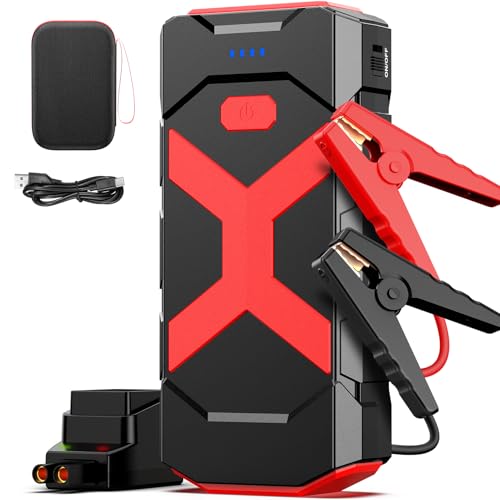
Pros
- High peak current (4000A) easily starts large engines including lawn mowers, trucks, and boats.
- Large 20000mAh battery capacity offers multiple device recharges and many jump starts before needing a recharge.
- Water resistant (IP66) and works in extreme temperatures, making it reliable in various weather conditions.
- Includes a hard carrying case and smart clamps with safety features for easy and safe operation.
Cons
- Weight of 1.93 pounds may be slightly heavier than some ultra-portable models.
- USB output max 5V/3A may charge larger tablets slower than dedicated chargers.
- Some users might prefer a model with built-in AC outlet for powering small appliances.
The BOOKOO A9 is a versatile 4000A jump starter that goes beyond just reviving dead car batteries. It is designed to handle a wide range of engines, including those in lawn mowers, garden tractors, riding mowers, boats, and more. This makes it a practical tool for homeowners with outdoor power equipment, as well as for anyone who wants a reliable emergency power source for their vehicle. Its compact size and included storage case mean it can live in your garage or car glove box, ready when you need it.
In terms of performance, the 4000A peak current is more than enough for most gasoline engines up to 12L and diesel up to 10L. Based on product specifications, it can start a dead battery in seconds, even in extreme temperatures from -4°F to 149°F. The 20000mAh capacity is generous, allowing for up to 50 jump starts per charge, plus it can recharge your smartphone, tablet, or other USB devices multiple times. This dual functionality makes it a handy power bank for camping, tailgating, or everyday use.
Build quality appears solid with a rugged exterior and an IP66 water resistant rating, meaning it can handle rain, snow, and dust. The smart jumper clamps include 10 safety protections such as reverse polarity, over-current, and short circuit prevention, which is reassuring for first-time users. The included hard carrying case keeps everything organized and protects the unit from bumps and scratches.
Setup is straightforward: connect the smart clamps to your battery, and the unit will indicate correct polarity. The built-in 400LM LED flashlight with flash, strobe, and SOS modes adds extra utility for nighttime emergencies or outdoor activities. The jump starter itself recharges via Type-C input, and the dual USB outputs (including Quick Charge 3.0) let you power up devices quickly. Maintenance is minimal—just keep it charged and store it in a dry place.
One realistic limitation is its weight of 1.93 pounds, which is slightly heavier than some ultra-portable models, though still easy to carry. The USB output maxes out at 5V/3A, so charging larger tablets may take a bit longer. Also, it does not include an AC outlet, so it won't power small appliances directly. However, for its intended purpose as a jump starter and power bank, these are minor trade-offs.
Overall, the BOOKOO A9 is a solid choice for homeowners who own lawn mowers, tractors, or other outdoor equipment with batteries. It is also great for anyone who wants a dependable jump starter for their car, boat, or RV. With a 24-month warranty and lifetime technical support, it offers good value for the price. If you need a versatile, weather-resistant power source that can handle multiple tasks, this is worth considering.

Using a Car or Booster to Start a 12-Volt Mower
A car battery can provide a jump to many 12-volt riding mowers, but the donor car’s engine must remain OFF throughout the connection and starting process. That precaution helps protect the mower’s stator and voltage regulator from possible electrical damage. A typical lawn mower starter battery is not a sensible donor for starting a car: it is designed for a smaller engine, and its available cranking capacity may not be enough. For jump-starting a car, use a vehicle battery or a portable booster specified for that application.
Small walk-behind mowers commonly use a pull cord or a proprietary cordless battery and are not equivalent to a 12-volt riding mower starting circuit. This discussion applies to equipment whose manual specifies a 12-volt starter battery. Do not connect a car or 12-volt booster to a 40V, 56V, 60V, or 80V cordless mower pack. Those platforms use different battery systems, and an improvised connection can damage the pack or tool.
Why the car engine stays off
With the car engine off, its battery can supply electrical energy without the alternator actively charging the connection. Starting the donor vehicle changes the electrical conditions and may expose sensitive mower charging components to voltage fluctuations. The mower’s stator and regulator are not designed to be treated as an automotive charging system. Keeping the donor engine off is a central safety condition, not an optional refinement.
A portable jump starter avoids using a second vehicle, but it still has to match the mower’s 12-volt system and be used as its maker directs. Product descriptions for the BooKoo options here explicitly mention lawn mowers, yet they do not identify every mower model or establish a fit for every battery fault. Check the jump starter’s instructions for connection points and any required operating mode. Never assume that a high advertised peak-current figure overrides the mower or booster manual.
Check the battery before connecting a donor
Do not jump a battery that is visibly damaged, leaking, swollen, frozen, or giving off an unusual odor. A lead-acid battery can release flammable gas, so keep flames, smoking materials, and sparks away from it. Wear eye protection and acid-resistant gloves when inspecting or handling a lead-acid battery, and follow its safety label and the mower manual. If you cannot determine whether the battery is safe, stop and seek qualified help.
Park equipment securely, set the parking brake, switch off the ignition, and disengage the mower blades before beginning. Keep clothing, hands, and tools clear of moving parts. Inspect the battery case, terminals, cables, and ground connection for corrosion, looseness, or visible damage. A poor cable connection can imitate a weak battery, so a jump may fail to address the real problem.
Connecting Safely and Interpreting the Result
Polarity and connection sequence matter
Identify positive and negative markings on both batteries before attaching any clamps. Connect positive to positive and negative to negative only as directed by the mower and donor or booster manuals; do not infer polarity from cable color alone. Reverse polarity can damage fuses, wiring, and electrical components. If the terminals are dirty or hidden, stop and confirm their markings rather than guessing.
For a car-to-mower jump, the car remains off. Follow the exact clamp order and designated grounding point in both manufacturers’ instructions, since procedures can vary by equipment and battery arrangement. Keep clamps from touching one another or metal surfaces in a way that could cause a short. Do not improvise a ground point or place a clamp near battery vents unless the manual identifies that location.
For removal of a mower battery cable during inspection, disconnect the negative cable first to reduce the chance of a tool bridging the positive terminal to the chassis. When reinstalling battery cables, connect positive first and negative last, while maintaining correct polarity. Those removal and installation sequences are not a substitute for the jump starter’s own clamp instructions. Consult the equipment manual if access or terminal layout makes the connection order unclear.
Attempt the start without repeated cranking
Once the approved connections are in place, use the booster or donor arrangement only for the interval and number of attempts permitted by its manual. Do not hold the mower key in the start position continuously or make repeated long attempts. Starter motors and cables can heat under sustained load, and repeated cranking may further discharge a weak battery. If the engine does not turn over promptly, stop and inspect the connections rather than increasing the duration.
A successful start shows that the mower received enough current to crank; it does not prove the installed battery is healthy or that the charging system works. Remove the clamps in the sequence specified by the manuals, keeping them separated from metal and each other. Do not leave a booster attached while mowing unless its instructions explicitly allow that use. A portable starter is an emergency aid, not an onboard replacement battery or charger.
What clicking or silence can tell you
Rapid solenoid clicking often occurs when voltage falls under starter load, but it does not identify the failed part by itself. A discharged battery, corroded terminal, loose ground, damaged cable, or starter-circuit fault can produce similar symptoms. A single click or complete silence also leaves several possible causes, including a solenoid, ignition circuit, fuse, or safety switch. Do not bypass seat, brake, or blade interlocks to test the mower.
If a correctly connected booster makes the engine crank normally, the original battery or its connections deserve attention, but the result is not a definitive battery test. If the starter remains sluggish, inspect visible cable condition and terminal security, then have the battery and starting circuit tested. A jump does not diagnose a seized starter, internal engine problem, faulty solenoid, or safety circuit issue. Stop if cables heat, smoke, spark unexpectedly, or the battery changes appearance.
Voltage Checks That Separate a Weak Battery from a Charging Fault
Read resting voltage before deciding to replace it
A digital multimeter can provide a useful first check on a conventional 12-volt lead-acid mower battery. With the mower off and the battery isolated from charging or recent use long enough for its reading to settle, set the meter to DC volts and place the probes on the matching terminals. A fully charged battery commonly rests around 12.6V to 12.8V. A reading near 12.2V indicates substantial discharge, while a value below 10.5V can point to a failed or shorted cell.
These readings are screening benchmarks, not a complete capacity or load test. A battery can show an acceptable resting voltage and still collapse when the starter demands current. Conversely, a low reading can reflect discharge rather than permanent failure. Follow the battery maker’s charging guidance and use a compatible charger; do not apply a high-current automotive charger without confirming its voltage profile and current limits suit the mower battery.
For a cranking check, observe meter behavior while the starter is engaged only if the manual and safe access permit it. A substantial voltage drop can support the suspicion of a weak battery or high-resistance connection, but readings must be interpreted with battery condition, temperature, and equipment specifications in mind. A commonly used general benchmark is that a 12-volt battery should remain above about 9.6V under cranking load, but this does not replace the mower manufacturer’s specification or a proper load test. Avoid holding probes where moving parts or exposed conductors could contact them.
Check charging output after the mower starts
If the mower starts with a jump but the battery repeatedly goes flat, the underlying issue may be a charging fault or an electrical drain. With the mower operating as its manual specifies, charging output is commonly checked at the battery with a meter. A general reference range is about 13.5V to 14.5V DC at full operating throttle, but the exact procedure and acceptable values depend on the mower. Do not reach near the deck, belts, or other moving parts while taking a reading.
A reading outside the expected range is a reason for further diagnosis, not proof that a particular stator or regulator has failed. Loose connectors, damaged wiring, grounds, or a defective component can affect the result. Use the model-specific service information for stator and regulator testing, especially when measurements require access to live circuits. A repair shop can perform controlled testing if the connections are difficult to reach safely.
When voltage rises within the mower’s specified range but the battery still loses charge while parked, investigate parasitic draw or battery condition. A stuck accessory, wiring fault, or aging battery may be involved, but identifying the cause requires circuit-specific checks. Do not disconnect random wires with the engine running or probe unknown connectors. A repeating discharge after storage is a reason to diagnose the electrical system before buying another battery.
Choosing a Portable Booster for Mower Emergencies
The listed BooKoo jump starters are portable lithium booster packs with 12-volt starting claims and product descriptions that name lawn mowers. The first option lists a 4000A peak rating and 16000mAh capacity, while the A9 lists 4000A and 20000mAh. The H5 lists a 6000A peak rating and 24000mAh capacity, along with a large LCD and multiple outputs. Those are manufacturer-listed specifications, not independent confirmation that a specific mower will start under every condition.
Capacity figures and peak-current ratings are not interchangeable with the mower battery’s Cold Cranking Amps (CCA), nor do they confirm compatibility with a particular engine. Check the booster manual for the supported battery voltage, connection method, operating limits, and charge state before use. The H5 description says to have its charge above 50% before starting and to recharge it every three months during extended storage. Follow the current product instructions because model guidance can change.
Portability, case storage, a display, USB outputs, and a flashlight may be useful extras, but they should not outweigh basic fit for the intended emergency. Consider whether the pack is easy to keep charged, whether its clamps reach the mower battery safely, and whether its manual covers your type of equipment. Do not treat water-resistance statements in a product listing as permission to connect or charge a wet unit. Keep the booster and clamps dry and inspect them before use.
A booster is especially useful when a mower’s battery is temporarily low, but it cannot restore damaged plates or correct a failed charging system. If it starts the mower once and the same problem returns, diagnose the battery and circuit instead of buying a higher advertised peak-current model by default. If a replacement is needed, match the mower manufacturer’s voltage, group size, terminal orientation, and starting requirements. A portable pack and an installed starter battery serve different roles.
Battery Fit, Storage, and the Next Diagnostic Step
Replacement fit matters because many riding mowers use a compact battery compartment and short cables. BCI Group U1 and U1R batteries differ in positive-terminal position, so a battery with the wrong layout may leave factory cables unable to reach or encourage a dangerous cross-connection. Confirm the mower label, owner’s manual, terminal markings, hold-down, and cable reach before purchase. Do not assume that all batteries described as U1 are interchangeable in a particular installation.
Physical terminals also vary, including bolt-through or flag-style connections and other post designs. A terminal that does not match the cable end can create a loose or improvised connection, which may heat or interrupt starter current. Verify that the hold-down secures the battery without pressing on the case or cables. If the layout is unclear, compare the old battery and mower documentation rather than relying on a generic listing.
Winter storage can leave a lead-acid battery discharged, and a deeply discharged battery may suffer sulfation that reduces its ability to accept or retain charge. A battery maintainer designed for the battery chemistry and voltage can help maintain charge when used according to its manual. An unregulated charger left connected without monitoring may overcharge a battery. Disconnecting or maintaining the battery for storage should follow the mower and battery instructions, including safe cable handling.
When removing a lead-acid battery, wear eye protection and acid-resistant gloves, keep the work area ventilated, and disconnect the negative lead first. Reinstall by connecting the positive lead first and the negative lead last, with the polarity verified. Keep metal tools from bridging terminals, and do not clean a leaking or damaged battery yourself. Use an appropriate local battery recycling or retailer return program for a battery that must be replaced.
For additional context on fit, see this guide to mower battery compatibility and sizing. A jump can be a reasonable temporary way to start a compatible 12-volt riding mower, provided the equipment is safe to connect and the donor car engine stays off. It cannot make a weak battery healthy or repair a defective charging circuit. Confirm the cause with voltage and charging checks, then replace only a battery that fails appropriate testing.





Write Your Review
No reviews yet. Be the first to share your experience!