


A battery that seems dead after storage may need a careful charge, but the correct method depends on whether your Honda mower uses a removable lithium-ion pack or a 12-volt starting battery. The phrase how to charge a honda lawn mower battery can describe either system, and their chargers are not interchangeable. Honda’s listed electric walk-behind models use lithium-ion packs with dedicated chargers, while a conventional riding mower starter battery requires a charger matched to its chemistry and voltage. Using the wrong charger can damage a battery or create a safety hazard.
Start by identifying the mower and reading its battery and charger labels. Honda lists a standard charger for its DP50120 pack and a separate fast charger, with different stated charge times; those figures apply to that battery system, not to a 12-volt AGM or flooded battery. If you’re also sorting out replacement fitment, our guide to mower battery compatibility explains why voltage, connector design, and case fit matter. This distinction helps prevent a slow-starting gas mower from being treated like a cordless mower with a removable high-voltage pack.
Top Products

Pros
- Reliable patented connection reduces vibration and shifting during use
- Decent runtime of 45 minutes covers typical suburban lawn sizes
- Clear 4-LED battery indicator for easy charge monitoring
- Strong 3-year residential warranty backs the product
Cons
- High price point compared to some aftermarket batteries
- Standard charge time is long (over 6 hours) without the optional fast charger
- Only compatible with Honda electric lawn mowers, limiting versatility
The Honda DP50120 12Ah lawn mower battery is a dedicated replacement battery for Honda electric mowers, designed for homeowners who already own a compatible Honda mower and want a reliable power source. This lithium-ion battery is built to deliver consistent performance for small to medium lawns, making it a practical choice for suburban yards and apartment dwellers with modest grass areas.
Based on product specifications, this battery offers up to 45 minutes of run time per charge, which translates to roughly 0.37 acres depending on mowing conditions. That's enough for most typical residential lawns without needing a mid-mow recharge. The patented connection system uses a ribbed notch and spring-loaded connector to keep the battery firmly in place during operation, preventing wobble or shifting that could interrupt power delivery. This design feature is a clear advantage over generic batteries that may fit loosely.
Build quality appears robust, with a lithium-ion construction that is lightweight at 9.6 pounds yet durable. The 4-LED indicator is a thoughtful touch, letting you check remaining charge with a quick press of a button. Charging is straightforward with the included standard charger, though it takes 370 minutes for a full charge. For those who need faster turnaround, Honda offers an optional fast charger (CV5080N1U) that cuts charge time to 90 minutes.
Setup is simple – the battery slides into the mower's compartment and clicks into place. No tools required. Storage is easy as well, since the battery can be removed and stored indoors during winter or off-season. The 3-year residential warranty (2-year commercial) adds peace of mind, especially for a product in this price range.
One realistic limitation is the price: at $599, this battery is a significant investment. It's also only compatible with Honda electric mowers, so it's not a universal solution. Additionally, the standard charge time may be inconvenient for users with larger lawns who need multiple charges in a single session.
Overall, the Honda DP50120 is a solid choice for existing Honda electric mower owners who want a genuine replacement battery with proven reliability and a strong warranty. If you value consistent performance and a secure connection, this battery is worth considering – just be prepared for the premium cost and plan your charging schedule accordingly.
The Honda DP50120 is a 12Ah lithium-ion battery that delivers up to 45 minutes of run time per full charge. According to the manufacturer, this covers about 0.37 acres of mowing under typical conditions. The battery uses a patented connection system that minimizes movement during operation, which helps maintain consistent power and prolongs battery life.
The 4-LED indicator on the battery makes it easy to see the charge level at a glance – just press the capacity button. This is handy for planning your mowing session and avoiding unexpected shutdowns.
The battery comes with a standard lithium battery charger (model CV5020N1A) that fully charges the DP50120 in about 370 minutes (just over 6 hours). For users who need quicker turnaround, Honda offers a fast charger (CV5080N1U, sold separately) that reduces full charge time to just 90 minutes. This is a significant upgrade for those with larger lawns or who want to minimize downtime between mowing sessions.
Charging the battery is simple: connect the charger to a standard household outlet and plug it into the battery. The LED indicator shows charging status. It's recommended to store the battery in a cool, dry place when not in use.
The Honda DP50120 battery is specifically designed for Honda electric lawn mowers. It is not compatible with other brands or gas-powered mowers. Before purchasing, verify that your Honda mower model accepts this battery – typically models that use the DP50120 series.
Honda backs this battery with a 3-year residential warranty, covering defects in materials and workmanship. There is also a 2-year warranty for commercial use. This warranty is a strong indicator of the product's expected durability and reliability.
Pros
- Very fast charging times—60 minutes for 8Ah and 90 minutes for 12Ah batteries.
- Wall-mountable design saves space and keeps the charger organized in the garage or shed.
- Clear LED indicator shows charging status, so you never have to guess if the battery is ready.
- Lightweight and portable, making it easy to move or store as needed.
- Strong 3-year warranty covers both residential and commercial use.
Cons
- Only works with specific Honda batteries (DP5080 and DP50120), so it won't charge other brands or models.
- Requires a dry indoor location for mounting, which may not be convenient for everyone.
- At $179, it's a premium-priced charger compared to generic alternatives, but it offers Honda-specific reliability.
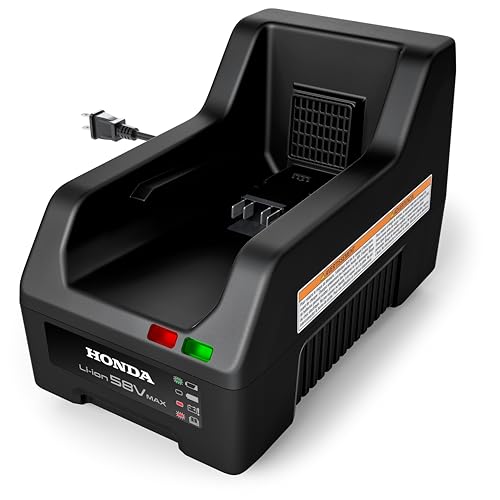
If you own a compatible Honda electric lawn mower, the CV5080N1U battery charger is a purpose-built accessory that promises fast, reliable charging. This charger is designed specifically for Honda's DP5080 (8Ah) and DP50120 (12Ah) batteries, making it an ideal companion for homeowners who want to keep their mower running without long downtimes. It's a practical choice for suburban lawns or small to medium-sized yards where quick battery turnaround matters.
Performance-wise, the charger delivers 58.8V at 8A current, which can fully charge an 8Ah battery in about 60 minutes and a 12Ah battery in 90 minutes. That's a significant speed advantage over many standard chargers, especially if you have multiple batteries and need to rotate them during a big mowing session. The patented connection ensures a snug fit, which may help maintain consistent charging and prolong battery life according to the manufacturer.
Build quality feels solid for a charger in this price range. The unit is enclosed in a durable plastic housing, and the included wall-mount bracket lets you secure it in your garage or shed. The LED indicator is straightforward—green when charging, off when done—so you can check the status without fumbling. Weighing only 6.6 pounds, it's light enough to move if needed, but the wall-mount installation is meant to be semi-permanent.
Setup is simple: mount the bracket, plug in the charger, and attach the battery. There's no complicated assembly or software. The 3-year residential and commercial warranty adds peace of mind, especially for those who use their mower frequently. For daily maintenance, keep the charger in a dry area and wipe it down occasionally—no special care required.
However, there are limitations. This charger only works with the two specific Honda batteries, so if you have other cordless tools or batteries from different brands, you'll need separate chargers. Also, the price point is higher than generic chargers, but the fast charging and Honda-specific design may justify the cost for dedicated users. Some homeowners might find the need for a wall-mount location inconvenient if they have limited garage space.
Overall, this charger is a worthwhile investment for Honda electric mower owners who want to maximize uptime and convenience. It's not for everyone—if you're on a strict budget or have multiple battery ecosystems, alternatives might be better. But for those who value fast charging and a reliable, brand-specific solution, the CV5080N1U delivers on its promises.
This charger is engineered for speed: 8A current at 58.8V means it can replenish a depleted 8Ah battery in just one hour, while a 12Ah battery takes about 90 minutes. That's noticeably faster than many standard chargers (often 2-4A), which can take 3-5 hours for a full charge. The proprietary connection ensures a stable electrical contact, which may reduce charging errors and improve overall battery health over time.
The LED indicator is simple: green while charging, off when done. There's no flashing or error codes, so it's easy to check at a glance. The charger also has built-in protection against overcharging, short circuits, and overheating, which is important for safety and battery longevity. For homeowners who mow a medium-sized lawn with a single battery, this charger can have the battery ready for a second pass or a quick trim.
The charger's design prioritizes practical storage. It comes with a wall-mounting bracket that can be screwed into a wall stud or drywall anchor, keeping the charger off the floor and out of the way. The unit itself is compact (about 6.6 pounds) and has a flat back that sits flush against the bracket. The cable is a standard AC power cord, and the battery connector is a custom Honda plug.
Build quality is typical for Honda accessories—durable plastic with a matte finish that resists scratches. The vents are on the sides to allow airflow during charging. There's no fan, so it operates silently. The LED is bright enough to see from across the garage. Overall, it feels like a premium product designed for long-term use in a home or commercial setting.
Honda backs this charger with a 3-year warranty that covers both residential and commercial use. This is a strong warranty period, especially for a charger that may see daily use in a landscaping business. The warranty covers defects in materials and workmanship, but not damage from misuse or improper installation. For support, Honda's customer service is generally responsive, and replacement parts are available through authorized dealers.
It's worth noting that the warranty is only valid if the charger is used with compatible Honda batteries. Using it with third-party batteries could void coverage. Still, for a product in this price range, the 3-year warranty adds significant value and peace of mind.

Pros
- Honda motor reliability translates to consistent performance and longevity.
- MicroCut twin-blade system provides excellent mulching and bagging quality.
- Variable speed self-propelled drive makes mowing effortless on various terrains.
- Seven height adjustments offer versatility for different grass types and seasons.
Cons
- 30-minute runtime may not be sufficient for lawns larger than 1/4 acre.
- Additional battery purchase is required for extended mowing sessions.
- Battery-powered mowers may have less pulling power than comparable gas models in very thick grass.
The Honda HRN-BV is a battery-powered self-propelled lawn mower that brings the brand's renowned gas engine expertise to the electric market. It's designed for homeowners with small to medium-sized lawns—up to about a quarter acre—who want the reliability of a Honda without the emissions and maintenance of a gas engine. With a 21-inch cutting deck and a twin-blade MicroCut system, this mower aims to deliver the same cut quality as its gas counterparts.
In terms of performance, the MicroCut system uses four cutting surfaces to finely chop clippings, which is ideal for mulching. The clippings are returned to the lawn as natural fertilizer, reducing the need for bagging. For those who prefer to collect clippings, the 1.9-bushel grass bag is easy to remove and empty. The Smart Drive variable speed control allows you to adjust the mower's speed from 0 to 3.8 mph, so you can match your walking pace comfortably. The dual-lever height adjustment system offers seven cutting heights between 1 and 4 inches, giving you precise control over grass length.
Build quality is a highlight of the Honda HRN-BV. Honda is known for durable construction, and this mower is no exception. The deck is robust, and the components are designed to withstand regular use. The 8Ah lithium-ion battery is housed securely and provides up to 30 minutes of runtime per charge. The mower also features safety mechanisms like a blade control button and automatic shutoff if the blade is inactive for three minutes, which adds peace of mind.
Setup is straightforward—the mower comes mostly assembled, and you just need to attach the grass bag and charge the battery. Maintenance is minimal compared to gas mowers: no oil changes, no spark plugs, and no fuel mixing. The foldable handle design helps with compact storage in a garage or shed. The included wall bracket for the charger is a nice touch for keeping the battery organized.
However, the 30-minute runtime is a limitation for larger properties. If your lawn is more than a quarter acre, you'll likely need a second battery to complete the job. The 8Ah battery is decent, but a 12Ah option is available separately for longer runtime. Also, while the motor is powerful for a battery mower, it may struggle in very thick or wet grass compared to a gas mower.
Overall, the Honda HRN-BV is a solid choice for homeowners with small to medium lawns who prioritize brand reliability, excellent mulching, and ease of use. It's an eco-friendly alternative to gas mowers without sacrificing cut quality. If you have a larger lawn or need extended runtime, consider investing in the larger battery or looking at Honda's gas models.
The Honda HRN-BV features a 21-inch steel deck with a twin-blade MicroCut system. This design uses four cutting surfaces to create ultra-fine clippings that are ideal for mulching. The clippings are small enough to decompose quickly, returning nutrients to the soil. The sliding Clip Director allows you to switch between mulching, bagging, and side discharge without stopping. The dual-lever height adjustment is easy to use and offers seven settings from 1 to 4 inches, so you can handle different grass types and seasons. Based on the product description, this mower is designed to maintain RPMs under load, similar to Honda's gas engines, ensuring consistent cut quality even in tough conditions.
The Honda HRN-BV comes with an 8Ah lithium-ion battery that provides up to 30 minutes of runtime, which is enough to mow about a quarter acre per charge, depending on grass conditions. The battery is charged with a standard 2A charger, which takes a few hours to fully recharge. A wall bracket is included for convenient storage of the charger. For those with larger lawns, a 12Ah battery is available separately, which can extend runtime significantly. The battery system is designed to be durable and long-lasting, and Honda offers a nationwide service network for support. It's important to note that runtime can vary based on grass thickness, terrain, and speed settings.
Pros
- High 230 CCA ensures reliable cold starts for lawn equipment in chilly mornings.
- AGM and SLA technology is completely maintenance-free – no need to add water.
- Sealed, spill-proof case can be mounted in any orientation, perfect for tight engine compartments.
- Vibration-resistant construction stands up to the bumps and jolts of mowing uneven ground.
Cons
- May require checking dimensions – not a universal fit for all riding mowers or lawn tractors.
- No wire harness or mounting brackets included – you may need to reuse your existing hardware.
- Some users report that the terminal orientation (positive on left) may not match every mower model.
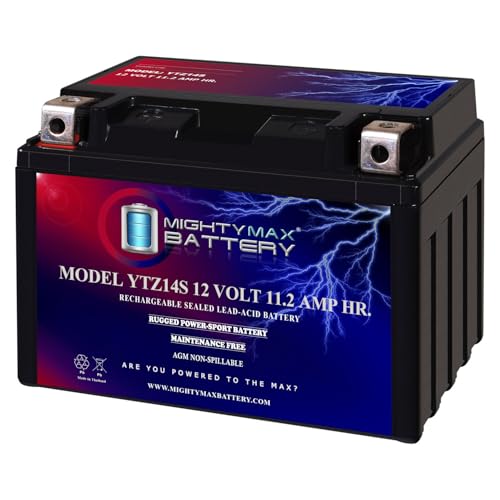
If you own a riding mower, lawn tractor, or zero-turn mower, you know the frustration of a battery that won't hold a charge or struggles in cooler weather. The Mighty Max Battery YTZ14S is a 12-volt, 11.2Ah sealed lead-acid (SLA) AGM battery designed to deliver 230 cold cranking amps (CCA) – enough to reliably start most residential lawn equipment. This battery is a direct replacement for many OEM batteries used in brands like John Deere, Husqvarna, Craftsman, and Troy-Bilt, making it a practical choice for homeowners looking to get their mower back in action.
In real-world use, the high CCA rating helps the engine turn over quickly even on brisk spring mornings or after the mower has sat in the garage all winter. The AGM (Absorbent Glass Mat) technology means the electrolyte is absorbed into fiberglass mats, so the battery is completely spill-proof. You can mount it sideways or even upside-down if needed, which is handy when the original battery tray is awkwardly positioned. The vibration-resistant construction also helps it withstand the constant shaking from mowing bumpy lawns or navigating rough terrain.
Build quality appears solid based on the specifications: a durable black case with threaded brass inserts for the terminals. The terminals are positive on the left and negative on the right, which matches many common lawn tractor layouts – but always double-check your mower's orientation before ordering. At 7.5 pounds, it's light enough to handle easily during installation. The battery ships with screws only, so you'll need to reuse your existing cables and any mounting brackets or hold-downs from your old battery.
Setup is straightforward if you have basic mechanical skills. Simply disconnect the old battery (negative first), remove it, place the new Mighty Max battery in the tray, secure it with your original hardware, and connect the cables (positive first). No filling with acid or initial charging is required – it comes fully charged and ready to use. Maintenance is zero: no watering, no cleaning of corrosion if the terminals are kept tight. For seasonal storage, a trickle charger can help maintain the battery over winter, though the AGM design handles discharge better than standard flooded batteries.
A realistic limitation is that the YTZ14S may not fit every mower model. Always measure your battery compartment – the dimensions are 6.00 x 3.44 x 4.38 inches. Some larger lawn tractors with higher CCA requirements may need a bigger battery. Also, because it's an SLA battery, it is heavier than some lithium options, but the trade-off is lower cost and proven reliability. There is no wiring harness included, so if your original cables are damaged, you'll need to source replacements separately.
Overall, the Mighty Max Battery YTZ14S is a solid, budget-friendly replacement battery for riding mowers and lawn tractors that require a 12V AGM battery. Its maintenance-free operation, high CCA, and spill-proof design make it a convenient upgrade for homeowners who want reliable starts without the fuss. If you measure your battery box and confirm the terminal orientation, this battery can get you back to mowing with confidence.

Pros
- Honda motor delivers reliable, powerful performance comparable to gas models
- Versamow system lets you switch between mulching, bagging, and leaf shredding instantly
- Expandable battery system – add a second battery for longer runtime on larger lawns
- Smooth, adjustable self-propelled drive reduces effort on slopes and thick grass
- 5-year residential warranty reflects long-term durability and manufacturer confidence
Cons
- Higher price point compared to many battery mowers, though justified by Honda build quality
- Heavier than some electric competitors at 99 pounds, which might be cumbersome for some users
- Only one 12Ah battery included – a second battery is needed to mow lawns larger than 0.37 acres
The Honda HRX-BE is a battery-powered walk-behind mower designed for homeowners who want the performance of a gas engine without the noise, fumes, and maintenance. This 21-inch self-propelled model is part of Honda's trusted HRX lineup, now available in a cordless electric version. It's best suited for small to medium-sized lawns (up to about 0.37 acres per charge) and for eco-conscious users who still demand premium cut quality.
Based on product specifications, the HRX-BE's motor delivers power comparable to Honda's GCV series gas engines, maintaining high torque even in thick or wet grass. The Versamow system with Clip Director lets you switch between mulching, bagging, and side discharge without any tools – a huge convenience for seasonal yard changes. The twin-blade MicroCut system uses four cutting surfaces to produce very fine clippings, which helps with natural lawn fertilization and reduces the need for bagging. The 2.2-bushel grass bag is easy to remove and empty, though some users might prefer a larger capacity for extra-large lawns.
Build quality reflects Honda's reputation for durability. The deck feels solid, and the components are designed to withstand regular use. Unlike many budget battery mowers, this model is fully supported by Honda's nationwide service network, with replacement parts readily available. The 5-year residential warranty is generous and covers most components, giving owners confidence in their investment. However, at 99 pounds, it's heavier than many electric mowers, so consider that if you need to lift it into a truck or over obstacles.
Setting up the HRX-BE is straightforward: the handle folds for storage, and the battery charges in a few hours. The e-Select Drive self-propelled system is a standout – a simple button lets you adjust speed from 0 to 4 mph, making it easy to match your pace. The dual-lever height adjustment offers seven cutting heights from 0.75 to 4 inches, useful for different grass types and seasons. Automatic shutoff and blade safety features add peace of mind, especially for families.
Realistic limitations include the price – at $999, it's a premium option in the battery mower market. The included 12Ah battery provides about 45 minutes of runtime, which may not be enough for larger lawns without buying a second battery (sold separately). Also, some users might find the mower a bit bulky for very small yards or tight storage spaces.
Overall, the Honda HRX-BE is an excellent choice for homeowners who want a reliable, powerful, and eco-friendly mower with proven engineering. It's especially suitable for those who value superior cut quality, convenience features, and long-term support. If you have a medium-sized lawn and are willing to invest in quality, this mower should deliver years of satisfying service.
The HRX-BE comes with one 12Ah lithium-ion battery, which provides up to 45 minutes of runtime – enough to mow about 0.37 acres on a full charge. The mower has two battery bays, so you can add a second 12Ah battery (sold separately) to double the runtime to 90 minutes, covering larger lawns. Charging takes approximately 4-5 hours with the included standard 2A charger, and the battery is removable for convenient indoor charging. Many homeowners may appreciate that the battery system is compatible with other Honda OPE tools, though the lineup is still expanding.
The HRX-BE features Honda's proven Versamow system with Clip Director, allowing you to switch between mulching, bagging, and leaf shredding without additional attachments. The twin-blade MicroCut system creates four cutting surfaces that chop clippings into very fine pieces, which decompose quickly and return nutrients to the lawn. Mulching performance is excellent, even in tall grass, and the bagging system captures clippings neatly with a 2.2-bushel bag. For fall cleanup, the leaf-shredding function can handle moderate leaf layers, reducing the need for a separate leaf blower or vacuum.
How to Charge a Honda Lawn Mower Battery Safely
Charging begins with identifying the battery, not plugging in whichever charger is nearby. Honda’s cordless mower packs are proprietary lithium-ion batteries, while many riding mower batteries are 12-volt lead-acid or AGM units. The charger voltage, charging profile, connector, and battery chemistry must match the equipment manufacturer’s directions. A Honda cordless pack charger must not be used on a 12-volt starter battery, and a generic 12-volt charger is not appropriate for Honda’s high-voltage cordless pack.
Identify the battery and the charger before connecting
Check the mower model, the battery label, and the charger label together. Honda’s DP50120 is listed as a 12Ah lithium-ion lawn mower battery for Honda’s electric mower system, and the product information names the standard CV5020N1A charger and the CV5080N1U fast charger. The Honda HRN-BV is listed with an 8Ah lithium-ion battery and standard 2A charger, while the HRX-BE includes a 12Ah lithium-ion battery and standard 2A charger. These details show why “Honda mower battery” alone is not enough information to select a charger.
Confirm that the charger’s model and connector are specified for your battery. A physical plug that appears to fit does not prove that its electrical output or charging control is suitable. Don’t modify a plug, use an adapter to force a connection, or connect a charger whose output is unclear. If the label is missing or the battery model cannot be confirmed, check the mower manual or contact Honda support before attempting a charge.
The battery’s capacity affects the stated charge time, but charge time also depends on the charger and battery state. Honda lists up to 370 minutes for a full charge of its DP50120 battery using the standard charger and 90 minutes with the CV5080N1U fast charger. For the fast charger, Honda lists a 60-minute full charge for its 8Ah DP5080 battery and a 90-minute full charge for the 12Ah DP50120. Treat these as manufacturer-stated figures for the specified combinations, not promises for another pack, charger, or starting condition.
Charging Honda’s removable lithium-ion mower packs
Park the mower safely, switch it off, and remove the battery only as directed in the mower manual. Keep the battery and charger in a dry, stable location, and inspect the case and connector before charging. Do not charge a pack that is cracked, swollen, unusually hot, wet, or otherwise visibly damaged. Stop and seek manufacturer guidance if the charger, pack, or connector shows damage or if the charger displays an unexpected fault.
Use the charger named for the pack and connect it according to the supplied instructions. The Honda CV5080N1U is listed as a 58.8V, 8A charger designed for Honda’s patented battery connection; its indicator is described as green while charging and off when charging is complete. The standard Honda charger is the other option listed for the DP50120, with a longer stated full-charge time. Follow the indicator and manual rather than estimating completion by warmth or elapsed time.
Keep the battery away from rain, standing water, direct heat, and combustible clutter while it charges. Don’t cover the charger or pack, and don’t leave a damaged pack connected in an attempt to revive it. If charging stops unexpectedly, disconnect only as directed by the manufacturer and check the manual’s troubleshooting guidance. Never open the battery enclosure or attempt to replace internal cells; pack electronics and cells are not a homeowner repair task.
Honda describes a four-LED capacity indicator on the DP50120. Pressing its indicator button gives a quick view of charge level, but an LED display is not a substitute for the charger’s completion signal or the mower’s instructions. If the mower still stops early after a full charge, note the conditions, battery indicator behavior, and any warning lights. Wet or tall grass, self-propelled operation, and mowing conditions can affect runtime, so a shorter session alone does not establish that the battery has failed.
The Honda HRN-BV product information lists up to 30 minutes of runtime for its included 8Ah battery, depending on mowing conditions. The HRX-BE listing gives up to 45 minutes for its 12Ah battery, also depending on conditions, and says a second battery is sold separately for its two-battery-bay design. Those are product-specific estimates, not charging instructions or guarantees of yard coverage. Use the battery and charger combination specified for the mower rather than assuming that a pack with a similar appearance will work.
Charging a 12-volt riding mower battery is a different job
A riding mower with an engine may use a 12-volt starter battery, commonly flooded lead-acid or sealed AGM. That battery requires a charger designed for its chemistry and 12-volt rating, following the battery and mower manufacturers’ directions. Honda’s cordless lithium charger is not the tool for this job. Likewise, a battery tender or automotive charger should not be connected without confirming its voltage, profile, and current suitability for the specific battery.
Before working around a lead-acid battery, turn the mower off, remove the key, and follow the manual’s isolation instructions. Wear eye protection and acid-resistant work gloves, keep sparks and flames away, and work in a ventilated area. Lead-acid batteries can release explosive gas during charging, and their electrolyte can injure skin and eyes. Do not charge a leaking, cracked, frozen, or visibly damaged battery; arrange safe handling or replacement instead.
Inspect the charger label and battery label before attaching clamps. Connect positive to positive and negative to negative, and keep the clamps from touching each other or nearby metal. Follow the charger manual’s connection and disconnection sequence, as well as the mower manual’s directions. Avoid high-current or boost settings unless the battery manufacturer specifically allows them; a small mower battery should not be treated like a large automotive battery merely because both are nominally 12 volts.
A resting-voltage check can help show whether a conventional 12-volt battery is discharged, but it does not reveal its full ability to crank an engine. A reading around 12.6V to 12.8V is a useful fully charged resting reference; around 12.2V suggests substantial discharge. A reading below 10.5V can indicate a failed or shorted cell, and charging may not restore a battery in that condition. Measure only if you know how to use a digital multimeter safely and can avoid shorting the probes across the terminals.
Charge the battery using the charger’s appropriate mode and let its status indicator guide the process. Don’t leave an unsuitable, unregulated trickle charger connected indefinitely. A smart maintainer designed for the battery chemistry is generally the better choice for storage, but its instructions still matter. If the battery gets unusually hot, vents heavily, swells, or smells abnormal, stop the charge if this can be done safely and move away; seek appropriate battery service advice rather than handling a hazardous battery casually.
Read the symptoms before assuming charging is the cure
A rapid clicking sound from a riding mower often points to low voltage or a poor electrical connection, but it is not proof that the battery is the only fault. Loose or corroded terminals, a weak ground, a failing solenoid, or another starting-circuit problem can produce similar symptoms. Clean, secure connections and a charged battery are reasonable checks, but don’t bypass safety switches or bridge terminals to force a start. If the mower remains silent or clicks after the battery is charged, use the service manual or arrange qualified diagnosis.
A battery that charges but quickly goes flat may be aging, damaged, or subject to a drain while the mower is off. It may also be failing to receive a proper charge from the mower’s charging system. A resting reading alone cannot separate these possibilities. If you can safely measure voltage while the engine runs, use the mower’s service information for the correct procedure and specifications; stop if testing requires exposed rotating parts or unfamiliar wiring.
Charging-system checks are particularly relevant when the battery repeatedly needs an external charge after mowing. The stator and voltage regulator are possible causes, but a precise test depends on the mower’s electrical design and manual. A generic voltage range should not be treated as a substitute for model-specific specifications. For a broader overview of replacement context and starting needs, see our riding mower battery guide.
Do not jump-start a 12-volt riding mower or zero-turn with the donor vehicle’s engine running. The donor vehicle engine must remain OFF to reduce the risk of electrical damage to the mower’s stator and voltage regulator. Use only a procedure permitted by both equipment manuals, maintain correct polarity, and do not proceed if the battery is damaged or the connection points are uncertain. A portable jump pack must also be rated and used according to its manufacturer’s instructions.
Choose replacement or maintenance equipment by battery type
If a battery repeatedly fails to accept or hold a charge, replacement may be more sensible than repeated charging attempts. For a riding mower, check the required voltage, physical group size, terminal orientation, cable reach, and specified cranking rating in the mower manual. BCI Group U1 and U1R batteries differ in positive-terminal position, so a similar case can still put the posts on the wrong sides for the cables. Never stretch a cable or reverse polarity to make a mismatched battery work.
The product list includes the Mighty Max Battery YTZ14S, a 12V, 11.2Ah sealed AGM battery listed at 230 CCA, with positive on the left and negative on the right. Its listed dimensions are 6.00 by 3.44 by 4.38 inches, and the listing says the battery and screws are included, not a wire harness or mounting accessories. Those details do not establish that it fits a particular Honda riding mower. Compare the mower’s manual and existing battery specifications before buying, including case dimensions, terminal hardware, and polarity.
AGM construction is sealed and spill-resistant according to the product description, but it still needs a compatible charging profile. Do not infer that every charger marked “12V” is suitable for AGM. A conventional flooded battery has different handling concerns, including electrolyte and venting, while lithium starter replacements require their own chemistry-specific charger and equipment approval. Do not substitute a 12-volt LiFePO4 starter battery or a high-voltage cordless pack unless the mower manufacturer permits that battery type.
For seasonal storage, keep a battery charged according to its manufacturer’s instructions and use a compatible smart maintainer if continuous maintenance charging is permitted. A neglected lead-acid battery can lose charge during storage, and prolonged low charge can contribute to sulfation. Disconnecting a battery or leaving it installed depends on the mower’s manual and storage conditions. Keep cordless packs dry and store and charge them only as directed by Honda; do not apply lead-acid maintainer advice to a lithium-ion mower pack.
The practical rule is to match the charger to the exact battery system, then follow its indicator and instructions rather than relying on a universal charging time. Honda cordless packs use their specified Honda charger, while a 12-volt riding mower battery needs an appropriate lead-acid, AGM, or other approved chemistry-specific charger. If the correct charge does not resolve repeated starting trouble, investigate connections and the mower’s charging system instead of repeatedly charging a battery that may be defective.



Write Your Review
No reviews yet. Be the first to share your experience!