


Starting a riding mower in the spring only to encounter silence or a rapid starter solenoid chatter usually points straight to the battery under the seat. Many lawn tractor owners trying to find a replacement find themselves asking are lawn mower batteries wet or gel, especially when looking through specifications for sealed lead-acid power cells. Understanding the actual chemical construction of your outdoor power equipment battery makes a massive difference in how you charge, maintain, and winterize your machine. You can find robust equipment recommendations across our guide to battery operated yard equipment when comparing modern cordless power options to conventional gas equipment.
While conventional riding mowers historically relied on traditional flooded lead-acid batteries, modern replacements increasingly utilize sealed absorbent glass mat designs rather than true gel technology. Navigating rough turf and steep hills demands reliable starting power and strong vibration resistance, as detailed in our guide to mowers engineered for steep terrain where battery stability is vital. Choosing the right replacement battery requires looking past confusing marketing terms, verifying terminal polarity, and matching cold cranking amps to your specific engine displacement.

Pros
- Maintenance-free AGM technology eliminates the need for water refills and reduces corrosion
- 200 CCA provides reliable starting power for most lawn tractors and riding mowers
- Universal U1 size fits a wide range of popular brands, simplifying replacement
Cons
- Some users may prefer a higher CCA rating for extremely cold climates or larger engines
- The square hole terminal design may require specific bolt sizes, potentially needing additional hardware for some mowers
The Daakmax AGM Battery Group U1 12V 24Ah 200CCA is a solid choice for homeowners looking to replace a worn-out battery in their riding mower or lawn tractor. Designed as a maintenance-free sealed lead-acid (SLA) battery, it fits the standard U1 size that many popular brands like Craftsman, Cub Cadet, and Toro use. If your mower struggles to start or you're tired of checking water levels in a flooded battery, this drop-in replacement could be a practical upgrade.
With 24 amp-hours (Ah) and 200 Cold Cranking Amps (CCA), this battery delivers enough punch to start most single-cylinder and small V-twin lawn tractor engines. The AGM construction means it's spill-proof and can handle moderate vibration from bumpy lawns—a clear advantage over traditional wet-cell batteries. The compact dimensions (7.68 x 5.12 x 7.09 inches) ensure it fits snugly in standard battery trays without modification.
Installation is straightforward thanks to the square hole nut and bolt terminals. The positive terminal is positioned on the left side, matching the layout of many Craftsman and Cub Cadet models. You'll just need a wrench to tighten the bolts securely. No special tools or adapters are required, which keeps the swap simple for DIY homeowners.
One of the biggest benefits of this battery is its maintenance-free design. You won't need to check electrolyte levels or deal with acid corrosion on your battery tray. The sealed case also reduces the risk of leaks, even if the mower tips slightly on uneven ground. For those who store their mower in a garage or shed over winter, this battery holds its charge reasonably well, though a trickle charger is still recommended for long off-seasons.
On the downside, 200 CCA is adequate for most residential riding mowers but may be borderline for larger engines or extremely cold climates. If you live in an area with harsh winters or have a heavy-duty lawn tractor, you might want a battery with higher cold cranking amps. Additionally, the square terminal design might not match every mower's existing cable connectors—some users may need to source the correct bolts or adapters.
Overall, the Daakmax U1 AGM battery offers a dependable, low-maintenance power source for typical suburban lawn care. It's a practical replacement for Craftsman, Cub Cadet, and Toro riding mowers, and the 1-year warranty provides reasonable peace of mind. For homeowners who want a hassle-free battery that gets the job done without constant upkeep, this is a solid option to consider.

Pros
- 300CCA delivers strong starting power for most lawn tractors
- AGM design means no watering and no leaks
- Fits many popular mower brands including John Deere, Toro, and Cub Cadet
- Compact dimensions fit standard Group U1 battery trays
- Good value for a reliable replacement battery
Cons
- Not suitable for heavy-duty or commercial use
- Terminal placement (positive on left) may not fit all models
- Some users may need to modify battery hold-downs
The WEIZE Lawn Garden AGM Battery is a solid replacement option for homeowners who need dependable starting power for their riding mowers or lawn tractors. This 12-volt battery delivers 300 cold cranking amps (CCA), which is plenty for most residential mowers used to maintain a typical suburban lawn. It's designed as a Group U1 battery, a common size for many popular brands like John Deere, Toro, Cub Cadet, and Craftsman.
In real-world use, this battery should provide reliable cranking even on cooler mornings when engines can be harder to start. The AGM (Absorbent Glass Mat) construction means it's sealed and spill-proof, so you don't have to worry about checking water levels or dealing with acid leaks. This makes it a low-maintenance choice for anyone who just wants to get the mower started and get on with their Saturday morning mowing.
Build quality appears solid based on the specifications and user feedback. The battery weighs about 18.7 pounds, which is typical for this size, and its dimensions (7.68 x 5.12 x 6.22 inches) should fit most standard battery trays. The terminals are the square hole nut and bolt type, which is common on many mowers. Just note that the positive terminal is on the left side, so it's a good idea to double-check your mower's cable orientation before buying.
Setup is straightforward for anyone comfortable with basic battery replacement. You'll need to disconnect the old battery, clean the terminals, and install the new one with the included hardware. There's no complicated wiring or programming required. Because it's an AGM battery, it can handle some vibration from mowing without issue, which adds to its durability over time.
One realistic limitation is that this battery is best suited for light-duty use. If you have a large lawn with heavy mowing demands or use your tractor for other tasks like towing, you might want a battery with higher CCA or reserve capacity. Also, the terminal configuration might not fit every model, so always check your current battery's orientation and terminal type before purchasing.
Overall, the WEIZE Group U1 AGM battery is a practical, budget-friendly replacement for many standard lawn mowers. It offers reliable starting power, maintenance-free operation, and compatibility with major brands. For the average homeowner looking to keep their mower running smoothly through the season, this is a solid option backed by a one-year warranty.
This WEIZE battery is designed as a Group U1 replacement, which fits a wide range of lawn tractors and garden mowers. It's compatible with popular brands such as John Deere, Toro, Cub Cadet, and Craftsman. However, always verify your mower's battery tray dimensions and terminal configuration before purchasing. The battery measures 7.68 inches long, 5.12 inches wide, and 6.22 inches tall (7.09 inches including terminals). The positive terminal is on the left side, and terminals are the square hole nut and bolt type.
WEIZE offers a 1-year warranty on this battery, covering defects in materials and workmanship. For warranty claims or support, the seller requests you contact them directly rather than going through Amazon's return process for battery-related products. This is standard for batteries due to shipping restrictions. Make sure to keep your purchase receipt and battery information handy if you need to make a claim.
Pros
- Reliable starting power with 200CCA for quick ignition
- Spill-proof AGM design enhances safety and mounting flexibility
- Vibration and shock resistant for durability on bumpy lawns
- Maintenance-free operation saves time and effort
Cons
- Does not include wire harness or mounting accessories, so you may need to reuse existing hardware
- Some users may find the terminal orientation requires careful checking to match their mower setup
- Not suitable for all mower models, so compatibility should be verified before purchase
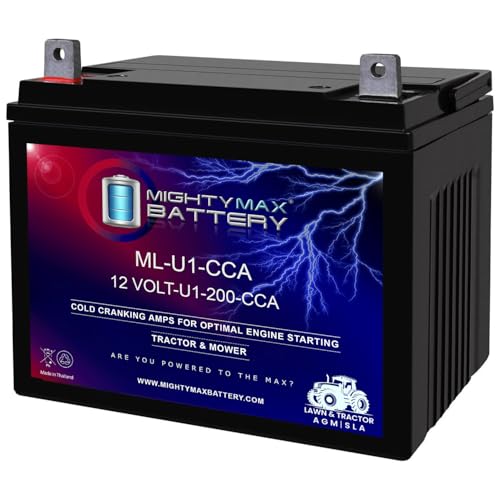
The Mighty Max Battery ML-U1 is a 12-volt sealed lead acid battery designed to replace the battery in many Craftsman lawn tractors and mowers, including the model 25780. This battery is a practical choice for homeowners who need a dependable power source for their riding mower without the hassle of traditional wet-cell batteries. With 200 Cold Cranking Amps, it provides enough power to start most single-cylinder engines commonly found on residential lawn tractors, even during cooler spring mornings or fall afternoons.
Performance-wise, this battery uses AGM (Absorbent Glass Mat) technology, which means it is spill-proof and can be mounted in any position. This flexibility is helpful if your mower has an odd battery tray orientation or limited space. The battery also handles deep discharges better than standard flooded batteries, which is a plus if you occasionally leave lights on or have a parasitic drain. However, it is not designed for high-drain applications like powering accessories for extended periods—its main job is starting the engine.
Build quality appears solid for its price point. The case is made from durable ABS plastic that resists cracking from vibration and impacts during mowing. The terminals are standard SAE posts, but you may need to check the polarity: this model has positive on the left and negative on the right. Some users report that the included screws are adequate, but you will need to reuse your existing wire harness and mounting hardware, as none are included.
Setup is straightforward if you are comfortable with basic tools. Simply remove the old battery, clean the terminals, and install this one using the provided screws. Because it is maintenance-free, you won't need to check water levels or clean corrosion as often as with a wet-cell battery. Storage is also easier since the battery can be stored on its side if needed, though keeping it upright is recommended for longest life.
One realistic limitation is that this battery may not be compatible with all mower models, especially those requiring different terminal configurations or higher CCA ratings for larger engines. Always verify your mower's battery group size and polarity before ordering. Additionally, the lack of included mounting hardware means you may need to purchase a battery hold-down kit separately if your old one is missing or damaged.
Overall, the Mighty Max Battery ML-U1 is a solid replacement option for Craftsman lawn tractor owners who want a reliable, maintenance-free battery at a reasonable price. It works well for typical suburban lawn mowing needs, but if you have a larger tractor with a high-compression engine or live in extremely cold climates, you might consider a battery with higher CCA. For most homeowners, this battery offers a good balance of performance, durability, and value.

Pros
- Affordable price point for a reliable replacement battery
- Maintenance-free AGM design-no watering or cleaning needed
- Good cold cranking amps (200 CCA) for consistent starting in cooler weather
- Fits many popular lawn tractor and mower brands
Cons
- Some users may find the terminal configuration requires careful matching with their equipment
- Limited to group U1 applications; not suitable for larger riding mowers or tractors with different battery sizes
- Warranty support is handled directly by the seller, which may be less convenient than Amazon's return process
If you own a lawn tractor or riding mower from John Deere, Toro, Cub Cadet, or Craftsman, you know how frustrating a dead battery can be. The WEIZE 12V 200CCA U1 AGM battery offers a practical and budget-friendly replacement option for homeowners who need reliable starting power for their outdoor equipment.
This battery delivers 200 Cold Cranking Amps (CCA), which is plenty for most small to mid-sized lawn tractors and mowers. The AGM (Absorbent Glass Mat) and SLA (Sealed Lead Acid) design means it's maintenance-free and spill-proof, so you don't have to worry about checking water levels or dealing with acid leaks. It's a straightforward swap for most U1 group batteries, with dimensions of 7.68 x 5.12 x 6.22 inches and a weight of about 16.95 pounds, making it easy to handle during installation.
Build quality appears solid for the price point. The case is durable enough to withstand the vibrations and jostling typical of mowing. The terminals are clearly marked with positive on the left (red) and negative on the right (black), using a square hole nut and bolt design that should fit most standard connectors. Just double-check your mower's terminal orientation before buying, as some models may have a different layout.
Installation is straightforward for anyone comfortable with basic DIY tasks. Remove the old battery, clean the tray and terminals, place the new WEIZE battery in position, and connect the cables. No special tools or professional help needed. Storage is not an issue since it's a sealed battery, but like any lead-acid battery, it's best to keep it charged during long periods of inactivity, especially in cold weather.
One realistic limitation is that this battery is designed specifically for group U1 applications. If you have a larger riding mower or a tractor that requires a different group size, this won't fit. Also, while the 200 CCA rating is adequate for most small engines, extremely cold climates or engines with high compression might benefit from a higher CCA battery. Additionally, warranty support is handled directly through the seller, which some users may find less convenient than Amazon's standard return process.
Overall, the WEIZE 12V 200CCA U1 AGM battery is a smart choice for budget-conscious homeowners who need a reliable replacement for their lawn tractor or mower. It offers good value, easy installation, and dependable starting power for the typical mowing season. Just ensure compatibility with your equipment's terminal layout and battery group size before purchasing.
Understanding Lawn Mower Battery Chemistry and Construction
The direct answer to whether lawn mower batteries are wet or gel is that they are almost always wet cell flooded lead-acid or sealed absorbent glass mat (AGM), while true gel batteries are virtually non-existent in riding mowers. Many homeowners use the term gel battery as a generic catch-all phrase for any sealed, maintenance-free battery that does not require adding distilled water. In reality, the sealed battery operating your lawn tractor or zero-turn mower relies on AGM chemistry rather than silica gel. Differentiating between these technologies is essential for properly maintaining your machine, choosing an appropriate charger, and avoiding premature battery failure.
The Direct Answer: Wet Cell and AGM Dominate Lawn Equipment
Standard riding mowers and lawn tractors leave the factory equipped with either a conventional flooded lead-acid battery or a sealed AGM battery. Flooded batteries represent the traditional wet design where lead plates sit submerged in liquid sulfuric acid electrolyte. Conversely, modern replacement batteries, including the Daakmax Lawn Mower AGM Battery Group U1 12V 24ah and the WEIZE Lawn Garden AGM Battery, utilize sealed AGM technology. These AGM designs are completely spill-proof and do not require liquid top-offs, which leads many buyers to mistakenly describe them as gel cells.
True gel batteries exist in the wider electrical market, but they are engineered for very specific deep-cycle applications like solar storage banks and mobility scooters. They do not tolerate the erratic electrical output typical of small engine charging systems. When shopping for replacement starting power, you will encounter flooded wet cells at retail farm supply stores and sealed AGM batteries from major online suppliers. Understanding that your sealed battery is almost certainly AGM rather than gel prevents severe charging mistakes that could ruin your new power cell.
How Flooded Wet Cell Batteries Function in Outdoor Power Equipment
A conventional flooded wet cell battery consists of six individual two-volt cells connected in series inside a durable plastic casing to produce a nominal 12 volts. Each cell contains alternating plates of lead and lead dioxide submerged in a liquid bath of sulfuric acid and distilled water. As the battery discharges to crank the engine, chemical reactions convert the active plate material into lead sulfate while diluting the electrolyte solution. When the mower runs, the onboard charging system reverses this chemical reaction to restore electrical capacity.
Traditional flooded batteries feature removable vent caps or a strip of plastic plugs along the top cover. These vents allow hydrogen and oxygen gases produced during normal charging cycles to escape safely into the atmosphere. Because water molecules break down and evaporate over time, owners of flooded batteries must periodically inspect fluid levels and add distilled water to keep the lead plates fully submerged. If the liquid drops below the tops of the plates, the exposed lead oxidizes rapidly, permanently reducing cranking capacity.
Vibration and sloshing present additional challenges for wet cell batteries in rough yard applications. Mowing over bumpy ground or traversing hillsides causes the liquid acid to shift constantly, which can lead to acid seepage around unsealed caps. This leaking electrolyte corrodes metal battery trays, damages wiring harnesses, and degrades hold-down brackets. While wet batteries remain economical, their requirement for routine fluid checks and susceptibility to vibration damage make them less appealing for demanding turf care.
The Mechanics of Absorbent Glass Mat (AGM) Starter Batteries
Absorbent Glass Mat (AGM) batteries represent an advanced evolution of lead-acid chemistry designed to eliminate the drawbacks of free-flowing liquid electrolyte. Inside an AGM battery, ultra-thin fiberglass mats are sandwiched tightly between the positive and negative lead plates. These micro-fiber mats absorb and immobilize the sulfuric acid electrolyte like a sponge, leaving no free liquid inside the case. The Mighty Max Battery ML-U1 12V 200CCA Battery highlights how this internal configuration creates a completely spill-proof starting solution for riding equipment.
The tightly compressed internal construction of AGM batteries provides exceptional resistance to the intense shocks and vibrations generated by mower decks and rough terrain. Because the electrolyte is trapped in fiberglass matting, these batteries can be operated at angles or mounted in varied positions without any danger of acid leakage. AGM units also feature internal recombinant technology, where oxygen produced at the positive plates travels through the mats to recombine with hydrogen at the negative plates. This internal gas recycling eliminates water loss completely, making the battery permanently maintenance-free.
Lower internal electrical resistance is another major advantage of the AGM design. Lower resistance enables the battery to discharge electrical current more rapidly during cranking, delivering strong ignition bursts even in lower ambient temperatures. Furthermore, AGM batteries exhibit a much lower self-discharge rate compared to traditional wet cells, allowing them to retain a healthy resting charge longer when stored in a shed. This resilience makes AGM the preferred choice for homeowners who want plug-and-play dependability without seasonal acid maintenance.
Why True Gel Cell Batteries Are Rarely Used in Lawn Tractors
True gel batteries differ fundamentally from both flooded and AGM designs because their electrolyte is transformed into a thick, paste-like gel. Manufacturers achieve this by blending fumed silica into the sulfuric acid solution during assembly. While this immobile gel prevents acid spills and provides excellent deep-cycle durability, it introduces strict operational limitations that make it unsuitable for small engines. Gel batteries require exceptionally tight, low charging voltage tolerances, usually restricted to a maximum of 14.0 to 14.2 volts.
Lawn mowers and garden tractors operate with relatively rudimentary electrical charging systems compared to passenger vehicles. A typical lawn tractor uses an under-flywheel stator coil paired with an unregulated diode or a basic solid-state voltage regulator. These systems frequently produce voltage fluctuations that can reach 14.5 volts or higher at wide-open throttle. If a true gel battery experiences charging voltages exceeding its strict ceiling, the excessive electrical heat creates gas voids and bubbles inside the silica gel.
Once gas bubbles form within the gel matrix, they pull the electrolyte away from the lead plates permanently. Because the gel cannot flow back together to fill these voids, the battery suffers irreversible plate damage and rapid capacity loss. True gel batteries also deliver lower instantaneous cranking amps compared to AGM batteries of identical physical dimensions. Since starting a high-compression gas engine demands a sudden surge of hundreds of amps, the slower chemical reaction of gel makes it a poor match for starting outdoor power equipment.
Unraveling Confusing Battery Terminology: SLA, VRLA, Wet, and Gel
Navigating battery marketing terms can be frustrating because industry acronyms often overlap in confusing ways. You will frequently see the terms Sealed Lead Acid (SLA) and Valve-Regulated Lead-Acid (VRLA) used interchangeably in product titles and technical specifications. Both SLA and VRLA are broad umbrella classifications that describe any lead-acid battery that is sealed and equipped with one-way pressure-relief valves. Both AGM batteries and gel batteries fall under the SLA and VRLA umbrella, which leads many retailers and consumers to conflate the two.
A battery labeled as SLA is almost always an AGM battery unless the manufacturer explicitly designates it as a deep-cycle gel unit. Manufacturers produce SLA starting batteries using glass mat separators because they offer the high discharge rates necessary for turning over starter motors. Retailers sometimes label an AGM battery as gel simply because non-technical shoppers search for gel when they really mean sealed and spill-proof. Checking the fine print on product descriptions usually confirms that the core construction is absorbent glass mat.
When shopping for parts, you will also see conventional batteries listed as flooded, wet, or flooded lead-acid (FLA). These descriptions signify that liquid electrolyte is present inside unsealed or vented cell caps. Understanding that SLA, VRLA, and AGM all point to sealed, non-spillable construction helps you filter out misleading labels. If you need a direct replacement for your equipment, choosing an SLA AGM battery ensures you receive modern spill-proof convenience without the delicate charging sensitivities of true gel.
Voltage Thresholds and Electrical Diagnostics with a Multimeter
Diagnosing mower starting problems requires an accurate digital multimeter rather than relying on guesswork. A healthy, fully charged 12-volt lead-acid or AGM mower battery should show a resting open-circuit voltage between 12.6 and 12.8 volts when tested across the terminals with the engine off. If your meter displays 12.4 volts, the battery has discharged to roughly 75 percent of its total capacity. A reading of 12.2 volts indicates a 50 percent discharge state, meaning the battery lacks the energetic punch required to spin the starter motor reliably.
A voltage reading that drops below 10.5 volts on a resting battery usually signals a dead or shorted cell. Lead-acid batteries contain six individual two-volt cells, and a sudden drop near 10.5 volts means one of those internal cells has collapsed chemically or physically. Attempting to recharge a battery with a shorted cell is futile and can cause the casing to overheat or swell. Conversely, measuring static voltage alone can be misleading because a degraded battery can exhibit a deceptive surface charge that vanishes the moment you turn the key.
Dynamic load testing reveals whether the battery can maintain sufficient voltage under active cranking load. To perform a basic load check, connect your multimeter leads to the battery posts and observe the display while cranking the mower engine. A sound battery must maintain at least 9.6 volts during active cranking at normal temperatures. If the display plunges below 9.0 volts while the starter solenoid clicks or groans, the battery plates have degraded and can no longer supply required cranking amperage.
Sizing Cold Cranking Amps (CCA) for Single-Cylinder and V-Twin Engines
Cold Cranking Amps (CCA) measure the number of amperes a 12-volt battery can deliver at 0 degrees Fahrenheit for 30 seconds while maintaining a voltage of at least 7.2 volts. While you probably will not mow your lawn in sub-zero weather, CCA serves as the primary benchmark for raw starting muscle. Different lawn tractor engines place vastly different electrical demands on the starter motor during ignition. Under-sizing your battery’s CCA rating leads to slow cranking, excessive starter wear, and repeated starting failures.
Single-cylinder engines, commonly found on smaller lawn tractors and rear-engine riders, typically require between 190 and 230 CCA to turn over comfortably. The WEIZE Lawn Garden AGM Battery delivers 200 CCA, making it well suited for standard single-cylinder applications from brands like Toro, Craftsman, and Cub Cadet. Single-cylinder motors have lighter rotational mass and smaller compression volumes, allowing a 200 CCA battery to spin the flywheel past top dead center with minimal resistance.
Larger riding mowers and commercial zero-turn machines equipped with high-displacement V-twin engines demand significantly more cranking power. Twin-cylinder engines, often displacing 600cc to over 800cc, create substantial compression resistance that can stall a weak starter. For these applications, selecting a battery rated at 300 CCA or higher, such as the WEIZE Lawn Garden AGM Battery with its 300 CCA specification, provides the extra rotational torque needed for crisp, reliable starts. Pairing the right amp rating to your engine displacement guarantees smooth operation across varying temperatures.
BCI Group Sizing and the Critical U1 Versus U1R Polarity Difference
Battery Council International (BCI) establishes standardized physical dimensions and terminal layouts for equipment batteries. The vast majority of riding mowers, lawn tractors, and commercial zero-turn machines use the BCI Group U1 case format. Standard Group U1 batteries share a compact footprint measuring approximately 7.68 to 7.75 inches in length, 5.00 to 5.12 inches in width, and 6.22 to 7.09 inches in total height. This standardized case fits snugly into factory battery trays located under tractor hoods or beneath operator seats.
While dimensions remain largely identical across the group, terminal polarity orientation creates a critical distinction between Group U1 and Group U1R batteries. On a standard Group U1 battery, the positive terminal sits on the left side and the negative terminal sits on the right side when viewing the battery from the front label side. In contrast, a Group U1R battery features reversed polarity, placing the positive terminal on the right side. Standard riding mowers have very short factory battery cables with virtually zero slack.
Inadvertently purchasing a U1 battery when your mower requires a U1R means your tractor cables will not stretch across the casing to reach their respective posts. Forcing or stretching cables strains terminal brackets, risks cracking the battery casing, or creates serious short-circuit hazards. Installing a battery backwards and accidentally connecting cables to the wrong posts can blow the main fuse, destroy the voltage regulator, and damage the stator. Always inspect the polarity layout of your old battery before ordering a replacement.
Off-Season Storage Protocols and Preventing Plate Sulfation
Lead plate sulfation is the single most common cause of premature battery death in outdoor power equipment. When a battery sits in an unmaintained state through winter, sulfur molecules from the electrolyte combine with the lead plates to form lead sulfate crystals. If left uncharged for months, these soft crystals harden into an impervious crystalline coating that insulates the plates from chemical reactions. A sulfated battery may read 12 volts on a meter but will instantly collapse under load because its internal surface area is choked.
Conventional flooded wet batteries experience a natural self-discharge rate of roughly 3 to 5 percent per month, which accelerates in warm storage environments. Sealed AGM batteries hold their charge considerably better, but they will still self-discharge gradually over a long winter off-season. Disconnecting the negative battery cable before putting your equipment away for the winter prevents parasitic electrical draws from draining the cells. Even better, removing the battery entirely and storing it in a dry, temperate area on a wooden workbench keeps the chemistry stable.
Connecting a dedicated smart float maintainer throughout the winter off-season keeps the battery in peak condition without risking overcharging. Unlike old-fashioned continuous trickle chargers that continually pump current into the cells and boil away electrolyte, smart maintainers automatically switch to a gentle float mode once full charge is reached. Performing this winter storage routine alongside your seasonal outdoor gear maintenance, such as routine lawn mower deck maintenance before winter storage, ensures your equipment starts instantly when spring arrives.
Safe Jump-Starting Procedures and Electrical System Protection
When you face a dead mower battery and need to cut the lawn immediately, jump-starting from a passenger car or portable jump pack is a practical option. However, jump-starting a small engine requires following strict safety procedures to avoid destroying sensitive onboard electronics. The most vital rule when jumping a 12-volt lawn tractor with an automobile is to leave the car engine turned completely OFF. The running alternator of a car generates excessive charging current that can easily fry the lawn mower’s delicate stator and voltage regulator.
With the donor vehicle engine off, connect the red jumper cable clamp to the positive terminal of the donor car battery, and then attach the other red clamp to the positive terminal of the mower battery. Next, connect the black cable clamp to the negative terminal of the car battery, and secure the remaining black clamp to an unpainted metal frame bolt on the lawn mower chassis. Grounding to the chassis rather than the mower battery terminal keeps any potential connection sparks away from battery vent paths.
Once the jumper cables are firmly secured, start the lawn tractor engine normally using the ignition key. As soon as the engine catches and settles into an idle, disconnect the jumper cables in the exact reverse order: remove the chassis ground first, then the donor negative, then the mower positive, and finally the donor positive. Allow the mower engine to run at full throttle for at least thirty minutes to let the onboard charging system replenish the battery, or place it on a bench charger afterward for a complete recharge.
Routine Maintenance and Selecting Your Ideal Replacement Battery
Selecting the best replacement battery for your lawn tractor comes down to balancing maintenance preferences, engine displacement, and terrain demands. While flooded wet cell batteries offer an entry-level purchase price, their need for periodic water inspections and potential for acid spills on rough acreage make them less practical for modern homeowners. Upgrading to a sealed AGM battery like those from WEIZE, Mighty Max, or Daakmax provides complete spill-proof security, zero liquid maintenance, and superior vibration resistance across bumpy yards.
Before finalizing any purchase, double-check your tractor manual to confirm the required Cold Cranking Amps and inspect your current battery tray for positive terminal placement. If you operate a compact rider or standard lawn tractor, a 200 CCA AGM model offers dependable power in a compact package. If you power a commercial zero-turn with a 24-horsepower V-twin engine, invest in a 300 CCA unit to ensure the starter has plenty of rotational punch. Taking the time to select the right specification guarantees years of trouble-free starts and keeps your yard maintenance running on schedule.
Maintaining clean terminal connections is just as vital as buying the right battery chemistry. Dirt, moisture, and dried grass clippings can create high-resistance corrosion paths across square-hole flag terminals, choking electrical flow to the starter solenoid. Cleaning terminal posts with a wire brush and applying a thin coat of dielectric grease or protective terminal spray prevents oxide buildup. Pair your battery upkeep with other routine yard tool care, such as managing matching replacement batteries for outdoor equipment across your property, to keep your entire lawn care toolkit ready for action.
Understanding that mower batteries are either wet cell or sealed AGM clears away common retail confusion and empowers you to care for your machine properly. By avoiding the pitfalls of true gel chemistry and investing in a properly sized, high-vibration AGM or well-maintained flooded battery, you protect your tractor’s charging circuit and prevent unexpected no-start headaches. Match your group size, verify your terminal orientation, maintain full resting voltage during the off-season, and your outdoor equipment will deliver reliable ignition season after season.



Write Your Review
No reviews yet. Be the first to share your experience!