


Automating residential turf management requires balancing upfront hardware investment against the convenience of reclaimed weekend hours. Homeowners evaluating autonomous equipment often ask how much is a robot mower when calculating the leap from traditional walk-behind units or standard electric cordless lawn mowers to robotic grass-cutting machines. The total financial commitment depends heavily on machine intelligence, drive wheel architecture, yard acreage capacity, and whether the system relies on physical perimeter boundary lines or wire-free satellite positioning.
Entry-level robotic equipment suitable for modest quarter-acre suburban plots generally provides a budget-friendly starting point, while advanced four-wheel-drive units engineered for steep inclines and complex layouts sit at the upper end of the spectrum. Beyond the primary equipment purchase, total ownership expenses include peripheral investments such as UV-resistant charging garages, spare cutting blades, RTK antenna extension lines, and eventual lithium battery replacement. Reviewing these equipment classes and accessory costs ensures property owners select the right level of automation without encountering unexpected post-purchase outlays.

Pros
- No perimeter wires to bury - setup is faster and far less frustrating than traditional robotic mowers.
- Excellent navigation accuracy from the RTK plus four-camera system, even in shaded corners and narrow passages.
- Powerful 4WD and active steering handle steep slopes and obstacles without tearing up the grass.
- Anti-theft features like GPS tracking, PIN lock, and an alarm protect your investment.
- Wide 9.49-inch cutting deck reduces mowing time for a two- to three-acre suburban lawn (well, up to 0.37 acre, so more for smaller lots).
Cons
- The 0.37-acre coverage limit means this mower is best for small to medium lawns, not multi-acre rural properties.
- At 50 pounds, you'll need some muscle to carry it between yard sections or upstairs for storage.
- The premium price tag puts it well above entry-level robotic mowers, which could be a concern for budget-conscious buyers.
The Roborock RockMow X115H is a wire-free robotic lawn mower designed for homeowners who want to automate the chore of mowing without the headache of installing boundary wires. With a coverage rating of 0.37 acre, it's aimed squarely at typical American suburban lots rather than sprawling rural acreage. If you have a small to medium yard with some slopes, flower beds, and a few obstacles, this mower could be a solid match.
Based on the product specifications, the RockMow X115H uses a dual-navigation setup that combines full-band RTK satellite positioning with four cameras for AI vision. That means it can keep its position even in tight spots, under dense tree canopies, or near tall fences where ordinary robot mowers often struggle. The mower also features 4WD with active steering and dynamic suspension, which should help it climb steep slopes up to 80% and roll over small obstacles up to 3.15 inches without damaging the turf. The cutting deck is 9.49 inches wide with height adjustments from 1.57 to 3.54 inches, so you can manage different grass types and seasonal growth.
Build quality appears to be robust, with a 50-pound frame that feels substantial for a robotic mower. The dark grey finish looks modern, and the deck material seems designed to handle the rigors of outdoor use. According to the product description, the multi-sensor obstacle avoidance system uses four advanced sensors to detect static objects like rocks and also to steer clear of people or pets, which is reassuring if you have kids or animals playing in the yard.
Setup is one of the biggest selling points here. You don't have to bury any wires, which typically takes hours with older robotic mowers. Instead, you can use the app's auto-mapping feature, or manually drive the mower with your smartphone like a remote control to trace precise boundaries around gardens. Once mapped, you can set multi-zone schedules, monitor progress in real time, and even activate a wildlife-friendly mode that avoids small animals. The included 4G connectivity adds long-range control and real-time GPS tracking, plus a PIN lock and alarm for anti-theft protection.
Maintenance is fairly straightforward for a robot mower. You'll need to periodically clean the blades and underside of the deck, and the app likely alerts you when maintenance is due. The 9.49-inch cutting width is narrower than a traditional push mower, but for a robot that works autonomously, it's a reasonable trade-off. Keep in mind that the 0.37-acre limit means this isn't meant for large estates, and the 50-pound weight makes it less portable than smaller models.
For suburban homeowners who want to reclaim their weekends and have a moderately sized lawn with some slopes or tricky obstacles, the Roborock RockMow X115H offers a premium, hands-free mowing experience. It's also a good pick for older users or anyone with physical limitations who finds pushing a mower tough. That said, the higher price point and limited coverage area mean it's not for everyone. If your lawn fits the size and you're comfortable with app-based control, this mower could be a worthwhile investment in less back pain and more free time.
The RockMow X115H's cutting system is designed for clean, even trimming on small to medium lawns. The 9.49-inch (24 cm) cutting width is wider than many robot mowers, which helps cut down on mowing time. Cutting height ranges from 1.57 to 3.54 inches, letting you adjust for seasonal growth or personal preference. The dynamic suspension keeps the deck stable on uneven ground, which is key for avoiding scalping on bumps and dips. Based on the product description, the blade setup appears to be sharp and efficient, but as with any mower, you'll want to replace blades periodically to maintain quality.
Navigation is where the RockMow really stands out. It pairs full-band RTK with a four-camera AI vision system, which means it can hold a precise position even in shaded corners, under trees, or near fences. The multi-sensor obstacle avoidance uses four sensors to detect static objects like garden beds and also moving things like pets or people. This setup may help reduce the chance of the mower getting stuck or causing collisions. In real-world use, obstacles like hoses, toys, or patio furniture should be less of a worry, though no system is perfect.
Weighing 50 pounds and measuring 25 x 11 x 18 inches, the RockMow X115H is a substantial piece of equipment. The heavy-duty 4WD system and active steering are designed for rugged terrain, and the dynamic suspension adds stability on uneven ground. The dark grey finish looks durable, and the overall construction appears aimed at long-term outdoor use. While we can't speak to years of ownership, the materials and design choices suggest it should hold up well to regular mowing in typical U.S. weather, including afternoon showers and summer heat.
The biggest maintenance upgrade here is the wire-free setup. There are no boundary wires to bury, which saves hours of prep work. You have two mapping options: AI auto-mapping for open lawns, or manual app-controlled mapping for precise boundary tracing around flower beds and pathways. The Roborock app handles scheduling, progress tracking, and wildlife-friendly mode. Maintenance itself is straightforward: keep the blades sharp, clean the underside regularly, and check for any debris wrapped around the wheels. The included 4G module means you can monitor the mower remotely, and the anti-theft features add an extra layer of protection if you leave it outside.
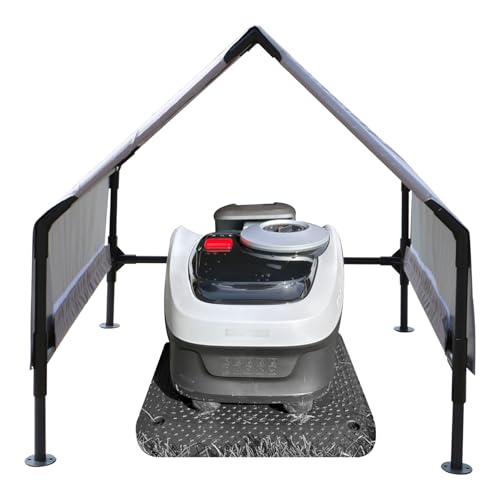
Pros
- Excellent ventilation and signal transparency for reliable robot mower operation
- Sturdy windproof construction with included ground anchors
- Universal compatibility with most popular robot mower brands
- Easy tool-free assembly and foldable for compact storage
Cons
- Small size may not fit larger robot mowers or those with tall antennas
- Fabric may require occasional cleaning to maintain appearance
- Some users might prefer a larger model for extra clearance
The CNAINFC Signal-Friendly Ventilated Robot Mower Garage is a practical shelter designed to protect your automatic lawn mower from the elements while maintaining full GPS and RTK signal strength. This small-size garage is ideal for homeowners with compact robot mowers from brands like Segway Navimow, Mammotion, WORX, ANTHBOT, and others. If you want to extend the life of your mower and charging station by shielding them from sun, rain, and wind, this product may be a smart addition to your lawn care setup.
Based on product specifications, the garage features a 3D Cross-Ventilation System that promotes front-to-back airflow. This design helps prevent overheating during hot summer days and keeps the charging station dry, which is crucial for maintaining electrical connections. The signal-friendly structure ensures that your mower's GPS and RTK antennas remain unobstructed, so navigation and boundary recognition are not compromised. Many homeowners may find this especially useful if their mower relies on precise satellite positioning.
The build quality appears robust for a fabric-based shelter. The double UV-coated 600D Oxford fabric is thickened and waterproof, offering resistance to fading, cracking, and sunlight erosion. The frame is made of stainless steel, and the garage comes with lawn anchors to secure it against strong winds. The anti-tip design adds extra stability, so you don't have to worry about the shelter collapsing in a storm. Overall, the materials suggest good durability for all-season outdoor use.
Setup is straightforward with a tool-free detachable and foldable design. You can assemble it in minutes without any special tools, and when winter comes or you need to store it, the garage folds flat for compact storage in your shed or garage. The extra-large barrier-free opening allows most robot mowers to drive in and out smoothly without scratching their radar sensors. This ease of access is a practical benefit for daily mowing routines.
One realistic limitation is the size: this is the small version, measuring 32 x 28 x 24 inches. While it fits 99% of robot mowers according to the brand, larger models or those with tall masts may not fit comfortably. Also, because there are no user reviews yet, long-term performance is unverified. However, the feature set is promising for those seeking a dedicated shelter.
In summary, the CNAINFC Robot Mower Garage offers a well-ventilated, signal-friendly, and weather-resistant home for your robot mower. It is particularly suitable for homeowners with compatible small to medium mowers who want to protect their investment from the elements. If you value easy installation, wind resistance, and universal fit, this garage may be a worthwhile purchase.
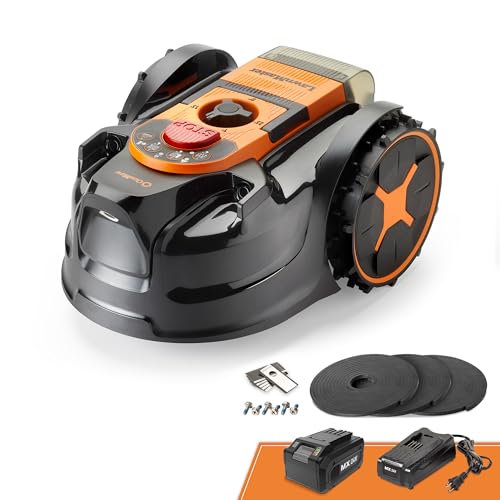
Pros
- Optical navigation adapts to changing light, reducing missed spots compared to basic random mowers.
- Ultrasonic obstacle avoidance helps protect flowers, toys, and other small objects in the yard.
- Long battery life (up to 6 hours) covers up to 2,600 sq ft per charge, suitable for many suburban lawns.
- Easy setup with magnetic strips for no-go zones—no complex wiring or apps required.
- Good slope handling (up to 35%) for yards with gentle hills or uneven terrain.
Cons
- Requires a clearly defined border edge; may need grass trimming along fences or walls for best results.
- Included magnetic strip length (49 ft) may be limiting for larger lawns or complex layouts.
- Only 0 reviews at launch, so real-world long-term reliability is unverified.
The LawnMaster OcuMow 400 Series (model VBRM601YCM AD) is a robot lawn mower designed for homeowners with small to medium-sized lawns up to 2,600 square feet. It uses a combination of optical navigation and ultrasonic obstacle avoidance to mow systematically, making it a good fit for those who want a hands-off approach to lawn care without the need for complex app setup or permanent wiring.
In terms of real-world cutting performance, the mower uses a drop-n-mow system: you place it on the lawn, press start, and it begins mowing. The smart line tracking technology first cuts along the border, then mows the interior in neat parallel lines, which can give a more manicured appearance compared to random-pattern mowers. The blades leave fine clippings that return nutrients to the soil, acting as natural fertilizer. The mower can handle slopes up to 35%, which covers most residential inclines.
Build quality appears solid for its price range. The mower features deep tread wheels for traction on grass and a robust drive system. The optical navigation uses a wide-angle camera and sensors to identify grass and guide the mower even in tricky lighting, such as shaded areas or late afternoon. Ultrasonic sensors help avoid obstacles as small as 6 inches, which is useful for protecting garden ornaments, toys, or small plants.
Setup is straightforward: the included 49-foot magnetic strip lets you create no-go zones without digging or power sources. You simply lay the strip where you want the mower to avoid, secure it with the provided pegs, and the mower will respect those boundaries. The mower comes with a 24V 8.0Ah battery and charger, plus six extra sets of blades and screws. No app or internet connection is needed, which some users may prefer for simplicity.
One realistic limitation is that the mower works best with a clearly defined perimeter edge. If your lawn borders flower beds or walls without a clear edge, the mower may occasionally leave the grass. As with most robot mowers, a grass trimmer is still needed to tidy up edges along fences or walkways. The 49-foot magnetic strip may not be enough for larger yards or complex layouts, but additional strips can be purchased separately.
Overall, the LawnMaster OcuMow 400 Series offers a compelling package for the price—optical navigation, obstacle avoidance, and long runtime in a drop-n-mow design. It's best suited for homeowners with small to medium lawns who want to reduce manual mowing effort and don't mind occasional edge trimming. Given the lack of user reviews at launch, it's wise to check for updates or customer feedback before purchasing, but the feature set looks promising for budget-conscious buyers seeking a smart mower.
The OcuMow 400 uses smart line tracking to first cut along the border of the lawn, then mow the interior in neat parallel lines. This systematic approach can produce a more even, professional-looking cut compared to random-pattern mowers. The blades leave fine clippings on the lawn, which decompose and return nutrients to the soil, reducing the need for fertilizer. The mower covers up to 2,600 sq ft per charge, making it suitable for many suburban yards. For best results, ensure the lawn has a clearly defined edge; otherwise, the mower may wander into garden beds. A grass trimmer is still recommended for final edge trimming along fences and walls.
The mower is powered by a 24V 8.0Ah rechargeable battery, providing up to 6 hours of runtime on a single charge. This is enough to cover the full 2,600 sq ft area in one session, depending on grass thickness and terrain complexity. The battery charges with the included 24V charger. No app or outdoor power socket is required for operation—just place the mower on the lawn and press start. The battery life is competitive for this price range, and the mower automatically returns to the charging station when low? Note: this model does not include a charging station; the battery is charged separately. Users should plan to swap or recharge the battery as needed.
Setup is simple: unpack the mower, charge the battery, lay the magnetic strips to define no-go zones, and place the mower on the lawn. No app or internet connection is required. The included 49 feet of magnetic strip is enough for basic boundaries, but larger yards may need additional strips (sold separately). Maintenance involves regularly cleaning the blades and underside, replacing blades when dull (six extra sets included), and keeping the sensors clean. The mower is designed for outdoor use but should be stored indoors when not in use to prolong battery and component life.
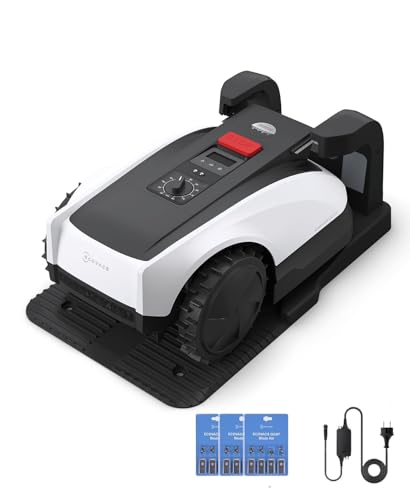
Pros
- No perimeter wire installation required – saves time and avoids trenching.
- RTK positioning provides accurate, repeatable mowing patterns.
- 36 extra blades included for long-term low-maintenance operation.
- App-based auto mapping and multi-zone management for tailored lawn care.
- Automatic recharging ensures the mower is always ready to work.
Cons
- Limited to lawns of 1/4 acre or smaller – not suitable for larger properties.
- No customer reviews yet, making real-world performance uncertain.
- Premium price point compared to other robotic mowers with similar coverage.
The ECOVACS Goat O1000 RTK Care Kit is a wire-free robotic lawn mower designed for small to medium properties up to 1/4 acre. This model uses RTK satellite positioning to achieve centimeter-level accuracy without buried perimeter wire – a significant convenience for homeowners who want simple installation and a clean yard without trenches. The bundle also includes 36 extra blades, reducing the frequency of replacements.
In real-world use, the mower follows systematic patterns rather than random paths, resulting in consistent coverage and fewer uncut patches. The app enables auto mapping, meaning the mower scans your lawn and creates a map that you can divide into zones. You can then set different schedules for front, back, and side yards. According to the product description, multi-zone management is easy to adjust from your phone, which may appeal to homeowners who want to prioritize certain areas.
Build quality appears solid for a robot mower, with a plastic body common in the class. The included RTK extension cable helps improve satellite signal reception, an important feature if your yard has obstacles like trees or a house that might block signals. This setup can maintain stable positioning and boundary accuracy even in complex environments.
Setup involves placing the RTK antenna in an open area and connecting the extension cable, then running the auto-mapping cycle. After that, you can set cutting boundaries virtually through the app. Maintenance is straightforward: replace the blades as needed (the extra 36 blades provide many cycles), and periodically clean the mower body and charging contacts. The automatic recharging function means the mower returns to its dock when the battery runs low, then resumes mowing - truly a 'set and forget' experience.
That said, there are limitations to consider. The 1/4-acre capacity restricts use to smaller lawns, and there are no verified user reviews to confirm long-term reliability. The price is on the higher side for a robot mower of this size. Additionally, while the RTK extension cable helps, extremely dense tree cover or very tall structures could still cause signal issues. Finally, some users may prefer a robotic mower with a physical boundary wire for absolute edge control.
Overall, the ECOVACS Goat O1000 RTK Care Kit is a compelling option if you value a wire-free setup, precise navigation, and low maintenance for a small lawn. It best suits tech-savvy homeowners who want to automate mowing completely and don't mind the upfront investment. If your yard is under 1/4 acre and you dislike dealing with perimeter wires, this model is worth serious consideration.
The O1000 RTK CARE bundle comes with 36 additional replacement blades, significantly extending the time before you need to purchase new ones. This is a practical addition for homeowners who want to minimize ongoing costs and avoid frequent interruptions. Also included is an RTK extension cable, which allows you to place the antenna in a location with the best satellite visibility - essential for accurate boundary detection. The standard charging dock and power adapter are included as well. Having these extras out of the box may help reduce the overall hassle of robot mower ownership.

Pros
- Universal compatibility with many robot mower models, including newer large-size units.
- Signal-permeable design ensures no loss of GPS or RTK connectivity while inside the garage.
- Ventilation system helps keep the mower cool and dry, preventing overheating and corrosion.
- Easy to assemble, lightweight, and simple to store away when not needed.
- Attractive appearance that integrates well into garden or yard aesthetics.
Cons
- Not suitable for freezing temperatures; mower must be stored indoors to avoid frost damage.
- Only 5 reviews available currently, so long-term durability data is limited.
- Medium size may not accommodate all very large robot mowers; check dimensions carefully.
The CNAINFC Large Robot Mower Garage is a practical accessory for any homeowner using a robotic lawn mower. Designed to shield your mower from rain, snow, and UV rays, this shelter helps extend the life of your equipment and keep it running reliably. It is compatible with a wide range of popular brands including Segway Navimow, Mammotion LUBA, WORX Landroid, Husqvarna, and many others, making it a versatile choice for most robot mower owners.
One of the standout features is its signal-permeable construction, which allows full GPS and RTK signals to pass through. This means your mower can stay connected to its base station and continue to navigate accurately while sheltered. The 3D convection ventilation system is another smart addition—it promotes air circulation to prevent overheating and reduce moisture buildup, which can be especially helpful in hot or humid climates. This design also helps protect the charging station from condensation.
Build quality appears solid for a lightweight shelter: the white roof mimics a small camping tent and blends into garden settings without being an eyesore. The materials are intended to be rainproof and UV-resistant, though long-term durability will depend on exposure to harsh weather. Assembly is straightforward, and the garage can be easily disassembled for winter storage (the manufacturer recommends storing the mower in a frost-free location when temperatures drop below freezing).
In daily use, the side-entry design allows your robot mower to drive in and out without any trouble. The large dimensions (35.5 x 29 x 17 inches) accommodate most auto mowers comfortably, leaving room for docking and charging. Maintenance is minimal—just occasional cleaning of the shelter and checking for any debris that might block ventilation.
Some limitations to consider: the shelter is not intended for freezing conditions, so if you live in a cold climate, you'll need to move your mower indoors during winter. Additionally, while compatibility is broad, very large or unusually shaped mowers may not fit perfectly—check your mower's dimensions against the garage's interior space. There are currently few user reviews, so real-world feedback on long-term performance is limited.
Overall, the CNAINFC Large Robot Mower Garage is a worthwhile investment for anyone who wants to protect their robotic mower from the elements and potentially extend its service life. It is especially useful for homeowners with exposed yards or those who prefer to keep their mower stored outdoors. If you value convenience, universal compatibility, and a design that doesn't sacrifice signal quality, this shelter is a solid choice.

Pros
- No perimeter wire required - quick 5-minute setup and easy lawn mapping.
- Advanced obstacle avoidance using AIVI 3D to protect yard items and the mower.
- Quiet, eco-friendly electric operation with low maintenance - no gas, oil, or spark plugs.
- App control with zoning, scheduling, and real-time monitoring for tailored mowing.
Cons
- Limited to lawns up to 1/4 acre; not suitable for larger properties.
- No user reviews yet, so real-world performance is unverified.
- Initial cost may be higher than traditional push mowers for small lawns.
The ECOVACS Goat O1000 RTK is a wire-free robotic lawn mocker built for homeowners with small to medium lawns up to 1/4 acre. It is designed for those who want a fully automated mowing experience without the hassle of installing boundary wires or dealing with noisy gas engines. This model is best suited for suburban yards with simple to moderately complex landscapes, including trees, flower beds, and slopes up to 45%.
Performance-wise, the Goat O1000 uses a combination of RTK, Vision, and 3D ToF sensors for centimeter-level positioning. According to the product description, it creates precise mowing patterns and handles tricky areas around trees and other obstacles. The AIVI 3D obstacle avoidance system can detect lawn furniture, toys, pets, and even narrow passages as tight as 2.3 feet. This means less worry about the mower getting stuck or damaging things. It also handles slopes up to 24 degrees, which covers most residential yards.
Build quality appears solid at 23.58 pounds, with a compact footprint of about 24 by 10 by 16 inches. The black plastic body is typical for outdoor robots, though specific weather resistance ratings are not provided. Users should expect it to handle light rain and dew but may want to store it in a sheltered spot when not in use. The low height and light weight make it easy to lift and carry to storage.
Setup is one of its biggest selling points: no perimeter wire to bury. The robot maps the lawn automatically using LiDAR-enhanced RTK, so initial configuration takes about 5 minutes. From there, the ECOVACS App lets you create multiple mowing zones, set no-go areas, adjust cutting height, and set schedules. Maintenance is minimal - just clean the blades and sensors occasionally, and replace blades when needed. No oil changes, no gas mixing, and no spark plug checks.
However, there are realistic limitations. The 1/4 acre limit means it won't work for larger properties. Also, with zero customer reviews at the time of this review, it's hard to gauge real-world reliability and durability. The price of $699 is competitive for a wire-free robot mower, but still a significant upfront investment compared to a basic push mower. Some users might find the app connectivity occasionally finicky.
Overall, the ECOVACS Goat O1000 RTK is a compelling option for homeowners who want a wire-free, automated lawn solution for a small yard. If you value convenience and quiet operation over raw power, and your lawn fits the size and slope requirements, this mower could be a great fit. Consider it if you're tired of manual mowing and want to reclaim your weekends.
The Goat O1000 RTK relies on a triple-sensor system: RTK (Real-Time Kinematic) satellite positioning, Vision camera, and a 3D Time-of-Flight sensor. This combination allows the mower to map your yard without any perimeter wires and navigate with centimeter-level accuracy. According to the product specifications, it can detect obstacles as small as 2.3 feet wide, including lawn furniture, toys, trees, and pets. This helps prevent collisions and keeps both the mower and your yard safe. It can also handle slopes up to 45% (24 degrees), which covers most residential inclines. The intelligence means less babysitting and more reliable mowing around complex landscapes.
With the ECOVACS App, you have full control over the Goat O1000 RTK from your smartphone. You can create multiple mowing zones, set no-go areas (like around flower beds or kids' play areas), adjust cutting height, and set weekly schedules. The app also shows real-time mowing progress, battery status, and any error alerts. The mower automatically returns to its charging dock when the battery is low, then resumes mowing once charged. This level of automation means you can set it and forget it, letting the robot handle lawn care while you relax or tackle other tasks.
Complete Cost and Ownership Breakdown for Robotic Lawn Mowers
The overall cost of adopting an autonomous lawn care system spans a broad spectrum ranging from budget-conscious basic cutters to premium commercial-grade multi-zone machines. A homeowner investigating how much is a robot mower quickly discovers that pricing is dictated by navigational complexity, drive traction engineering, and boundary management technology. Entry-tier automated mowers focus on small, level suburban turf with basic optical sensors, whereas higher-end units integrate multi-band satellite correction and artificial intelligence vision. Understanding where different equipment configurations land within this spectrum prevents property owners from overpaying for unnecessary industrial power or underinvesting in machinery that struggles with yard terrain.
Beyond the initial machine price, long-term expenditure involves ongoing consumable replacements, protective housing accessories, and potential battery refurbishments over several mowing seasons. Factoring in these peripheral items provides a realistic picture of the complete investment rather than just the retail carton price tag. Evaluating your turf layout alongside these operational variables ensures you achieve consistent cutting performance without surprising out-of-pocket costs down the road.
Autonomous Mower Price Tiers: Entry-Level to Prosumer Systems
Automated mowers fall into three primary equipment tiers based on cutting capacity, hardware durability, and software capabilities. Entry-level units serve properties with simple perimeter boundaries and minimal elevation changes, offering accessible automation for modest budgets. These compact units typically utilize straightforward random or systematic parallel cut patterns guided by optical sensors or physical border lines. While they provide significant labor savings on small suburban lawns, their cutting decks tend to be narrower and their obstacle detection remains relatively basic.
Mid-tier units incorporate wire-free satellite positioning, allowing homeowners to eliminate physical perimeter wiring through real-time kinematic differential GPS technology. Models in this intermediate bracket often include features like automated yard mapping, multi-zone scheduling, and active obstacle avoidance through onboard vision sensors. They effortlessly manage quarter-acre to third-acre lots with complex landscape islands, garden beds, and variable terrain. Because these machines navigate along systematic parallel pathways rather than random bouncing patterns, they complete mowing cycles faster while consuming less electrical power.
Premium and prosumer robotic mowers represent the pinnacle of automated turf equipment, carrying significant engineering enhancements designed for severe conditions. These machines frequently feature true four-wheel-drive powertrains, active turf-friendly steering systems, dynamic chassis suspensions, and expansive multi-blade cutting discs. They are purpose-built to conquer extreme slopes, tall weeds, and expansive properties that would stall lighter two-wheel-drive platforms. While the acquisition price for this category is substantial, it eliminates the physical labor demands of maintaining difficult hills and large obstacle-heavy properties.
How Navigation Architecture Dictates Equipment Value
The guidance system built into an autonomous mower represents the single largest hardware cost factor across modern platforms. Traditional robotic units rely on low-voltage perimeter wires buried beneath the sod, which emit an electromagnetic induction signal that keeps the mower within designated cutting zones. While perimeter wire models remain the most affordable hardware to purchase initially, the labor or tool cost required to trench hundreds of feet of boundary wire adds friction to the installation process. Furthermore, buried wires remain perpetually vulnerable to accidental cuts during seasonal core aeration, edging, or rodent burrowing.
Optical navigation mowers bypass perimeter wires by using front-facing cameras and ground-recognition sensors to distinguish green grass blades from paved surfaces, mulch beds, and patio stones. Some compact models combine optical tracking with magnetic boundary strips to establish simple no-go virtual barriers around delicate plantings without digging trenches. This drop-and-mow approach provides exceptionally low upfront costs and eliminates installation headaches for well-defined small yards. However, optical systems require clear perimeter contrast to function reliably, meaning homeowners must maintain distinct physical turf borders with a manual string trimmer.
Real-Time Kinematic positioning, commonly known as RTK-GNSS, represents the advanced standard in wire-free autonomous mowing. By pairing satellite signals with a local reference station, RTK systems calculate mower coordinates down to centimeter-level precision across open lawns. High-end setups combine RTK satellite receivers with quad-camera artificial intelligence vision to maintain navigational accuracy when driving under dense tree canopies or near tall structural walls. Investing in wire-free RTK technology demands higher upfront equipment expenditure, but it yields complete digital boundary control through smartphone apps and eliminates wiring maintenance entirely.
Powertrains, Drive Tractions, and Incline Capabilities
Chassis engineering and motor design heavily influence equipment pricing because navigating rolling terrain requires substantial mechanical torque and tire grip. Entry-level robot mowers utilize lightweight two-wheel-drive motors supported by front passive caster wheels, which perform adequately on flat sod but tend to spin out on wet grades. When standard wheeled mowers encounter slopes, gravity pulls the drive wheels downward, leading to turf scalping and navigation errors. For yards with modest grades up to thirty-five percent, reinforced rear drive wheels with aggressive knobby tread patterns provide sufficient stability without inflated manufacturing costs.
Properties featuring severe retention swales, steep ditches, and hillside embankments demand dedicated all-wheel-drive powertrains and advanced traction management. While standard residential riding tractors must comply with strict ANSI safety limits that restrict operation on slopes exceeding fifteen degrees, specialized autonomous equipment can safely traverse much steeper inclines without risk of operator injury. Property owners maintaining extreme yard topography often compare robotic hill climbers against specialized manual mowers engineered for steep inclines to determine the safest mowing strategy. Heavy-duty robotic units equipped with independent four-wheel-drive systems and active articulated steering can conquer inclines as steep as eighty percent while preserving delicate turf roots.
This heavy-duty hill capability requires high-output brushless electric motors, reinforced internal gearboxes, and multi-axis gyroscopic sensors that prevent rollover accidents on challenging topography. The added hardware complexity naturally elevates the equipment price tier, reflecting prosumer-grade durability and rigorous electronic safety redundancies. Homeowners dealing with flat, uniform suburban lawns can safely bypass these expensive four-wheel-drive platforms in favor of economical two-wheel-drive units.
Protective Shelters and Charging Station Accessories
Protecting an autonomous mower from harsh outdoor weather is a critical secondary expenditure that directly impacts hardware lifespan. Robotic mowers live outdoors on their outdoor charging pads throughout the mowing season, leaving sensitive electronics exposed to blistering ultraviolet sunlight, torrential rains, and falling hail. Intense summer heat can cause battery cells to overheat during recharge cycles, triggering thermal protection shutdowns that disrupt scheduled mowing routines. Investing in a ventilated, UV-resistant garage shelter helps shield the machine and its sensitive charging terminals from solar radiation and driving moisture.
High-quality robot mower shelters utilize heavy-duty fabrics such as UV-coated 600D Oxford cloth supported by corrosion-resistant stainless steel structural frames. Crucially, these shelters feature signal-permeable canopy materials that permit unobstructed passage of GPS and RTK satellite signals to the docked unit. Front-to-back cross-ventilation openings prevent heat and internal humidity from accumulating around the charging base while the mower is docked. While purchasing a dedicated shelter adds a minor accessory expense to your initial setup budget, it prevents weather-induced degradation and significantly extends equipment longevity.
Base station placement also incurs minor logistical considerations regarding electrical hookups and satellite antenna positioning. Wire-free RTK mowers often require an elevated antenna mounted to a fence post, outbuilding, or roof fascia to maintain line-of-sight communication with passing satellites. In yards with dense tree foliage or tall physical barriers, property owners may need an RTK antenna extension cable to reposition the receiver in an open sky corridor. Factoring in weather-resistant exterior power cords, ground anchoring stakes, and mounting brackets ensures your outdoor charging hub operates reliably without hidden post-installation expenses.
Consumables, Cutting Blades, and Ongoing Maintenance
Operating expenses for robotic mowers are remarkably low compared to gas-powered tractors, but routine consumable costs must be factored into ownership projections. Unlike heavy rotary blades found on traditional lawn tractors, robot mowers utilize lightweight, razor-style cutting blades mounted on a spinning disc. These razor blades deliver exceptionally clean cuts by slicing grass tips cleanly rather than tearing plant tissues, but they dull quickly when encountering twigs, acorns, and small surface stones. Regular blade replacement is essential to maintain clean cutting quality and prevent ragged brown grass tips across your lawn.
Replacement blades are inexpensive and typically sold in bulk packs containing dozens of razor blades and replacement mounting screws. A standard robotic cutting disc utilizes three to six free-swinging blades that should be rotated or replaced every four to eight weeks during peak growing seasons. Some robotic mower packages, such as dedicated care bundles, include up to thirty-six extra blades in the carton, effectively covering multiple full seasons of blade maintenance upfront. Routine blade changes require only a standard screwdriver and several minutes of simple bench maintenance, keeping ongoing labor minimal.
Turf residue accumulation under the cutting deck represents another minor maintenance demand that requires regular attention. Wet clippings and organic debris cling to the underside of the chassis, adding rotational drag to the cutting motor and reducing overall battery efficiency. Applying specialized protective mower deck sprays to clean plastic and metal undercarriages helps prevent moist grass buildup and simplifies routine seasonal cleaning. Over a multi-year horizon, the primary hardware replacement expense is the onboard lithium-ion battery pack, which typically delivers three to five seasons of dependable cycle life before requiring renewal.
Yard Preparation and Installation Requirements
Property preparation represents a critical indirect cost that many first-time robotic mower buyers overlook during initial planning. Autonomous mowers excel on manicured, uniform turf, but rough properties with exposed tree roots, deep ruts, and low-hanging branches can cause the unit to beach or fault out. Filling sunken soil depressions, leveling abrupt transition edges between sod and patio pavers, and pruning surface roots ensures uninterrupted automated operation. Spending time and modest materials on lawn grading before deploying an autonomous mower prevents frustrating operational errors and protects the chassis from impact damage.
Defining boundaries and establishing travel corridors between segregated yard sections also influences setup time and potential equipment requirements. When lawns are split into distinct front and back zones by perimeter fences, the mower requires a clear passage or an automated pet gate to travel between cutting zones independently. Alternatively, owners can map multi-zone layouts within the companion smartphone app and manually transport the machine between locked yard areas for scheduled mowing passes. Modern RTK and optical systems allow digital boundary configuration directly on your smartphone screen, completely eliminating the labor expenditure of burying boundary wires beneath the turf.
Homeowners must also maintain clean, defined borders around garden beds and property lines using a manual string trimmer or edger. Because robotic mowers prioritize safety by stopping slightly inward from perimeter barriers, a narrow fringe of taller grass naturally persists along fence lines and foundation walls. Budgeting for a complementary cordless line trimmer ensures your entire property retains crisp, manicured curb appeal alongside the automated mowing schedule.
Long-Term Value: Robot Mowers vs Traditional Machinery
Evaluating total cost of ownership reveals that autonomous electric mowers frequently offset their initial purchase premiums through drastically lower operational expenses. Traditional gas riding mowers and lawn tractors require recurring purchases of seasonal fuel, engine oil, spark plugs, air filters, and drive belts. Internal combustion engines also suffer from mechanical wear, gummed carburetors, and costly hydrostatic transmission repairs after several hundred hours of residential operation. In contrast, electric robotic mowers operate on clean household electricity, costing only pennies per full battery charging cycle while producing zero direct exhaust emissions.
Time valuation represents the most substantial return on investment for busy homeowners balancing family, work, and property chores. Maintaining a typical residential lawn with a walk-behind mower consumes two to three hours every single week throughout the active growing season. A robotic mower operates autonomously on customized schedules, quietly grooming the turf daily while recycling micro-clippings back into the soil as natural fertilizer. Over a five-year operating window, the cumulative savings in personal labor, fuel, and mechanical engine service easily justify the upfront price of a capable robotic platform.
Selecting the ideal machine ultimately centers on matching your property specifications to the correct equipment tier without unnecessary overspending. By accurately assessing your yard acreage, slope steepness, canopy cover, and boundary layout, you can invest in a robotic mower that provides reliable autonomous lawn care for years to come.






Write Your Review
No reviews yet. Be the first to share your experience!