


Dull mower blades rip and tear turfgrass foliage instead of shearing it cleanly, leaving frayed brown tips across the lawn and putting unnecessary strain on the engine or electric motor. Maintaining a sharp cutting bevel restores clean slicing performance, reduces resistance beneath the deck, and helps turf heal rapidly after every weekly pass. Learning how to sharpen a lawnmower blade with a grinder allows property owners and equipment operators to re-establish factory bevel angles without spending money on frequent blade replacements or commercial grinding fees. Dedicated blade grinders, angle grinder guide jigs, and specialized rotary attachments provide controlled material removal while preserving the temper of the steel.
Whether you operate commercial walk-behind machines, residential zero-turn riders, or modern electric cordless lawn mowers, routine edge maintenance prevents deck clumping and ensures proper aerodynamic vacuum lift. Using dedicated bench units or specialized angle grinder guides helps maintain consistent 30-degree or 40-degree edge geometry across flat, low-lift, high-lift, and mulching blade profiles. Regular balance checks and careful heat management protect spindle bearings from high-frequency vibration and extend the working lifespan of the cutting deck. This guide details the equipment selection, safety isolation, bevel calibration, and workshop techniques required to sharpen mower blades safely and effectively.
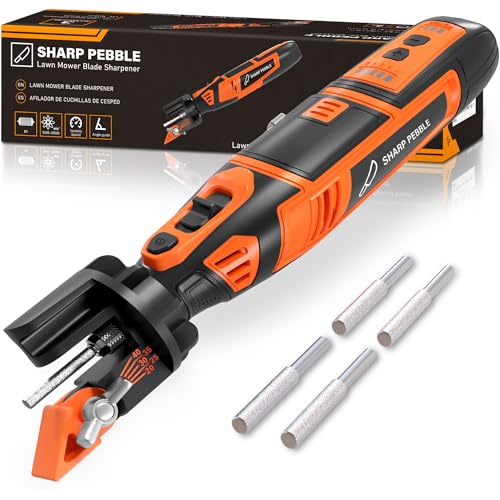
Pros
- Lets you sharpen blades without removing them from most standard mowers.
- Adjustable angle guide helps maintain consistent edge geometry.
- Cordless operation offers freedom to move around the yard.
- Variable speed provides flexibility for different blade conditions.
- Lightweight and easy to handle, especially for quick touch-ups.
Cons
- Not intended for zero-turn or heavy-duty commercial blades.
- Only a sharpener - cannot repair chipped or deeply damaged blades.
- Battery life may only cover 1-2 blades per charge, requiring recharging for multiple mowers.
The Sharp Pebble Cordless Lawn Mower Blade Sharpener is a practical tool for homeowners who want to keep their mower blades sharp without the hassle of removal or the expense of professional sharpening. Designed for standard residential blades, it aims to make routine maintenance quick and convenient. This kit is best suited for those who mow regularly and want to maintain a clean cut for a healthier lawn.
In terms of performance, this sharpener can handle light to moderate edge dulling in about 2-3 minutes per blade when used on the mower, according to the product description. For badly worn edges, removal is recommended for better results. The adjustable angle guide (20-40 degrees) allows you to match your blade's factory bevel, which is crucial for effective cutting. The variable speed control (5,000-30,000 RPM) gives you the flexibility to work at a pace that feels right for the task. The cordless, lightweight design means you can take it to your mower wherever it sits, without dragging a cord.
Build quality appears solid for a home-use tool, with an ergonomic grip and a compact form factor. The adjustable angle guide feels sturdy when tightened, and the variable speed trigger offers good control. It's not designed for heavy-duty or commercial use, but for the average suburban lawn owner, it should hold up well over a season of regular touch-ups.
Setup is straightforward - charge the battery, set your desired angle, and you're ready to go. Storage is easy thanks to its small size. Maintenance is minimal: just keep the tool clean and the battery charged. This tool is especially handy for those who prefer to do quick sharpenings between mows, helping to extend blade life and reduce the need for replacements.
One realistic limitation is that this sharpener is only for standard residential blades - it won't work on zero-turn or heavy-duty commercial blades. Also, it's a sharpener, not a grinder, so if your blades have chips, dents, or missing metal, you'll need a grinder first. Battery life covers 1-2 blades per charge, which is fine for a single mower but may require a recharge for multiple blades.
Overall, the Sharp Pebble Cordless Lawn Mower Blade Sharpener is a solid choice for homeowners who want an easy, cordless way to maintain their mower blades. It's practical, adjustable, and offers good value for those who prefer to keep their equipment in top shape between professional sharpenings or replacements. If you have a standard residential mower and want a quick, no-fuss sharpening solution, this kit is worth considering.

Pros
- Easy to install and use with any drill - no special skills needed
- Durable brown corundum stone handles high temperatures without melting
- Stainless steel base adds strength and longevity compared to plastic models
- Affordable price point makes it accessible for budget-conscious homeowners
Cons
- Requires a power drill (not included) and a steady hand for even sharpening
- May need multiple passes to fully sharpen very dull or nicked blades
- Small size limits sharpening to blades that can be easily clamped or removed
If you own a lawn mower, you know that dull blades can turn a quick Saturday morning mow into a frustrating, uneven mess. The IRONHIT Lawn Mower Blade Sharpener is a straightforward tool designed to bring old blades back to life using any standard power drill. Made with a brown corundum stone and a stainless steel base, this sharpener is built for homeowners who want to maintain their equipment without spending a lot of money or time.
Performance-wise, this tool does exactly what it promises. Once you attach it to your drill (set around 4000 RPM), you can sharpen a dull blade in just a few minutes. The brown corundum material is tough and heat-resistant, so it won't break down easily even during extended use. Many users find that a quick sharpening session restores a clean cut, which helps your mower handle grass more efficiently and reduces the need for multiple passes. This is especially useful during spring growth or after hitting a hidden rock.
Build quality is a highlight here. The stainless steel base is a smart upgrade over cheaper plastic versions that can crack or warp over time. It feels solid in the hand and holds the stone securely, which makes the sharpening process more stable and predictable. The stone itself is dense and seems durable enough for regular maintenance throughout a typical mowing season.
Setup and storage are about as simple as it gets. You just insert the sharpener into your drill chuck like a drill bit, and you're ready to go. It takes about 10 seconds to install. When you're done, the compact size (2 x 1 x 1 inches) means it can easily fit in a toolbox or hang on a pegboard in the garage. No complicated assembly or special maintenance is required - just wipe it clean and store it dry.
Of course, there are a few limitations. The sharpener works best with blades that are already removed from the mower, so you'll need to take off the blade first. It also requires a steady hand and some practice to get an even edge, especially if the blade is heavily nicked or worn. And since the drill is not included, you'll need to have one on hand. But for the price, these are minor trade-offs.
Overall, the IRONHIT Lawn Mower Blade Sharpener is a practical, no-fuss solution for anyone who wants to keep their mower cutting clean without frequent blade replacements. Whether you're a first-time buyer or a seasoned lawn care enthusiast, this tool offers good value and solid performance. If you're looking for an affordable way to maintain your mower, trimmer, or garden tools, this sharpener is worth adding to your shed.

Pros
- Powerful motor and durable build reduce vibration and provide stable sharpening
- Ceramic wheel and included sandpapers offer long-lasting performance
- Dual angle brackets and blade balancer help achieve professional-quality results
- Wide compatibility with most residential mower blade types
- Easy setup with included accessories – no extra tools needed
Cons
- At 35 pounds, it is relatively heavy and not easily portable
- May require some practice to get consistent sharpening angles on curved blades
- Only designed for mower blades – not suitable for other garden tools like shears or pruners
This lawn mower blade sharpener from Holdwell S is a dedicated bench grinder built to restore the cutting edge on various mower blades. It is best suited for homeowners who prefer to maintain their own equipment, as well as small landscaping businesses looking for a reliable sharpening solution. The 2/3HP 500W motor provides ample power for most residential blades, and the aluminum housing helps dissipate heat during extended use.
Based on product specifications, the 7-inch ceramic 60-grit wheel delivers fast material removal while leaving a clean edge. The included 30° and 40° angle brackets allow you to set a consistent sharpening angle for different blade profiles—whether you use standard flat blades, high-lift blades, or gator blades. After sharpening, the included blade balancer helps you check for balance, which can reduce vibration and extend the life of your mower.
Build quality appears solid: the steel base and integrated motor design aim to minimize vibration and keep the grinder stable during operation. The unit weighs 35 pounds, so it will stay put on a workbench, but it is not intended for frequent relocation. The 7-inch wheel is larger than many bench grinders, which helps sharpen longer blades more evenly.
Setup is straightforward with three main steps, and the package includes extra sandpapers, a screwdriver, and a user manual. The six blade hole adapters let you secure blades with different center hole sizes, preventing slippage while sharpening. Maintenance is minimal—just replace the sandpaper as needed and keep the wheel clean.
A realistic limitation is that this sharpener is purpose-built for mower blades. It is not a multi-purpose grinder for other tools, so you will need a separate solution for shears, hedge trimmers, or chainsaws. Also, new users may need a few attempts to get the hang of holding the blade steady against the bracket, especially with curved gator blades.
Overall, if you mow a decent-sized lawn and want to keep your blades sharp without sending them out, this grinder offers good value. The combination of a powerful motor, ceramic wheel, and included accessories makes it a practical addition to any garage or workshop. For homeowners who prefer a hands-on approach to lawn care, it is a worthwhile investment.
This sharpener works with high-lift, low-lift, gator, and flat mower blades commonly found on push mowers, riding mowers, and zero-turn mowers. The included 6 blade hole adapters fit various center hole diameters, ensuring a secure grip during sharpening. The 7-inch wheel accommodates blades up to about 20 inches long. Always check your blade’s hole size and shape before use.

Pros
- Powerful 1HP motor handles even badly worn blades without bogging down.
- Ceramic grinding wheel runs cool and lasts longer than traditional stones.
- Blade balancer included helps prevent vibration and uneven cutting after sharpening.
- Dual angle brackets accommodate a wide variety of blade designs.
- Solid steel build reduces shaking and provides long-term durability.
Cons
- Price point may be high for homeowners who only sharpen blades once or twice a year.
- Requires some assembly and a learning curve to set the correct angle and pressure.
- Only designed for lawn mower blades, not other cutting tools like shears or pruners.
The JLD Lawn Mower Blade Sharpener is a purpose-built tool for anyone who wants to keep their mower blades in top shape without relying on a professional sharpening service. Whether you maintain a small suburban lawn or a larger rural property, this machine is designed to handle the most common blade types—high lift, low lift, gator, and flat blades—with precision and speed. It's especially well-suited for homeowners who mow frequently and want to extend blade life, improve cut quality, and reduce stress on their mower's engine.
In terms of performance, the 1HP motor delivers consistent power at 1750 RPM, which is enough to quickly remove nicks and dull edges from even heavily used blades. The 9-inch 60-grit ceramic grinding wheel provides a smooth, cool grind that helps prevent overheating and blade damage. You can switch between the included 30° and 40° angle brackets to match the factory bevel of most blades, ensuring a clean, sharp edge every time. The machine also comes with a blade balancer, so you can check for even weight distribution after sharpening—a crucial step to avoid vibration and uneven cuts during mowing.
Build quality is a strong point here. The JLD sharpener uses thick steel plates for the frame and base, which keeps the unit stable during operation. The base has rubber feet to further reduce movement, and the overall assembly feels solid. The ceramic sandpaper discs are easy to replace, and the kit includes four discs total (two pre-installed) plus a spark guard and mounting screws. Setup is straightforward, though you will need to bolt the unit to a workbench or sturdy surface for best results.
Maintenance is simple: swap out the sandpaper discs when they wear, and periodically clean the grit collector to keep the workspace tidy. The dual angle brackets are quick to change, and the blade hole adapters ensure a snug fit for most blade center holes. One thing to note is that this sharpener is designed exclusively for lawn mower blades—it won't work for other garden tools like hedge trimmers or chainsaws. Also, if you only sharpen blades once a season, the $230 price tag might feel steep compared to a manual file or a bench grinder, but for frequent users, the time saved and consistent results make it worthwhile.
Overall, the JLD Lawn Mower Blade Sharpener is a smart investment for anyone serious about lawn care. It eliminates the hassle of removing and replacing blades or paying for professional sharpening, and it helps your mower cut cleaner, which is better for your grass. If you have a collection of mower blades to maintain and value precision, durability, and convenience, this machine is well worth considering.

Pros
- Very affordable solution for blade maintenance
- Simple to install and use with any standard drill
- Works on a wide range of blades beyond just mowers
- Sturdy construction from double-layer corundum
Cons
- May not be suitable for very thick or hardened blades
- Requires a drill and some manual effort for best results
- Limited to sharpening only the cutting edge, not for reshaping severely damaged blades
Keeping your lawn mower blades sharp is one of the most important steps for a clean, healthy lawn. Dull blades tear grass instead of cutting it, leaving ragged edges that turn brown and invite disease. The Bneykrir 4Pcs Lawn Mower Blade Sharpener offers a simple, low-cost way to maintain your blades right at home using any power drill you already own.
This set includes four sharpening stones made from double-layer corundum, a material known for its hardness and durability. Each stone is designed to mount quickly onto your drill's chuck—installation takes about 10 seconds. Once attached, you run the spinning stone along the edge of your mower blade to restore a sharp cutting surface. Based on user feedback, this method is effective for most standard lawn mower blades, including those on push mowers, riding mowers, and even tractor blades.
The sharpener is lightweight and compact, making it easy to store in a toolbox or garage drawer. Because it comes as a 4-pack, you have extras to keep in your shed, share with a neighbor, or use for different tools. The corundum construction holds up well over multiple uses, though like any abrasive stone, it will eventually wear down with heavy use.
One of the biggest advantages is the cost savings. Instead of paying for professional sharpening or buying new blades every season, you can touch up your blades in minutes. This is especially useful for homeowners who mow frequently and want to maintain peak cutting performance without a big investment. The process also helps keep your blades balanced, which reduces vibration and wear on your mower's engine.
However, there are some limitations. This sharpener is best for routine maintenance on moderately dull blades. If your blades are deeply nicked, bent, or heavily worn, you may need to replace them or use a grinder first. Also, while the product works with any drill, achieving a consistent edge takes a steady hand and some practice. It's not as precise as a dedicated sharpening guide or professional service.
Overall, the Bneykrir blade sharpener is a practical choice for the budget-conscious homeowner who wants to keep their mower running efficiently. It's easy to use, versatile, and delivers good results for the price. If you're looking for a no-fuss way to extend the life of your blades and get a better cut, this set is worth adding to your lawn care toolkit.
Pros
- Powerful motor (1HP) provides ample torque for sharpening even dull blades quickly.
- Ceramic wheel is more durable and runs cooler than traditional wheels, reducing blade overheating.
- Includes both 30° and 40° angle brackets for versatility across different blade designs.
- Comes with blade balancer and multiple hole adapters, adding value and convenience.
- Heavy build (43 lbs) ensures stability during use, reducing wobble.
Cons
- Weight of 43 lbs makes it less portable; requires a dedicated workspace or bench.
- No user reviews yet, so real-world performance feedback is limited.
- Price point ($172.99) may be higher than simpler manual sharpeners, though it offers more features.
The Holdwell S Lawn Mower Blade Sharpener is a bench grinder designed specifically for sharpening lawn mower blades. It suits homeowners, gardeners, and landscaping enthusiasts who want to maintain their mower blades for optimal cutting performance. Instead of replacing blades frequently, this sharpener allows you to restore edges quickly and consistently.
Based on product specifications, the 1HP motor and 9-inch ceramic wheel deliver efficient sharpening. The 60-grit wheel removes metal effectively without excessive heat buildup, which can weaken blade steel. The dual angle brackets (30° and 40°) accommodate most blade types, including high-lift, low-lift, gator, and flat blades. This versatility means you can sharpen blades for push mowers, riding mowers, and even some commercial equipment.
Build quality appears robust: the solid steel base and integrated design reduce vibration, and the aluminum-housed motor aids heat dissipation. The unit weighs 43 pounds, which adds stability during operation but limits portability. It's best suited for a permanent spot in a garage or workshop.
Setup is straightforward with a 3-step assembly process. The package includes extra sandpapers, a blade balancer, and six hole adapters—all useful for maintaining blade balance and fit. The balancer is a nice touch because unbalanced blades can cause mower vibration and damage.
One realistic limitation is the weight, which makes it less convenient to move around. Also, because there are no user reviews yet, it's hard to gauge long-term reliability. The price is higher than basic manual sharpeners, but the motorized convenience and included accessories justify the cost for regular users.
For anyone serious about lawn care and wanting to extend blade life, this sharpener is a practical investment. It's particularly useful for those with multiple mowers or large properties where sharp blades are essential for clean cuts and healthy grass. If you prefer a simple, low-cost option, a manual file may suffice, but for consistent, professional results, the Holdwell S is worth considering.
The Holdwell S blade sharpener comes with several useful accessories: extra replacement sandpapers for long-term maintenance, a blade balancer to check balance after sharpening, and six blade hole adapters to fit different mower blade center holes. These items add value and make the sharpener ready to use out of the box.

Pros
- Adjustable angle range covers most common blade sharpening needs, from 15 to 45 degrees.
- Compatible with many angle grinders thanks to multiple guide pins, reducing setup hassle.
- Sturdy construction and precise fit between bushings and pins minimize wobble for cleaner sharpening.
- Easy to mount on a workbench and adjust with thumb screws, making it user-friendly for first-time sharpeners.
Cons
- Requires an angle grinder (not included), so you need to own or purchase one separately.
- May not fit very narrow or unusually shaped blades outside the 1.65-3.60 inch width range.
- Some users might find the initial setup takes a few tries to get the angle exactly right.
The SporGain Lawn Mower Blade Sharpener is a practical accessory for homeowners who want to keep their mower blades sharp without spending a lot on professional sharpening. This tool is designed to work with most angle grinders, making it a versatile addition to any DIY lawn care kit. It's especially useful for those who mow their own lawns and notice that dull blades leave ragged cuts, which can stress the grass and lead to a less healthy lawn.
Based on product specifications and user feedback, the sharpener offers an adjustable angle range from 15 to 45 degrees. This flexibility allows you to match the sharpening angle to different blade types, including standard straight blades, mulching blades, and high-lift blades. Many homeowners may find this helpful for achieving a cleaner cut that helps grass recover faster and look better. The tool accommodates blades from 1.65 to 3.60 inches wide, covering most residential mower blades.
Build quality appears solid, with durable materials that should hold up to repeated use. The four guide pins included help ensure compatibility with various angle grinders, and the precise fit between bushings and pins reduces wobble during sharpening. This stability is important for maintaining a consistent edge and avoiding uneven sharpening that could affect cutting performance.
Setup is straightforward: you mount the sharpener on a table or workbench, adjust the angle and blade position using thumb screws, and then run your angle grinder along the blade. The simple design means you can sharpen multiple blades quickly, which is handy for maintaining several mowers or tackling a stubborn dull blade before your Saturday mowing session. Storage is easy too, as the compact size fits neatly in a garage or shed without taking up much space.
One realistic limitation is that this sharpener requires an angle grinder, which you need to own or buy separately. Also, the blade width range (1.65-3.60 inches) may not fit every blade, especially very narrow or unusual shapes. Some users might need a few tries to get the angle dialed in perfectly, but overall the process is simple once you get the hang of it.
For budget-conscious homeowners who want to extend the life of their mower blades and improve cutting quality, the SporGain sharpener is a worthwhile investment. It saves money over professional sharpening and helps keep your lawn looking its best. If you already have an angle grinder and are comfortable with basic DIY tasks, this tool can become a regular part of your lawn care routine.
Step-by-Step Equipment Guide to Sharpening Mower Blades with a Grinder
Restoring a clean cutting edge to your mower blade transforms how cleanly your machinery manicures turfgrass. When a rotary mower operates at full throttle, blade tips achieve rotational velocities between 15,000 and 19,000 feet per minute. At those speeds, a dull or notched edge tears grass foliage instead of slicing it cleanly, leaving damaged leaf tissue that turns brown and invites turf disease. Using a mechanical grinder provides the fastest, most reliable method to eliminate impact notches and restore proper edge geometry across high-carbon steel blades.
Different grinding tools match different workshop environments and blade maintenance routines. Dedicated bench sharpeners equipped with ceramic grinding wheels provide rigid angle brackets for consistent passes, while handheld angle grinders paired with adjustable guide jigs offer flexible benchtop setups. Compact rotary tools and drill-powered corundum stones handle quick edge touch-ups when severe metal removal is unnecessary. Regardless of your chosen grinding equipment, mastering proper bevel calibration, controlled heat dissipation, and static balance testing ensures clean cutting passes across your lawn.
Essential Safety Isolation and Workspace Staging
Safety preparation must begin before any hand tool touches a deck spindle bolt. On gasoline-powered mowers, disconnect the spark plug wire and position the boot away from the terminal to eliminate accidental engine ignition. For cordless electric mowers, remove the high-voltage safety key and slide out all battery packs from the chassis before handling the deck. When servicing riding tractors or zero-turn mowers, engage the mechanical parking brake, lower the deck to its lowest setting, and chock the drive wheels securely.
Removing the blade requires immobilizing the spindle shaft to prevent rotation while loosening the mounting hardware. Wedge a heavy block of scrap hardwood between the blade tip and the inner deck baffle to counter the force of your wrench. Note the spindle bolt thread direction before applying heavy torque. Standard residential decks generally use right-hand threads that loosen counterclockwise, but commercial zero-turns with timed counter-rotating spindles may feature left-hand reverse threads on specific arbors.
Personal protective equipment shields the operator from high-speed metal shavings and abrasive particles during grinding. Grinding wheels throw hot sparks and abrasive grit that can cause serious eye injuries without full coverage. Wear ANSI-rated safety glasses paired with a full-face polycarbonate shield, along with heavy split-cowhide work gloves to protect your hands from razor burrs. High-RPM grinding motors also generate high-frequency sound, making hearing protection essential throughout the operation.
Inspecting Blade Integrity and Wear Limits
Thorough visual inspection determines whether a mower blade can be safely sharpened or must be replaced. Scrape away packed grass clippings and caked dirt with a wire brush or putty knife to reveal the bare steel surface. Examine the curved lift sail behind the cutting edge for signs of severe metal thinning. Mowing in dry, sandy soils creates abrasive sandblasting inside the deck, which gradually erodes the lift wings until the steel becomes dangerously thin and prone to fracture.
Inspect the center arbor hole and blade body for cracks, twists, or structural bends. Place the blade on a flat steel workbench to verify that both cutting wings sit parallel along the horizontal plane. If the blade shows twisted tips, a warped hub, or cracks radiating from the center hole, discard it immediately. Grinding a cracked or bent blade cannot restore its structural strength and creates severe hazards at high rotational speeds.
Distinguish between routine edge dulling and severe blade impact damage when planning your grinding approach. Light edge wear and small surface burrs can be touched up quickly with portable rotary sharpeners or drill stones. Blades with deep stone gouges or rolled edges require the higher material removal rate of an angle grinder or bench machine. The Sharp Pebble Cordless Lawn Mower Blade Sharpener handles routine maintenance on standard residential blades, but blades with deep chips require a primary grinding wheel first.
Selecting Grinding Equipment and Abrasive Media
Choosing the right grinding tool depends on your blade inventory, workshop space, and maintenance schedule. Dedicated bench blade grinders use aluminum-housed motors engineered to maintain steady RPM under continuous steel contact. The Lawn Mower Blade Sharpener pairs a 2/3-horsepower 500W motor with a 7-inch ceramic wheel for stable benchtop operation. Heavy-duty commercial units like the JLD Lawn Mower Blade Sharpener and the Holdwell S Lawn Mower Blade Sharpener feature 1-horsepower 750W motors and 9-inch 60-grit ceramic wheels to reshape thick blades rapidly.
Angle grinders offer a versatile alternative when paired with precision guide hardware. Freehand angle grinding often results in wavy bevels, uneven angles, and excessive metal removal across the cutting wing. Clamping fixtures like the SporGain Lawn Mower Blade Sharpener,15°-45°Adjust stabilize the grinder body using guide pins and precision bushings. This fixture accommodates blade widths from 1.65 to 3.60 inches on a standard workbench, allowing the user to guide the wheel smoothly at a controlled angle.
Drill attachments provide an affordable option for routine blade touch-ups on residential walk-behind equipment. Sharpening kits like the IRONHIT Lawn Mower Blade Sharpener and the Bneykrir 4Pcs Lawn Mower Blade Sharpener,Universal feature double-layer brown corundum stones mounted on standard drill arbors. Running these abrasive stones around 4,000 RPM allows the tool to hone dull factory bevels without dedicated bench machinery. Units built with stainless steel base plates prevent premature friction wear against the blade spine during sharpening passes.
Calibrating the Cutting Bevel Angle and Edge Profile
Establishing the correct bevel angle balances clean grass shearing against long-term edge durability. Most residential mower blades feature a factory 30-degree cutting bevel, which provides an effective compromise between sharp cutting action and impact resilience. Commercial blades operating in rocky or rough turf often utilize a steeper 40-degree bevel. Steeper angles support more steel directly behind the cutting edge, reducing the likelihood of chipping when striking small obstacles.
Adjustable sharpening brackets ensure consistent bevel angles across various blade designs. Dedicated bench grinders often supply pre-set 30-degree and 40-degree brackets that lock the blade guide in fixed alignment with the wheel. Multi-angle guide jigs allow custom adjustments from 15 to 45 degrees, accommodating low-lift, high-lift, flat, and specialty mulching blades. Maintaining accurate edge geometry across both cutting wings ensures uniform resistance and clean discharge inside the deck chamber.
A common misconception is that lawnmower blades should be sharpened to a razor-thin edge. A razor edge lacks structural mass, causing the microscopic cutting tip to roll over, chip, or dull rapidly in thick turf. Professional maintenance standards target a working edge with a blunt leading flat measuring approximately 1/32 of an inch, comparable to a butter knife. This blunt leading flat withstands impacts from small debris while slicing grass foliage cleanly at high blade tip speeds.
Step-by-Step Lawnmower Blade Grinding Technique
Secure the mower blade firmly in a heavy bench vise or clamp it into your sharpening guide fixture. Orient the blade with the original top bevel facing upward toward your working hand. Rest the blade flat against the guide bracket to establish uniform contact with the abrasive wheel. Start the motor and allow the grinding wheel to reach its rated operating RPM before introducing the blade edge.
Make smooth, continuous passes across the length of the cutting bevel, moving from the inside heel outward toward the blade tip. Maintain light to moderate pressure throughout each pass, avoiding the urge to grind heavily in one spot to remove deep gouges. Pausing in one area concentrates friction, which overheats the steel and distorts the straight cutting line. Continue making steady, even passes along the factory angle until the entire edge is clean and uniform.
Controlling friction heat preserves the metallurgical hardness of the carbon steel blade. If the metal turns straw-colored, bronze, or deep blue, excessive heat has compromised the heat treatment, leaving the steel soft and prone to rapid dulling. Keep a container of cool water next to your workstation and quench the blade frequently whenever it becomes warm to the touch. Ceramic grinding wheels running at moderate speeds generate noticeably less heat buildup than coarse aluminum oxide bench wheels.
After sharpening the angled top bevel, inspect the flat underside of the cutting wing. Grinding the top bevel inevitably rolls a thin burr of displaced steel across the bottom edge. Place a flat hand file or fine dressing stone completely flat against the blade bottom and make a few light passes to remove the wire burr. Never grind an angle or bevel onto the bottom flat face, as modifying that surface degrades aerodynamic vacuum lift inside the mower deck.
Balancing the Blade for Vibration-Free Operation
Verifying blade balance is just as critical as achieving a sharp cutting bevel. Mower blades spin between 2,800 and 3,600 RPM, meaning an imbalance of only a few grams creates noticeable centrifugal vibration. This vibration transmits directly into the deck shell, causing operator fatigue, loosening fasteners, and accelerating spindle bearing wear. Checking and correcting balance after every sharpening session prevents mechanical deck damage and ensures smooth operation.
Check blade balance using a cone balancer, a magnetic wall-mounted balancer, or precision center hole adapters. Place the blade onto the balancer cone on a level workbench and observe whether one cutting wing dips downward. The wing that drops toward the bench contains excess mass and requires corrective material removal. Complete grinder kits from Holdwell S and Jinlida include static balancers and multi-size center hole adapters to fit various arbor hole diameters accurately.
When balancing a blade, never grind metal away from the freshly sharpened cutting edge or alter your bevel angle. Instead, remove steel exclusively from the heavy wing’s trailing back edge or the flat rear section of the lift sail. Making light grinding passes along the non-cutting rear spine reduces weight without degrading your sharpened edge geometry. Re-check the blade on the balancer after each light pass until it rests completely level.
Spindle Maintenance, Reinstallation, and Verification
Inspect the spindle assembly and clean the mounting hub before bolting the sharpened blade back into position. Dried grass clippings, dirt, and rust scale trapped between the blade and the spindle face create artificial blade wobble. Rotate the bare spindle by hand to check for bearing roughness, binding, or axial play that signals bearing wear. If the spindle housings feature grease zerks, pump fresh multi-purpose or marine grease into the fitting to purge moisture and lubricate the bearing cavity.
Position the blade against the spindle arbor, verifying that the cutting edge faces in the direction of deck rotation. The curved aerodynamic lift sails must point upward toward the underside of the deck to generate the air draft needed for clean discharge and bagging. Installing a blade upside down causes the blunt back spine to batter grass while pushing clippings downward into the turf. Reinstall the concave Belleville washer with its bowed crown facing the bolt head to maintain spring tension against the blade hub.
Thread the spindle bolt by hand to prevent cross-threading before tightening with a calibrated torque wrench. Tighten the hardware to the equipment manufacturer’s specified torque rating, which typically ranges from 35 to 50 foot-pounds on walk-behind mowers and 70 to 90 foot-pounds or more on commercial zero-turns. Correct torque prevents blade slippage under heavy cutting loads while avoiding stripped arbor threads. Reconnect the spark plug boot or install the battery pack, start the deck at low throttle, and confirm smooth, vibration-free operation before mowing.
Maintaining sharp blades directly enhances the performance of all mower types, including modern battery-operated lawn equipment that relies on low cutting resistance to maximize runtime per charge. Sharp cutting edges also improve airflow into discharge chutes and boost the collection efficiency of lawn tractor leaf collection setups during seasonal yard cleanups. Inspecting blades every twenty to twenty-five mowing hours ensures consistent, manicured turf health throughout the growing season.
Mastering how to sharpen a lawnmower blade with a grinder keeps your cutting equipment in peak mechanical condition while saving significant maintenance expenses over time. Taking measured passes, preserving a durable 1/32-inch leading edge, and confirming dynamic balance prevents costly spindle damage and guarantees clean grass shearing. Routine edge maintenance ensures your lawn maintains its lush green color, free from the ragged, brown-tipped stress caused by dull blades.


Write Your Review
No reviews yet. Be the first to share your experience!