


A riding mower that clicks instead of cranking after winter may have a discharged battery, but charging it without checking the battery type and condition can create new problems. Knowing how to trickle charge lawn mower battery means matching the charger to the battery chemistry, confirming correct polarity, and using a maintainer suited to a small 12-volt starting battery. A smart charger can help maintain a healthy battery during seasonal storage, but it cannot make a damaged or deeply failed battery dependable again.
Start by reading the battery label and the charger instructions rather than assuming every 12V charger is appropriate. Flooded lead-acid, AGM, gel, and LiFePO4 batteries can require different charging settings, and some chargers only support selected types. For context on physical fit and terminal orientation when replacement is necessary, see this guide to mower battery compatibility. The broader riding mower battery overview can also help explain why a replacement must match the mower’s requirements.
Top Products
Pros
- Versatile compatibility with both lead-acid (AGM, flooded, gel) and lithium (LiFePO4) batteries.
- Smart charging technology prevents overcharging and sulfation, extending battery lifespan.
- Compact and lightweight, easy to mount or store near your lawn mower.
- Safety features include spark-proof connections and reverse polarity detection.
Cons
- Only 800mA output, which may be slower for deeply discharged batteries compared to higher amperage chargers.
- Limited to 12V batteries; not suitable for 6V systems or larger equipment batteries requiring higher amperage.
- Some users may prefer a charger with a built-in display for voltage monitoring.
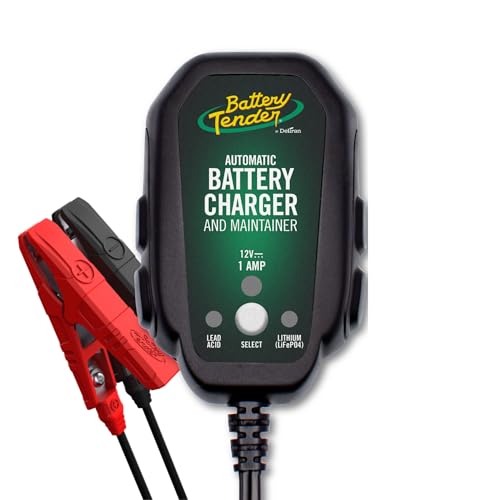
The Battery Tender Junior 12V 800mA charger and maintainer is a practical solution for homeowners who want to keep their lawn mower, motorcycle, ATV, or other powersport batteries in top condition. Designed for both lead-acid and lithium batteries, this compact device automatically adjusts its charging profile to match the battery type, ensuring optimal performance and longevity.
Many users appreciate the smart technology built into this charger. The microcontroller constantly monitors the battery's state and adjusts the charge rate accordingly, preventing overcharging and reducing the risk of sulfation in lead-acid batteries. This is especially useful for seasonal equipment like lawn mowers that sit idle during winter months. The 800mA output is sufficient for maintaining a charge, though it may take longer to revive a deeply discharged battery compared to higher-amp models.
Safety is a key feature of the Battery Tender Junior. It is spark-proof during connection and automatically detects reverse polarity, ensuring a correct hookup before delivering power. This gives peace of mind, especially for those who are not experienced with battery maintenance. The unit also holds multiple safety certifications, including ETL US/CSA, FCC, and ICES, and comes with a 5-year warranty.
Setup is straightforward: simply connect the ring terminals or alligator clips to the battery, plug the charger into a standard outlet, and select the battery type with the push of a button. The compact size (4.4 x 2.9 x 2.15 inches) and lightweight design (under 1 pound) make it easy to store in a garage or shed, or even mount near your equipment.
A potential limitation is the low amperage, which means it's best suited for maintaining batteries rather than charging deeply discharged ones. For larger batteries or faster charging, a higher-amp model may be more appropriate. Additionally, it only works with 12V batteries, so it cannot be used with 6V systems or some larger equipment.
Overall, the Battery Tender Junior is a reliable and affordable option for anyone who wants to prolong the life of their lawn mower or powersport battery. It's ideal for seasonal use, helping to ensure your equipment starts reliably when you need it. For most homeowners with small to medium-sized batteries, this charger offers excellent value and convenience.
Pros
- Affordable price point for a smart charger with maintainer and desulfator functions
- Temperature compensation helps protect battery in extreme weather conditions
- Multiple safety features reduce risk of damage to battery or charger
Cons
- Desulfation mode may not revive completely dead or deeply discharged batteries
- Only 6-amp output may be slower for larger batteries used in riding mowers or tractors
- Some users might prefer a charger with a higher amp rating for faster charging
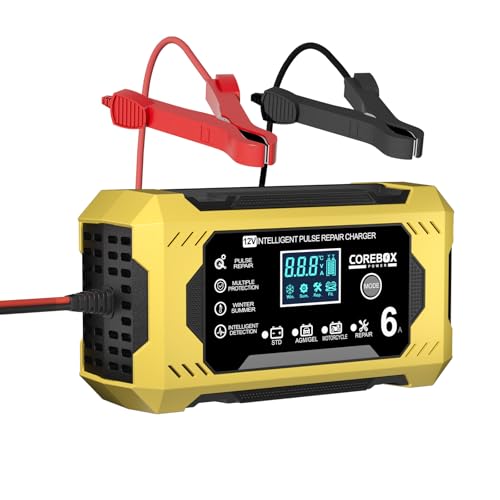
The Corebox 6-Amp automatic battery charger is designed to be an all-in-one solution for maintaining and extending the life of 12V lead-acid batteries. While it's marketed for cars, trucks, and motorcycles, it is especially useful for homeowners with lawn mowers, riding mowers, or other outdoor power equipment that sits idle during the winter months. Instead of pulling out a dead battery in spring, you can simply hook up this charger to keep it topped off and ready to go.
Based on product specifications, the 7-stage charging process includes desulfation, soft start, bulk charge, analysis, recondition, float, and pulse maintenance. This intelligent sequence helps optimize battery power and can even restore some lost performance from sulfation. Many homeowners may appreciate the pulse repair feature, which uses slow pulses to break down sulfate crystals on battery plates. However, the product description notes it cannot repair a totally dead battery, so it's best for batteries that still hold some charge.
Build quality appears solid with high-quality copper wire and a 7-foot cable that offers flexibility in placement. The charger is housed in a yellow casing with a cooling system to prevent overheating. Safety features are comprehensive: reverse polarity protection, overcurrent, overcharge, short circuit, and temperature compensation. The temperature compensation is a standout for those in regions with harsh winters or hot summers, as it adjusts the charging voltage to prevent over- or under-charging.
Setup is straightforward—just connect the clamps to the battery terminals and plug in. The automatic mode means you don't need to monitor it; it switches to float mode when the battery is full. For a lawn mower battery, this is ideal for long-term storage. The compact size makes it easy to store in a garage or shed when not in use.
A realistic limitation is the 6-amp output. While sufficient for smaller batteries like those in push mowers or garden tractors, it may take longer to charge larger batteries in zero-turn mowers or lawn tractors. Also, the desulfator may not work miracles on severely degraded batteries. Some users might prefer a higher-amp model for faster charging.
Overall, the Corebox charger is a practical and affordable tool for any homeowner who wants to avoid the frustration of a dead lawn mower battery. It's especially suited for those who store their equipment for extended periods or live in climates with temperature extremes. If you're a budget-conscious shopper looking for a reliable maintainer, this charger offers good value for the price.
The Corebox charger is compatible with all 12V lead-acid batteries, including flooded, AGM, GEL, and SLA types. This covers the vast majority of lawn mower batteries, from small push mower batteries to larger riding mower batteries. The 6-amp charging rate is ideal for maintaining batteries during storage, but it can also charge a moderately discharged battery overnight. For very large batteries (100Ah+), a higher amp charger may be more practical for quick recharging.
The temperature compensation function is a highlight—it automatically adjusts the charging voltage based on ambient temperature, which helps prevent overcharging in hot weather and undercharging in cold weather. This is particularly beneficial for outdoor power equipment stored in unheated garages or sheds.

Pros
- Two-pack provides great value and convenience for maintaining multiple batteries simultaneously.
- Comprehensive safety features protect against common charging mistakes.
- 10-foot cable offers excellent reach for batteries in hard-to-access locations.
- Works with a variety of 12V lead-acid batteries, making it versatile for different equipment.
- Desulfation mode can help revive older batteries and extend their usable life.
Cons
- Not a jump starter—only maintains or trickle charges batteries, so it won't start a dead battery.
- LED indicators could be brighter for easier reading in dim garage lighting.
- Some users may prefer a single, higher-amp charger for faster charging of deeply discharged batteries.
If you own a lawn mower, riding mower, ATV, motorcycle, or even a car, you know the frustration of a dead battery—especially when you're ready to mow on a Saturday morning. The HECHOBO 2-Pack 12V 2A Battery Charger is designed to prevent that headache. This is a trickle charger and maintainer, not a jump starter, so its job is to keep your battery topped off and healthy over long periods of storage or infrequent use. It's a practical tool for anyone who wants to avoid the cost and hassle of replacing batteries prematurely.
Performance-wise, this charger delivers a steady 2-amp charge that's perfect for maintaining 12V lead-acid batteries, including AGM and gel types. The intelligent interface automatically monitors the battery's condition and adjusts the charge rate to prevent overcharging. It also includes a desulfation mode that can help break down sulfate crystals on battery plates, potentially restoring lost capacity in older batteries. While you won't get a quick jump-start, the slow, steady trickle charge is ideal for keeping batteries in peak condition during off-seasons.
Build quality is reassuring for a budget-friendly product. The charger features an ABS flame-retardant shell that resists fire and electric shock, and built-in protection against reverse polarity, over current, overload, and over voltage. The 10-foot charging cable gives you plenty of reach to connect to batteries mounted in tight spots—like under the seat of a riding mower or in a boat's engine compartment. The LED indicators are simple but effective, showing charging status at a glance.
Setup is straightforward: just connect the alligator clips to the battery terminals, plug the charger into a standard wall outlet, and let it do its work. There's no complicated programming or settings to adjust, which makes it accessible for first-time users. The compact size means it won't take up much space in your garage or shed, and having a two-pack allows you to maintain multiple batteries simultaneously—handy if you have both a lawn tractor and a motorcycle, for example.
One realistic limitation is that this is strictly a maintainer, not a jump starter. If your battery is completely dead, this charger won't bring it back to life quickly; you'll need a higher-amp charger or a jump starter for that. Also, the LED indicators could be a bit brighter for easier reading in dim light. But for its intended purpose—keeping batteries healthy during storage—it performs reliably.
Overall, the HECHOBO 12V 2A Battery Charger is a solid investment for any U.S. homeowner who wants to extend the life of their batteries and avoid unexpected starting issues. It's especially useful for those who store lawn mowers, ATVs, or seasonal vehicles over winter. If you're looking for a simple, safe, and affordable way to maintain multiple batteries, this two-pack is a smart choice.

Pros
- Smart 4-step charging prevents overcharging and extends battery life—great for lawn mowers stored over winter.
- Quick disconnect harness makes it easy to hook up and remove without tools.
- Compact and lightweight, easy to store in a small garage or shed.
- 10-year manufacturer's warranty and lifetime customer support add confidence.
Cons
- 1.25 amp output is relatively low, so charging a deeply discharged battery can take several hours.
- Some users may prefer a higher amp model for faster charging of larger batteries.
- Price is slightly higher than basic trickle chargers, but the smart features justify the cost.
The Battery Tender Plus is a 12V, 1.25 amp smart battery charger and maintainer designed to keep your lawn mower, car, motorcycle, or ATV battery in top condition. For homeowners who store their mower over winter or only use it occasionally, this charger is a practical investment. It automatically adapts to the battery's needs, delivering the right amount of charge without overdoing it—something a basic trickle charger can't promise.
In terms of performance, the 4-step charging program first analyzes the battery, then charges it safely, and finally switches to a float mode that maintains the battery at full charge. This process helps prevent sulfation, a common cause of battery failure in seasonal equipment like lawn mowers. The included ring terminal and alligator clip cables give you flexibility, and the quick disconnect harness means you can leave the ring terminals attached to your mower battery and simply plug in the charger when needed. The two-color LED status light clearly shows charging progress and indicates if the battery voltage drops too low, automatically resuming full output.
Build quality is solid—the unit is compact (about 4.9 x 3.3 x 2.9 inches) and weighs just 1.45 pounds, making it easy to store on a garage shelf or hang on a wall. The cables feel durable, and the 10-year manufacturer's warranty speaks to the brand's confidence. While it's not designed for heavy-duty shop use, it's perfectly suited for maintaining a single battery at a time.
Setup is straightforward: attach the ring terminals or alligator clips to your battery, plug the charger into a standard 120V outlet, and let it do its job. No complicated programming or monitoring required. For storage, the compact size means it won't take up much space, and the quick disconnect harness makes it easy to pop on and off without tools. Maintenance is minimal—just keep the connections clean and dry.
One limitation is the 1.25 amp charging rate. If your lawn mower battery is completely dead, it may take 8-12 hours to bring it back to full charge. That's fine for overnight or while you're at work, but if you need a quick boost, a higher amp charger might be better. Also, the price is a bit higher than basic trickle chargers, but the smart features and long warranty make it worthwhile for most homeowners.
Overall, the Battery Tender Plus is an excellent choice for anyone who wants to extend the life of their lawn mower battery with minimal effort. It's especially useful for seasonal storage, and the quick disconnect harness adds convenience that busy homeowners will appreciate. If you value battery longevity and hassle-free maintenance, this charger is a solid buy.

How to Charge and Maintain a Lawn Mower Battery Safely
A trickle charger or smart maintainer supplies a controlled charge to a battery that is not being used regularly. For a lawn tractor, the goal is to restore charge without using an unsuitable charging profile or leaving an uncontrolled charger attached indefinitely. Confirm the battery is a compatible 12V type, inspect it for damage, and follow the mower and charger manufacturers’ instructions. If the battery is swollen, cracked, leaking, unusually hot, or otherwise damaged, do not charge it.
Identify the battery and charger before connecting anything
Read the battery label to identify its nominal voltage and chemistry. These products are 12V chargers, but their listed battery support differs: the Battery Tender Junior 12V has selectable lead-acid and lithium settings, while the HECHOBO chargers described here are for 12V lead-acid batteries. COREBOX lists support for 12V lead-acid types including AGM, GEL, SLA, and flooded batteries. Do not infer compatibility with a chemistry or voltage that the charger manufacturer does not list.
A 12V LiFePO4 starting battery is not the same thing as a proprietary high-voltage cordless mower pack. A charger intended for a 12V battery must not be used on a 40V, 56V, 60V, or 80V tool battery unless the battery and charger manufacturers explicitly specify that pairing. Cordless packs use their own platform charger and battery-management arrangements. Match the charger to the exact battery system, not just to the word “lithium.”
Check the charger output and operating instructions, including whether it is intended for charging, long-term maintenance, or both. A smart maintainer monitors charging stages, while an old or unregulated trickle charger may continue supplying current in a way that is unsuitable for extended connection. The product descriptions characterize the Battery Tender Junior as a smart charger and maintainer, and the Battery Tender Plus as a four-step charger and maintainer. The COREBOX listing describes a seven-stage charging process and automatic shutdown when full; those features are product claims, not a reason to disregard the manual.
Check battery condition before charging
Park the mower on a stable surface, disengage the blades, remove the key, and let the engine and battery area cool. Work in a ventilated place, keep sparks and flames away, and wear eye protection and acid-resistant work gloves around lead-acid batteries. Inspect the case, posts, cables, and hold-down for cracks, leaks, corrosion, looseness, or signs of overheating. Do not charge a damaged battery or handle leaking electrolyte yourself.
If using a digital multimeter, set it to DC volts and check the battery’s resting voltage with the charger disconnected. A fully charged 12V lead-acid battery commonly rests around 12.6V to 12.8V, while about 12.2V indicates substantial discharge. A reading below 10.5V can indicate a failed or shorted cell, although a voltage reading alone does not establish the battery’s full condition. Let a recently charged battery rest before interpreting its reading because surface charge can briefly make the voltage appear higher.
Do not try to revive a visibly compromised battery by selecting a repair or desulfation mode. The COREBOX product information specifically warns that its repair function cannot repair a totally dead battery. Desulfation features do not guarantee that sulfation or internal damage can be reversed. If the battery will not accept charge, rapidly loses it again, or remains below the mower maker’s service limits, arrange a suitable battery test or replacement instead of leaving it on charge repeatedly.
Connect the maintainer with correct polarity
Use the charger maker’s connection sequence and the mower manual’s instructions. With a negative-ground system, remove the negative cable first if battery isolation is required; that reduces the chance of a tool bridging the positive terminal to the chassis. If you remove the battery, disconnect negative first and reconnect it last during installation. Keep metal tools from touching both a terminal and grounded metal, and do not allow clips to bridge the battery posts.
With the charger unplugged from its power source, attach the positive lead to the battery’s positive terminal and the negative lead to the negative terminal or the grounding point specified by the charger instructions. Verify the plus and minus markings directly on the battery rather than relying on cable color or terminal position alone. Then select the correct battery chemistry and charging mode, if the unit offers those choices, before supplying power. Stop if the charger reports reverse polarity or another fault; disconnect and correct the connection rather than forcing it.
Keep the charger and connections in a dry, ventilated location, with cables clear of hot engine parts, moving components, and sharp edges. Do not place a charger on the battery or obstruct its ventilation. Lead-acid batteries can release explosive gas during charging, so avoid smoking, flames, and sparks near the battery. If the manufacturer’s instructions require disconnecting the battery from the mower, follow that requirement rather than charging through the mower wiring.
Choose a suitable charging rate and monitor progress
A low-current charger is often a practical match for maintaining a small mower starting battery, but the battery maker’s allowable charge rate takes priority. The Battery Tender Junior is listed at 800mA, and the Battery Tender Plus at 1.25A. The HECHOBO units are listed at 2A, while the COREBOX is listed at 6A. These ratings are not interchangeable recommendations for every battery; confirm that the battery manufacturer permits the selected current.
Do not choose a faster setting simply to shorten the wait. Charging current that is too high for a small battery can cause excessive heat or damage, and an incorrect chemistry mode can apply an inappropriate charging profile. Keep the charger within the manufacturer’s specified temperature and ventilation conditions. If the battery becomes hot, swells, leaks, or gives off an unusual odor, stop charging safely and seek guidance.
Use the charger’s indicator lights or display as described in its manual; indicator colors and meanings differ by model. Some maintainers move from bulk charging to a float or maintenance stage after charging, while others may require disconnection once charging is complete. Do not assume that a charger can remain attached for the entire winter just because it is called a trickle charger. Confirm its maintenance behavior and the battery maker’s storage advice first.
The product listings offer distinct connection and status details that can matter in a cramped mower shed. HECHOBO’s two-unit 2A charger listing describes LED indicators and a 10-foot cable, while its single-unit lead-acid charger also lists LED status indicators. The Battery Tender Plus listing includes alligator clips and a fused ring-terminal accessory cable, plus a quick-disconnect harness. Choose based on battery chemistry, the charger instructions, cable access, and whether the accessory connections suit the mower installation.
Make sense of a battery that will not recover
A discharged but serviceable battery may regain charge, while a battery with a damaged cell or severe sulfation may not. After charging, disconnect the maintainer as directed and allow the battery to rest before checking voltage again. If voltage quickly falls or the starter only clicks, inspect for loose or corroded connections and have the battery load-tested. A resting voltage reading cannot show how well the battery performs under starter load.
Corrosion, a loose ground, or a damaged cable can prevent starter current from reaching the motor even when the battery is charged. With the mower off and isolated according to its manual, inspect the terminal connections and chassis ground for looseness or corrosion. Avoid scraping or brushing in a way that causes a short, and do not use household cleaners on battery internals. If acid is present, keep skin and eyes protected and follow the battery manufacturer’s cleanup instructions.
If the battery is repeatedly low after mowing, investigate the charging system instead of relying on a maintainer to mask the cause. A mower’s stator and voltage regulator should be evaluated using the service procedure for that machine; a general running-output benchmark is approximately 13.5V to 14.5V DC at operating speed, but model specifications can differ. A low or excessive reading may point to a charging-system issue, yet wiring, regulator, stator, and test conditions all matter. Seek qualified service if the procedure requires exposed moving parts or access to unfamiliar electrical connectors.
For a no-start that requires a jump, follow the mower and vehicle manuals and use only a compatible 12V system. The donor vehicle’s engine must remain OFF while connected to a 12V riding mower or zero-turn, to help prevent electrical damage to the mower’s stator and voltage regulator. Maintain positive-to-positive and negative-to-negative polarity as directed, keep clamps from touching, and disconnect in the order specified by the manuals. Jump-starting is not a substitute for diagnosing a battery that repeatedly discharges.
Keep seasonal storage from undoing a good charge
Lead-acid batteries lose charge while sitting, and a battery left discharged for an extended period can develop sulfation that limits its ability to accept and hold charge. Before winter storage, clean and secure the connections, then follow the battery and mower manufacturers’ guidance about leaving the battery installed or disconnecting it. Store it in a dry, protected location within the stated temperature limits. Check it periodically if the maker calls for periodic voltage checks or maintenance charging.
A smart maintainer can reduce the need for repeated manual charging when its manufacturer permits long-term use with the battery type. A basic trickle charger without automatic regulation should not be assumed safe for continuous attachment. Temperature compensation, automatic shutoff, and float maintenance are useful listed features, but their presence does not override the charger manual or battery instructions. Inspect cables and connections periodically so a damaged lead or poor contact does not go unnoticed.
Battery Tender Junior 12V is the option here whose product information explicitly lists selectable lead-acid and LiFePO4 settings. That flexibility applies to compatible 12V batteries, not to high-voltage cordless mower packs. The Battery Tender Plus is listed as a 12V, 1.25A four-step maintainer for applications including lawn mowers. COREBOX lists a 12V, 6A automatic charger with temperature compensation and several charging stages, while both HECHOBO listings describe 12V lead-acid maintenance charging.
Buyers should compare supported chemistry, current, charging behavior, cable reach, and connection accessories rather than relying on the word “trickle” alone. A lower-current unit may suit long-term maintenance when approved for the battery, while a higher-current charger may charge more quickly but still needs to match the battery’s permitted rate. Product descriptions do not establish compatibility with every mower battery, nor do they replace the mower’s electrical specifications. Check the exact battery label and manual before choosing.
Verify the mower after charging
Once the charger is removed, check that the battery terminals are secure and the hold-down prevents movement without crushing the case. If the mower starts, observe whether it cranks normally and whether the battery remains charged after use. A battery that repeatedly needs an external charge may be nearing failure, or the mower may have a charging fault or parasitic draw. Avoid replacing parts based on a single voltage reading.
Do not confuse starter batteries with cordless mower batteries when diagnosing runtime or charging. A gas riding mower typically uses a separate 12V starting battery, while a cordless machine’s traction battery belongs to its specific tool platform and must use the matching charger. Do not attempt to trickle-charge a cordless pack through its terminals with a 12V maintainer. If a cordless pack becomes unusually hot, swollen, or damaged, stop using it and follow its manufacturer’s handling and service guidance.
The practical sequence is straightforward: identify the battery chemistry, inspect for damage, verify polarity, select a compatible smart charger, and monitor it according to both manuals. If the battery will not accept charge or quickly goes flat again, investigate battery condition and mower charging output instead of extending charge time blindly. Correct matching and controlled maintenance help preserve a serviceable battery, but no charger can guarantee recovery from internal failure.


Write Your Review
No reviews yet. Be the first to share your experience!