


Clearing stubborn turf clippings, wet leaves, and driveway grit requires balancing kinetic velocity with overall air delivery. Determining what is a good air speed for a leaf blower depends on whether your yard work involves light patio dusting, blowing out packed grass beneath mower decks, or scouring waterlogged debris from dense turf. When standard raking or towing dedicated leaf collection equipment for lawn mowers leaves behind fine trimmings, high-velocity handheld airflow quickly finishes the cleanup job.
Air speed, measured in miles per hour (MPH), dictates the initial dislodging force necessary to strip stuck organic waste from hard surfaces and root zones. Modern cordless platforms have expanded significantly within battery-operated lawn tools, allowing homeowners to shift from low-velocity shop clearing to aggressive outdoor sweeping without managing gas mixtures. Selecting the appropriate blowing parameters ensures you can dislodge matted debris without unnecessarily gouging decorative mulch beds or depleting battery reserves in minutes.
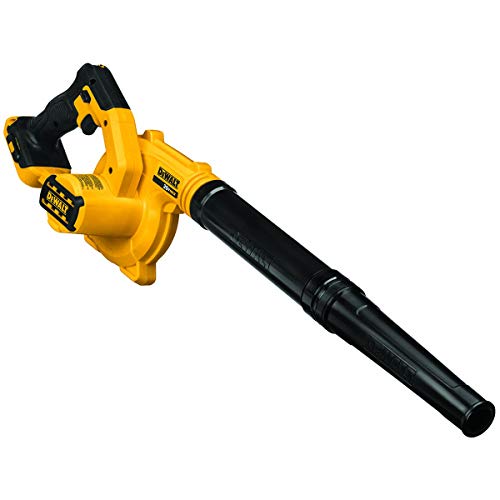
Pros
- Extremely light at 2.5 pounds for easy one-handed operation
- Three-speed switch and variable trigger give excellent airflow control around mulch and gravel
- Trigger lock feature minimizes hand cramps during extended cleaning sessions
- Compact shape reaches tight spots under outdoor furniture and behind planters
- Integrates effortlessly with existing DEWALT 20V power tool batteries
Cons
- Bare tool configuration means battery and charger must be purchased separately
- 100 CFM output is suited for hard surfaces and light yard debris rather than heavy, wet fall leaves
- Narrow air stream covers less surface area per pass than full-size yard blowers
The DEWALT 20V MAX DCE100B Compact Blower fills a specific and handy role in the outdoor power equipment lineup. Rather than attempting to move massive piles of wet, sodden autumn leaves across a two-acre lawn, this compact utility blower is built for quick precision cleanups. It is an appealing choice for homeowners, suburban lawn owners, and DIYers who want to tidy up walkways, sweep off back decks after a Saturday morning mow, or blast sawdust out of the workshop without dragging out heavy gas equipment.
In terms of performance, the blower produces up to 100 CFM of focused air movement. It features a three-speed selector switch on the side housing, paired with a variable-speed trigger. This dual-control setup lets you dial back the intensity when you are gently sweeping dry grass trimmings away from delicate flower beds, or crank it up to high when dislodging sand and acorns from sidewalk expansion joints. The included trigger lock is a helpful feature, allowing you to maintain continuous airflow during steady driveway sweeps without holding down the trigger.
Build quality matches the rugged standard expected from DEWALT outdoor tools. The impact-resistant yellow composite housing withstands everyday bumps against masonry, concrete floors, and wheelbarrows. The tool includes three nozzle attachments: a standard extension tube, an inflator/deflator tip, and a curved tube that aids in directing air beneath low patio chairs or into tight workbench corners. Despite its durable exterior, the bare tool weighs a mere 2.5 pounds, making it one of the easiest outdoor sweepers to maneuver over your head or along rafters.
Storage and daily handling are refreshingly simple. Because the blower operates entirely on the DEWALT 20V MAX battery platform, there is no carburetor to clean, no oil to change, and no stale fuel stabilizer to worry about during winter months. Its compact frame takes up virtually no floor space in a crowded shed or garage, fitting easily on a standard wall bracket or shelf. Grabbing the tool with a fresh battery to sweep a front porch takes just seconds, turning a chore that often gets skipped into an effortless routine.
Potential buyers should understand its practical limits. This unit is intentionally engineered as a compact spot-sweeper rather than a primary yard clearing beast. Homeowners facing thick blankets of damp maple leaves or broad expanses of turf will find the 100 CFM output and narrower nozzle diameter slow going compared to full-sized 400-plus CFM handheld or backpack units. Additionally, as a bare tool, you will need to supply your own DEWALT 20V battery and compatible charger.
For suburban homeowners and hobbyists who already own DEWALT cordless tools, the DCE100B serves as a dependable, grab-and-go solution for everyday porch, patio, and garage maintenance. It takes the heavy lifting out of post-mowing cleanup and delivers precise air control where oversized blowers simply feel like overkill.
Measuring just 12.6 inches long in its base form and tipping the scales at 2.5 pounds, the DEWALT DCE100B is exceptionally easy to store in tight spaces. Homeowners with crowded suburban garages or modest garden sheds will appreciate that it can hang on a standard hook or sit upright on a workbench shelf without claiming valuable floor space.
Its featherweight construction also makes it a breeze to transport in a trunk, utility vehicle, or camper. The removable nozzle pipes detach quickly without tools, letting you break the entire assembly down into a compact package that slides into a standard tool tote or utility drawer between seasonal cleanups.
The DCE100B operates on any standard DEWALT 20V MAX lithium-ion pack, making it a budget-friendly addition for anyone with existing DEWALT drills, mowers, or trimmers. Running the blower on medium speed provides balanced runtime for clearing a typical two-car driveway and front sidewalk on a single mid-capacity battery.
For homeowners planning continuous garage sweep-outs or clearing large back decks, pairing the tool with a 4.0Ah or 5.0Ah battery provides ample sustained power while maintaining comfortable tool balance. Because it uses slide-on battery packs, swapping in a fresh battery takes only seconds, ensuring your cleanup is never interrupted.

The Mechanics of Air Speed and Air Volume in Yard Maintenance
A functional air speed for most residential yard cleanup ranges between 130 MPH and 200 MPH, but velocity alone does not guarantee effective performance. Air speed represents how rapidly the air column moves as it exits the nozzle, providing the initial strike required to peel wet leaves and stuck grass clippings from soil or concrete. Without sufficient air volume backing up that velocity, a fast jet simply drills narrow channels through debris piles instead of rolling them forward into manageable windrows. Matching the velocity rating of your machine to your actual property layout prevents wasted energy and poor cleanup results.
Defining Miles Per Hour Versus Cubic Feet Per Minute
Evaluating blower output requires understanding the distinct roles played by air speed measured in miles per hour and air volume measured in cubic feet per minute. Velocity provides the stripping kinetic energy that breaks surface tension, lifting water-soaked clippings and heavy debris from textured asphalt or thatch layers. Volume provides the physical mass of air that sweeps that dislodged debris across lawns, driveways, or commercial properties. A blower operating at high velocity with low volume can dislodge heavy objects, but it will struggle to relocate large piles across wide open acreage.
Blower engineering often balances these two forces against motor wattage and battery pack capacity. Narrowing the blower outlet increases air speed by restricting discharge, but it simultaneously throttles overall air volume. Conversely, widening the exit housing allows massive air displacement at a lower exit velocity, which works well for broad sweeps across dry turf. Balancing these two specifications ensures that your outdoor power equipment can loosen stubborn waste while maintaining the mass airflow needed for rapid yard clearing.
Recommended Air Speed Ratings Across Common Cleanup Tasks
Light maintenance around workshops, porches, and enclosed garages typically requires an air speed between 100 MPH and 130 MPH. Lower velocity ratings prevent excessive airborne dust clouds from filling indoor work areas while still providing plenty of push to sweep away sawdust, cobwebs, and dried dirt. Compact tools such as the DEWALT 20V MAX Blower, 100 CFM Airflow excel in these tight quarters by combining a controlled 100 CFM volume with variable speed switching to avoid scattering small hardware or disturbing indoor fixtures. This moderate power envelope gives operators precise directional control around tool benches, wall framing, and vehicle interiors.
Standard yard maintenance, including clearing dry deciduous leaves and grass clippings from asphalt walkways, performs best between 140 MPH and 170 MPH. This intermediate speed easily sweeps lawn debris into neat staging areas without uprooting soil or scouring gravel from unpaved driveways. Many suburban property owners find that this velocity range strikes an ideal compromise between battery runtime and sweeping productivity. It provides sufficient force to clean expansive patio flagstones and long perimeter fence lines during routine weekly maintenance.
Heavy-duty cleanup tasks involving rain-soaked foliage, pine needles embedded in sod, or wet spring scalping residue demand speeds between 180 MPH and 210 MPH paired with high volume. High velocity is essential for cutting through saturated clumps of organic matter that cling to turf blades. Modern axial fan units like the LOSART Leaf Blower Cordless utilize advanced turbo designs to produce an air volume of up to 650 CFM, enabling rapid movement of deep debris mats across open yards. Clearing thick, decaying leaves from uneven terrain requires both forceful scouring and wide-column sweeping to prevent repeated passes over the same patch of lawn.
Nozzle Tapering and the Physics of Air Velocity
The structural shape of the blower nozzle heavily dictates the final exit velocity and functional width of the discharged airstream. A tapered or concentrator nozzle forces high air volume through a constricted orifice, converting pressure into rapid kinetic speed according to fluid dynamics principles. This concentrated jet functions much like a pressure washer tip, allowing operators to scour stubborn debris from driveway seams, expansion joints, and textured pavers. However, this narrow focus reduces the overall working swath, requiring more side-to-side sweeping motion across expansive turf areas.
Flat and flared nozzles distribute air into a wide, horizontal fan that works exceptionally well for herding dry leaves across level ground. While a broad opening naturally lowers peak air speed compared to a pinpoint tip, it prevents the blower from scattering debris randomly into unintended garden beds. Some equipment kits supply interchangeable attachments, including curved tubes and extension nozzles, to adapt the blower for specific applications. Matching the right attachment to your task allows you to toggle between scouring power and broad sweeping efficiency without changing machines.
Seasonal Yard Transitions and Wet Debris Management
Seasonal weather shifts alter the physical density of yard waste, directly impacting how much air speed is needed to maintain clean turf. Dry autumn leaves possess very little mass, allowing even modest air velocities to carry them across manicured lawns. In contrast, late autumn rains saturate fallen foliage, creating dense, mat-like layers that stick fast to the soil. Slicing underneath these waterlogged debris mats requires maximum air velocity combined with a focused nozzle angle to break the hydraulic bond holding leaves to the ground.
Spring cleanups present similar challenges when clearing winter deadfall, pine cones, and decomposing thatch from dormant turf. Low-velocity sweepers often glide right over embedded pine cones and twigs without dislodging them from the grass blades. Employing a variable speed unit allows you to surge to full velocity when clearing heavy perimeter boundaries and throttle back when sweeping delicate foundation beds. Adapting your air velocity to seasonal moisture levels ensures rapid cleanup times while preserving the structural integrity of your lawn and landscaping borders.
Cleaning Mower Decks and Maintaining Power Equipment
Beyond leaf management, high-velocity air streams serve an essential function in routine lawn mower maintenance and shop cleaning. Blowing out damp grass clippings from commercial zero-turn frames, hydrostatic cooling fans, and belt pulleys prevents premature bearing corrosion and belt slippage. Applying a slick mower deck spray after using a high-velocity blower to clear deck baffles helps prevent sticky wet turf from adhering during subsequent mowing sessions. Removing accumulated clippings around spindle assemblies also eliminates insulating organic mats that trap excess heat against transaxles and electromagnetic PTO clutches.
When clearing equipment around delicate electrical connections, throttle linkages, or sealed spindle bearings, variable speed triggers provide crucial protection. Firing an unrestricted 200 MPH blast directly into bearing seals can force moisture and fine grit past dust shields, leading to accelerated spindle wear. Lowering tool output to a moderate 100 MPH allows safe removal of grass debris from engine cooling fins and battery terminals without dislodging sensitive wire harnesses. Controlled air velocity preserves equipment longevity while keeping maintenance bays and storage sheds free from hazardous dry debris accumulations.
Cordless Battery Platforms and Motor Efficiency
Cordless electric blowers rely on sophisticated brushless motors and lithium-ion battery packs to generate high air speeds without the emissions or pull-cord maintenance of two-stroke gas engines. Evaluating cordless capability requires examining total energy capacity, calculated in Watt-hours by multiplying pack voltage by amp-hour capacity. For instance, dual 20V 5.0Ah battery packs deliver a combined 200 Watt-hours of energy, providing enough stamina to support high-output axial fan motors during prolonged yard cleanups. High-draw turbo modes consume battery reserves quickly, making multi-battery kits or efficient low-speed running modes essential for properties exceeding a quarter acre.
Axial fan configurations draw air straight through the back of the tool housing and propel it forward along the motor axis, minimizing internal turbulence and maximizing CFM delivery. Traditional centrifugal blowers pull air laterally and force it out at a right angle, which can generate respectable static pressure but often limits overall air volume. Modern axial engineering allows lightweight 20V tools to reach performance levels once restricted to bulky gas backpacks. Additionally, integrated trigger locks and electronic speed dials let operators maintain steady air speeds without inducing finger cramping during sustained property cleanups.
Turfgrass Density and Debris Scouring Considerations
Turfgrass species and seasonal growth habits directly dictate how much air speed is required to dislodge organic matter. Cool-season grasses like Kentucky bluegrass and perennial ryegrass feature upright, flexible leaf blades that release thatch and leaves relatively easily under moderate air speeds. In contrast, warm-season southern turf species such as Bermuda, Zoysia, and St. Augustine produce dense, lateral stolons and thick rhizome mats that trap debris tightly against the soil. Dislodging wet leaves from these interwoven turf surfaces requires an air speed exceeding 180 MPH to slice through the grass canopy.
Mowing practices also alter the volume and consistency of clippings that blowers must handle across the season. Consulting a lawn mower blade selection guide helps explain how high-lift versus mulching blade designs impact clipping dispersal and particle size. Fine mulched clippings break down rapidly and generally clear with moderate airflow, whereas long grass discharges left by dull or low-lift blades create dense windrows requiring serious blowing force. Adjusting your seasonal blowing strategy according to grass condition and cutting height ensures a clean, manicured finish across every corner of your property.
Ergonomic Controls, Weight Balance, and Operating Angle
Managing high air velocity requires ergonomic tool geometry to prevent wrist strain and back fatigue during extended cleanup sessions. High-output blowers generate noticeable reactive thrust, pushing the nozzle backward as fast-moving air exits the tube tip. Tools designed with inline battery positions, rubberized grips, and balanced pivot points direct that thrust along the operator’s forearm rather than twisting the wrist. Adding an adjustable shoulder strap distributes tool weight evenly across the torso, which proves especially beneficial when navigating sprawling yards with high-capacity battery packs.
Effective blowing technique involves maintaining a shallow approach angle between thirty and forty-five degrees relative to the ground surface. Pointing the nozzle straight downward reflects high-velocity air back into your face and digs unsightly ruts into mulch, gravel, or soft topsoil. Keeping the airstream moving in smooth, rhythmic arcs forward allows the air column to peel debris from the surface and roll it forward continuously. When working around garden beds, lowering blower speed prevents displacing bark nuggets while still clearing stray grass clippings from border edging.
Matching your equipment setup to your specific property layout ultimately determines how much air speed you need for daily maintenance. Homeowners caring for compact suburban lots and hard surfaces benefit most from lightweight maneuverability and controllable lower speeds between 100 and 140 MPH. Those managing expansive acreage, dense turf, and heavy autumn leaf drop should prioritize robust air volume backed by at least 170 to 200 MPH velocity. Selecting a versatile blower with multi-speed controls ensures you have the exact air speed needed to keep your lawn and outdoor equipment pristine throughout the entire year.







Write Your Review
No reviews yet. Be the first to share your experience!