


A mower that cranks normally one season and clicks the next can make an annual battery replacement seem unavoidable. But a weak battery may be the result of months sitting discharged, a charging-system fault, dirty connections, or an electrical draw while the mower is parked. Before buying another one, answer why do i have to replace my lawn mower battery every year by checking both the battery and the system that should keep it charged.
A rested 12-volt starting battery near 12.6V to 12.8V is generally fully charged; a reading around 12.2V suggests substantial discharge, while a reading below 10.5V can point to a failed cell. Those numbers help narrow the problem, but a battery can show acceptable resting voltage and still fail under starter load. Use the mower maker’s instructions, protect yourself around lead-acid batteries, and verify terminal layout before ordering a replacement. Our guide to mower battery fitment explains why case size and terminal placement both matter.
The products below include sealed lead-acid options and a 12V LiFePO4 starter battery, but battery chemistry alone cannot correct a faulty regulator or neglected winter storage. Confirm the required voltage, capacity, terminal orientation, and physical clearance from the mower manual or existing battery label. For additional context on selecting a riding mower starting battery, see our riding mower battery guide.

Pros
- Lightweight design makes handling and installation much easier compared to heavy lead-acid batteries.
- Longer service life means fewer replacements and less downtime for your mower.
- Maintenance-free operation is perfect for homeowners who want a set-it-and-forget-it solution.
Cons
- Wire harness and mounting accessories are not included, so you may need to purchase separately.
- Higher upfront cost compared to standard lead-acid batteries, though long-term value may offset this.
The Mighty Max Battery ML-U1-CCALI is a 12V lithium battery designed specifically for lawn mowers and tractors. It uses advanced LiFePO4 cells and an integrated Battery Management System (BMS) to deliver reliable starting power, even in tough outdoor conditions. This battery is a direct replacement for standard U1 lead-acid batteries, making it a convenient upgrade for many riding mowers.
One of the biggest advantages of this battery is its weight – it's up to 60% lighter than a comparable lead-acid battery. That makes installation a lot easier, especially if you're tired of lugging around heavy batteries. The lighter weight also reduces strain on your mower's electrical system, which may help improve overall performance. According to user feedback, the fast charging capability is another plus, getting you back to mowing sooner.
Build quality is solid, with a fully sealed design that resists vibration and weather. There's no need to check water levels or perform any routine maintenance – just install it and forget it. The battery is also designed to last longer than traditional lead-acid options, with more charge cycles and fewer replacements over time. That's a real benefit for homeowners who use their mower regularly.
Setup is straightforward: the battery comes with nut and bolt hardware, and you can mount it in multiple positions (just not upside down). However, you'll need to supply your own wire harness and mounting accessories if they're not already part of your mower. The dimensions (7.75 x 5.25 x 7.25 inches) and polarity (positive on left, negative on right) are standard for U1 batteries, so compatibility is likely high.
A realistic limitation is the upfront cost – lithium batteries are more expensive than lead-acid ones. But if you factor in the longer lifespan, reduced maintenance, and lighter weight, many homeowners find the investment worthwhile. Also, the 5-year warranty provides extra peace of mind.
Overall, the Mighty Max Battery ML-U1-CCALI is a practical choice for anyone with a riding mower or lawn tractor who wants a reliable, lightweight, and maintenance-free power source. It's especially suited for those who use their equipment frequently and want to minimize downtime. If you're okay with the higher initial price, this battery can be a smart long-term upgrade.

Pros
- Affordable replacement for Toro mower batteries – saves money over dealer parts
- Spill-proof and vibration-resistant – safe for rough terrain and all-season use
- Maintenance-free – no need to add water or clean terminals frequently
- Compact size fits standard battery trays, easy to install in minutes
Cons
- Battery only – no mounting hardware or wire harness included; may need to reuse existing brackets
- 3.4Ah capacity may be lower than some OEM batteries, potentially requiring more frequent charging for heavy use
- Lead acid chemistry – not as lightweight or long-lasting as lithium-ion alternatives
If you own a Toro lawn mower that requires a 12V battery, the Mighty Max Battery ML3-12 is a practical and budget-friendly replacement option. This sealed lead acid (SLA) battery is designed to deliver reliable starting power for your mower without the hassle of regular maintenance. It’s a direct fit for many Toro models that use battery part number 106-8397, making it a convenient choice for homeowners who prefer to replace rather than repair.
Based on product specifications, this battery offers a high discharge rate and stable performance across a wide temperature range. Whether you’re mowing in the heat of summer or storing the mower in a cold garage, the ML3-12 is built to handle the extremes. The AGM (Absorbent Glass Mat) construction makes it spill-proof and resistant to shocks and vibration—important for the bumpy ride of a lawn mower.
Installation is straightforward: simply remove the old battery, connect the F1 terminals, and secure the battery in place using your existing mounting hardware. The compact dimensions (5.28 x 2.64 x 2.64 inches) mean it fits most standard battery trays without modification. However, note that the package includes only the battery—no wires or brackets—so you’ll need to reuse those from your original setup.
In everyday use, this battery provides consistent cranking power for most residential mowers. The 3.4Ah capacity is adequate for typical starting duties, but if you have a larger mower with additional electrical accessories (like headlights or electric start), you might need to recharge more frequently. For most homeowners mowing a standard suburban lawn, this battery should last a full season with proper charging.
One limitation is that SLA batteries are heavier than modern lithium-ion alternatives, but they are also more affordable and widely available. The one-year warranty from Mighty Max adds confidence, and many users find this battery to be a reliable drop-in replacement. If you’re looking to save money without sacrificing dependability, the ML3-12 is a solid choice for your Toro mower.
Pros
- Maintenance-free operation saves time and hassle
- Spill-proof AGM design allows flexible mounting and safe use
- Good cold cranking amps for reliable starts even in cooler weather
- Reputable brand with positive user feedback on longevity
- Affordable replacement compared to OEM John Deere batteries
Cons
- Does not include mounting brackets or wire harness – may need additional parts for some mower models
- Some users report that the terminal orientation may differ from original – check fitment before ordering
- Sealed lead-acid chemistry means it cannot be deep cycled as often as lithium batteries
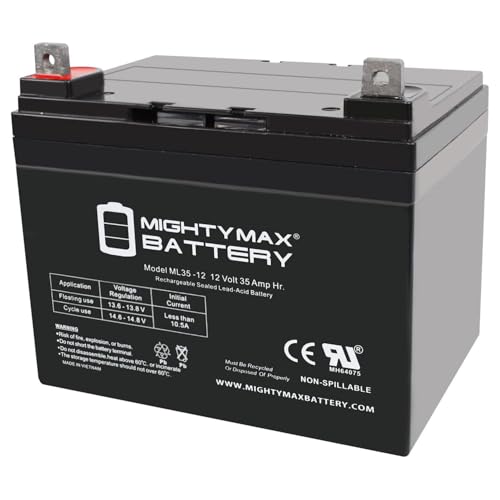
For homeowners who rely on a riding mower or lawn tractor to keep their yard in shape, the battery is an often-overlooked but critical component. The Mighty Max Battery 12V 35Ah SLA AGM is a direct replacement for many John Deere models and other compact riding machines. This sealed lead-acid battery is designed to deliver reliable starting power without the maintenance headaches of traditional flooded batteries.
Based on product specifications, this battery uses AGM (Absorbent Glass Mat) technology, which makes it spill-proof and vibration-resistant. That means you can mount it in any position—even sideways—without worrying about acid leaks. Many homeowners may prefer this for mowers stored in tight sheds or trailers. The 35Ah capacity and high discharge rate provide enough cranking amps for most single-cylinder and twin-cylinder lawn tractor engines.
The build quality feels solid for the price point. The black case is impact-resistant, and the terminals are clearly marked. At 7.76 x 5.12 x 7.01 inches, it fits many standard battery trays, but it’s always wise to measure your old battery before ordering. The package includes the battery and screws only—no wiring harness or mounting hardware—so you may need to reuse existing brackets or buy them separately.
Installation is straightforward for anyone comfortable with basic tools: disconnect the old battery, clean the terminals, place the new battery, connect the cables (positive first, then negative), and secure it. Since it’s maintenance-free, you never have to check electrolyte levels or add water. That’s a real time-saver for busy homeowners who just want to mow and go.
A realistic limitation is that this is a standard lead-acid battery, not a lithium upgrade. It’s heavier (around 22 lbs) and won’t deliver the same deep-cycle capacity if you ever use it for accessories like lights or winches. Some users note that the terminal orientation (positive on left vs right) may differ from your original, so verify the layout before purchase. Also, while it comes pre-charged, a full charge via a trickle charger before first use may help extend its life.
Overall, the Mighty Max Battery is a solid choice for anyone needing a dependable, no-fuss replacement for their riding mower or lawn tractor. It’s particularly suited for budget-conscious homeowners who want OEM-like performance without the high price tag. If you’re replacing a dead battery in your John Deere, Craftsman, or similar mower, this model deserves a close look.
Mighty Max Battery offers a full one-year warranty against manufacturing defects. The warranty covers replacement if the battery fails under normal use within that period. It's worth noting that the warranty does not cover damage from improper installation, overcharging, or physical abuse. For support, contact the seller or manufacturer directly—customer service response times are generally favorable based on user feedback. Always keep your purchase receipt and original packaging for any claims.
Why annual replacement may point to a deeper problem
Replacing a mower battery every year is not automatically required. A recurring failure often means the battery is being stored discharged, is not receiving a proper charge, or is being asked to crank through resistance at corroded terminals or cables. The first useful distinction is whether the battery itself has lost capacity or whether something on the mower is draining or failing to replenish it.
Winter discharge and lead-acid sulfation
A lead-acid battery slowly loses charge while idle, and cold-season storage can leave it sitting below a healthy charge for months. If a discharged battery remains that way, lead sulfate crystals can build on its plates and reduce the battery’s ability to accept and deliver charge. This damage, commonly called sulfation, may make a battery seem finished after winter even though the underlying cause was long-term neglect rather than an annual service-life limit.
Flooded lead-acid batteries may self-discharge around 3% to 5% per month, so several months without use can matter. AGM and lithium chemistries have different storage behavior, but they still need to be stored and charged as their manufacturer directs. A smart maintainer designed for the specific battery chemistry is generally preferable to leaving an unsuitable charger connected unattended.
Do not assume a deeply discharged battery can be restored by repeated charging. Follow its charging instructions and stop if the case is cracked, swollen, leaking, unusually hot, or otherwise damaged. Lead-acid batteries can release hazardous acid and gas, so wear eye protection and suitable acid-resistant gloves, avoid sparks and flames, and use a qualified service provider if the battery is unsafe to handle.
Check voltage at rest before condemning the battery
Park the mower safely, turn the key off, and allow surface charge to settle before measuring. With a digital multimeter set to DC volts, place the probes on the battery posts, red on positive and black on negative. A reading around 12.6V to 12.8V indicates a full charge for a conventional 12V lead-acid battery; it does not prove that the battery can supply starter current.
A reading near 12.2V indicates a significantly discharged battery, not necessarily a battery that must be replaced immediately. Charge it using a charger compatible with the battery type and the mower or battery maker’s directions, then let it rest and measure again. A reading below 10.5V after charging can indicate a dead or shorted cell, which is a stronger reason to replace it than a single low reading after storage.
Inspect the battery case and cables before moving to a load test. Look for corrosion, loose connections, damaged insulation, a poor frame ground, or a hold-down that allows the battery to move. A terminal that looks only slightly dirty can still add resistance, so a solenoid may chatter or the starter may turn slowly even when the battery’s resting reading appears reasonable.
Separate battery weakness from starter-circuit trouble
Starter symptoms provide clues, not a final diagnosis. Rapid clicking often occurs when voltage collapses under load or a connection cannot carry enough current; a single click may also involve the solenoid or starter circuit. Silence can have causes beyond the battery, including a switch, fuse, wiring fault, or safety interlock, so do not bypass interlocks to test the mower.
A battery load test is more revealing than resting voltage alone. A commonly used reference is that voltage should remain above about 9.6V during cranking, but test conditions and manufacturer guidance matter, and a multimeter reading during a brief crank is not a substitute for a proper load test. If the voltage falls sharply, have the battery tested or follow the mower maker’s diagnostic procedure before replacing other electrical parts.
With the ignition off and the key removed, clean and secure connections only as directed by the equipment manufacturer. For removal, disconnect the negative cable first to reduce the chance of a tool shorting the positive terminal to the chassis; for installation, connect positive first and negative last. Keep correct polarity throughout, use eye protection and acid-resistant gloves around lead-acid batteries, and never let a metal tool bridge the terminals.
If a charged battery tests well but the mower still cranks poorly, inspect the ground path, cable ends, starter connections, and solenoid according to the service manual. A damaged starter or high-resistance connection can mimic a failing battery by demanding more of the battery or wasting available voltage. Replacing batteries without locating that fault can repeat the same cycle.
Verify that the mower is charging while running
A riding mower’s charging system should replenish the starting battery during operation. If the battery starts the mower after charging but gradually goes flat during use, investigate the stator, regulator, wiring, and connections rather than assuming the replacement battery is defective. The system’s exact test procedure varies by mower, so consult the service information before probing connectors or running the engine for a measurement.
A general diagnostic benchmark for charging output is approximately 13.5V to 14.5V DC at full operating throttle, measured at the battery when the manufacturer permits that test. A result outside the specified range can indicate a charging-system issue, but meter setup, battery condition, engine speed, and the machine’s design affect readings. Avoid touching moving parts, keep leads and clothing clear, and ask a repair professional to test the stator or regulator if the procedure is unfamiliar.
Also consider whether the battery is being drained while the mower is parked. An accessory, damaged wiring, or a fault in the electrical system may draw current with the key off. Rather than disconnecting random wires or defeating safety equipment, use the manufacturer’s parasitic-draw procedure or have a technician isolate the circuit.
Storage habits that reduce repeat failures
Before seasonal storage, clean and dry the battery exterior, inspect its cables, and charge it according to the battery maker’s instructions. A lead-acid battery should not be left discharged for the winter. If the manual permits removing it, store it in a suitable protected location and use a compatible smart maintainer when recommended; do not leave an unregulated trickle charger connected indefinitely.
Check a stored battery periodically if its maker calls for it, and keep the terminals protected from accidental contact. A battery that is fully charged before storage has a better starting point than one left depleted after the final mow. Do not assume that a maintainer can repair an internally damaged battery or compensate for a parasitic drain once the mower is returned to service.
At spring startup, inspect for loose hardware, corrosion, cracked insulation, and signs of leakage before reconnecting power. If the battery was maintained correctly but is again discharged, recheck the charging system and parked-current draw instead of buying another battery immediately. If the mower remains unreliable, a repair shop can test the battery under load and diagnose the charging circuit.
Replacement chemistry and terminal fit still matter
When replacement is justified, match the mower’s specified voltage, battery type, capacity, terminal hardware, and dimensions. Many riding mowers use a Group U1-style case, but positive-post orientation differs between U1 and U1R configurations. A reversed layout can leave factory cables too short or put the terminals in the wrong position, so compare the old battery and the manual rather than relying on a group label alone.
The listed Mighty Max Battery ML-U1-CCALI U1 Lithium Battery is described as a 12V LiFePO4 starter battery rated at 400 CCA, with positive on the left and negative on the right. Its listed dimensions are 7.75 by 5.25 by 6.63 inches, with a total height of 7.25 inches; the product information says nut-and-bolt hardware is included, while harness and mounting accessories are not. Verify tray clearance, hold-down fit, cable reach, charging compatibility, and the mower manufacturer’s approval before considering a chemistry change.
The Mighty Max Battery ML3-12 Replacement for Toro is listed as a 12V, 3Ah sealed lead-acid battery with F1 terminals and dimensions of 5.28 by 2.64 by 2.64 inches. It is marketed as a replacement for the cited Toro battery reference, but those details do not establish compatibility with every Toro mower. The Mighty Max Battery 12V 35Ah Battery Replaces John is listed as a 12V, 35Ah sealed lead-acid battery measuring 7.76 by 5.12 by 7.01 inches, and its listing says battery and screws are included, not a harness or mounting accessories.
These products are not interchangeable simply because they are all batteries. A small sealed battery listed for a particular Toro reference differs greatly in capacity and dimensions from a riding-tractor battery, while the LiFePO4 option has a different chemistry and charging considerations. Confirm the actual equipment specification and terminal arrangement before ordering; product descriptions are not a substitute for the mower’s manual.
For a broader explanation of mower battery sizing and interchangeability, consult this mower battery sizing guide alongside the machine’s documentation. Compare the required cranking rating and case dimensions, not just the nominal 12V label. If the cables do not reach naturally, stop and verify polarity rather than stretching them or crossing connections.
Safe jump-starting is temporary, not a repair
A jump can help establish whether a discharged battery is preventing a start, but it does not explain why the battery went flat. Follow the mower and donor equipment instructions, use a compatible 12V source, and connect positive to positive and negative to negative as specified. The donor vehicle’s engine must remain OFF while jump-starting a 12V riding mower or zero-turn, because a running vehicle can expose the mower’s stator and voltage regulator to damaging electrical conditions.
Keep sparks, flames, and smoking materials away from a lead-acid battery, which may release explosive gas during charging or starting. Wear eye protection and acid-resistant gloves, avoid leaning over the battery, and do not attempt a jump if the case is damaged, leaking, or frozen. If the mower or vehicle instructions do not clearly allow the connection, do not improvise; use an approved charger or seek assistance.
After a successful start, do not treat a short run as proof that the battery has recovered or that the charging system works. Test the battery after charging and check the mower’s charging output using the manufacturer-approved method. A recurring need for a jump means the storage, battery condition, wiring, or charging system still needs attention.
In short, an annual replacement pattern is a signal to diagnose, not a normal maintenance schedule to accept without question. Check resting and cranking condition, inspect terminals and grounds, verify charging output, and correct winter-storage practices before deciding the battery is the only failed part. Replace it when testing supports replacement, and match the new battery’s specifications and polarity to the mower.



Write Your Review
No reviews yet. Be the first to share your experience!